
Quick Answer
Home health hazards are environmental conditions in residential buildings that can cause illness or injury. The U.S. Department of Housing and Urban Development identifies eight primary hazards: radon, mold, carbon monoxide, indoor air pollutants, lead, unsafe drinking water, pests, and household chemicals. Most are invisible, most are testable, and most are treatable once identified.
Why trust this guide
Written by Protect Environmental, a national network of radon and indoor air quality companies operating across 9 U.S. markets through 6 regional legacy brands. Our network includes RAdata, the first licensed radon testing business in New Jersey, and Cliff Cummings Water Services, serving Central Massachusetts for 40+ years. All recommendations follow ANSI/AARST radon measurement and mitigation standards and align with the U.S. Department of Housing and Urban Development’s Healthy Homes framework.
HUD-aligned framework • ANSI/AARST standards • 9 markets served • 40+ years legacy
What the 2026 Illinois Radon Report Card Shows
June is National Healthy Homes Month, a federally-designated awareness campaign run by the U.S. Department of Housing and Urban Development. The point of the month is simple: most American homes contain hidden health hazards, and most homeowners never check for them.
HUD’s Office of Lead Hazard Control and Healthy Homes maintains an official list of the environmental hazards most likely to make families sick at home. The list includes eight primary threats, ranked by health impact, frequency, and severity. Most are invisible. Most are testable. And most are treatable once found.
This guide walks through all eight, in HUD’s order of risk. Some are simple do-it-yourself checks. A few require a certified professional. None of them should be ignored.
What is National Healthy Homes Month?
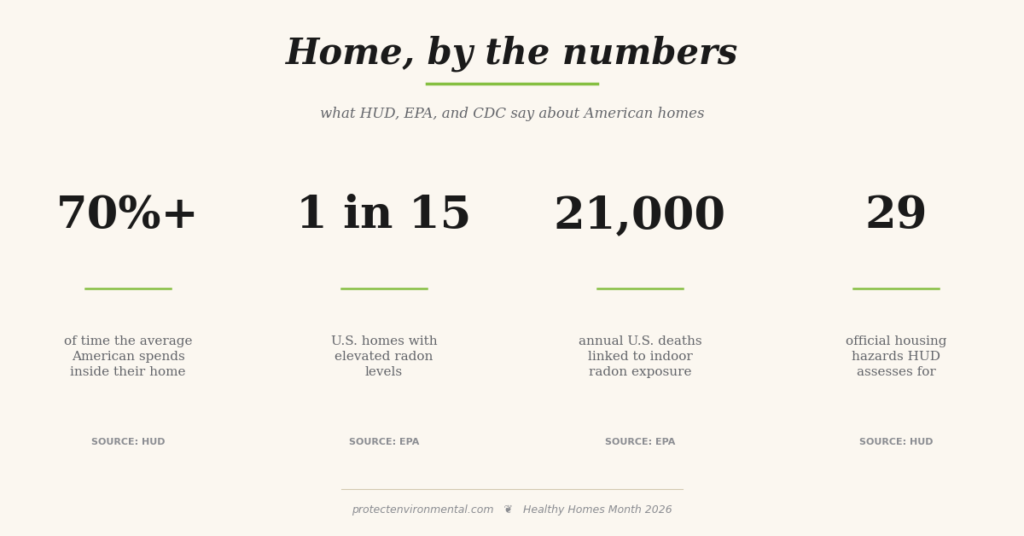
National Healthy Homes Month is observed every June, established by HUD’s Office of Lead Hazard Control and Healthy Homes. The campaign is supported by the EPA, CDC, and dozens of state and local public-health agencies. The federal Healthy Homes Initiative was launched to address a body of research showing that the home environment is one of the most significant determinants of long-term health, particularly for children, older adults, and people with chronic illness.
HUD assesses American homes against 29 specific housing hazards using its Healthy Homes Rating System. For this guide, we focus on the eight that affect the most U.S. homes and that homeowners can actually do something about.
The 8 home health hazards, ranked by HUD
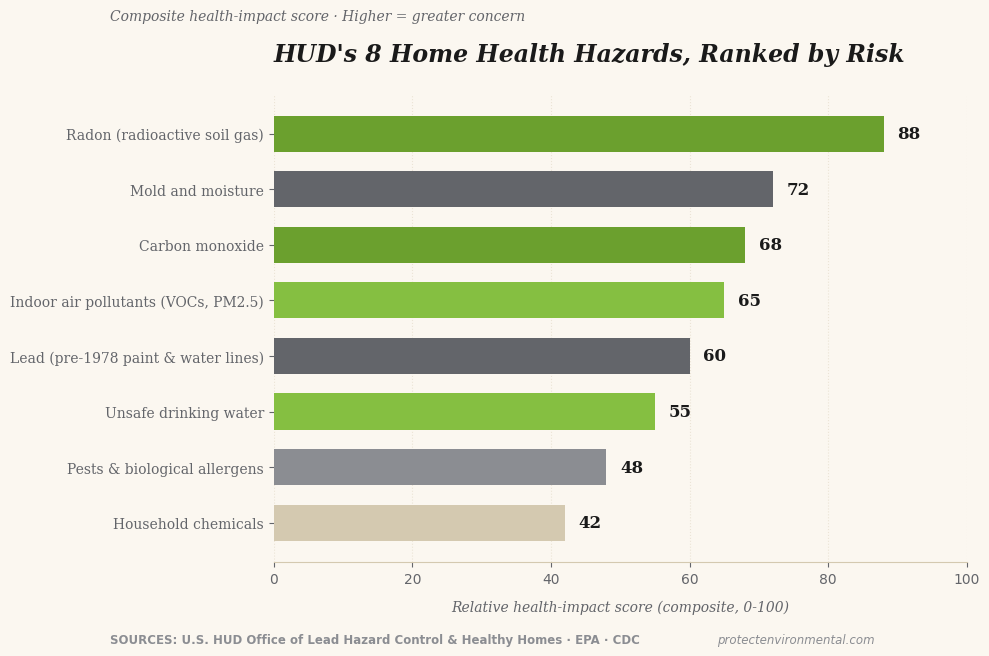
Ranked by composite health impact. Each section covers what the hazard is, how it affects you, and how to test or check for it.
1. Radon
Radon is a naturally occurring radioactive gas that rises from soil into homes through foundations, cracks, and crawl spaces. It is the second leading cause of lung cancer in the United States and the leading cause among non-smokers. The EPA estimates radon kills 21,000 Americans every year. About 1 in 15 U.S. homes has elevated levels. Check the EPA radon zone map for your county’s baseline risk.
How to check: every home should be tested. Short-term test kits (3-7 days) are widely available, simple to use, and the EPA’s Citizen’s Guide to Radon walks through the protocol. For a certified, lab-grade reading, hire a licensed radon professional.
2. Mold and moisture
Mold grows wherever moisture lingers. Common sources include leaky roofs, plumbing problems, condensation, flooding, and high indoor humidity. Mold spores are a major asthma and allergy trigger, and certain species produce mycotoxins that cause more serious respiratory illness.
How to check: visual inspection of basements, bathrooms, under sinks, around windows, and behind appliances. Watch for musty odors, water stains, peeling paint, or visible growth. Keep indoor humidity between 30-50%. For suspected hidden mold or post-flood remediation, hire a certified inspector.
3. Carbon monoxide
Carbon monoxide is colorless, odorless, and lethal at high concentrations. Typical sources include malfunctioning gas furnaces, water heaters, fireplaces, generators, and attached garages. According to the CDC, around 400 Americans die from CO poisoning each year, mostly from preventable home incidents. Thousands more visit emergency rooms with non-fatal exposure.
How to check: install battery-powered CO detectors on every floor and outside every sleeping area (required by code in most U.S. states). Have all fuel-burning appliances inspected annually by a qualified technician. Never run a generator or vehicle inside an attached garage.
4. Indoor air pollutants (VOCs and particulate matter)
Beyond radon, indoor air contains a mix of volatile organic compounds (VOCs) from paint, furniture, cleaning products, and air fresheners, plus particulate matter (PM2.5) from cooking, candles, fireplaces, and infiltrating outdoor air. The EPA reports indoor air is typically 2-5 times more polluted than outdoor air.
How to check: a consumer-grade air quality monitor gives you real-time readings on PM2.5, VOCs, CO2, and humidity. For a comprehensive professional assessment, hire a certified indoor air quality specialist.
5. Lead (paint and water lines)
Lead is most commonly found in paint applied before 1978 (when residential lead paint was banned) and in older municipal water service lines. Lead exposure is particularly dangerous for children, where even small amounts can cause irreversible neurological damage and developmental delays, per the CDC.
How to check: if your home was built before 1978, assume lead-based paint is present unless tested otherwise. DIY swab tests are available, but for renovations, removal, or sales disclosures, hire an EPA-certified lead-based paint inspector. For water, your municipal utility can confirm whether your home is connected via a lead service line; the EPA’s Lead in Drinking Water resource explains testing and remediation options.
6. Unsafe drinking water
U.S. municipal water systems are regulated under the Safe Drinking Water Act, but contamination can still occur at the household level through aging pipes, well-water sources, or recent infrastructure failures. Common contaminants include lead, bacteria, nitrates, arsenic, and PFAS (per- and polyfluoroalkyl substances) — the so-called “forever chemicals” the EPA has linked to multiple cancers and immune dysfunction.
How to check: request your utility’s most recent Consumer Confidence Report (free, mailed annually). For private wells, the EPA recommends annual testing for bacteria, nitrates, and pH at minimum. Comprehensive water-quality testing by a certified lab is the most reliable approach, especially for newer concerns like PFAS.
7. Pests and biological allergens
Pests include rodents, cockroaches, dust mites, and bed bugs. Beyond the direct disease risk (rodents carry hantavirus, salmonella, and other pathogens), pest droppings are a major asthma and allergy trigger, particularly in children. Cockroach allergens are among the strongest predictors of childhood asthma development.
How to check: visual inspection of kitchens, basements, attics, and behind appliances. Look for droppings, gnaw marks, nests, shed exoskeletons, or live insects. Seal cracks and gaps. Eliminate standing water and accessible food. For serious infestations, the EPA recommends integrated pest management (IPM) rather than blanket pesticide use, which introduces its own indoor air quality issues.
8. Household chemicals
Cleaning products, pesticides, solvents, paint, and aerosols all release chemicals into indoor air during use and (slowly) during storage. Common hazardous components include ammonia, bleach, formaldehyde, chlorinated solvents, and pesticide residues. Mixing certain products (notably bleach and ammonia) produces toxic gases that can cause acute respiratory injury.
How to check: audit storage areas. Move solvents, paints, pesticides, and pool chemicals out of the living envelope, a detached garage or outdoor shed, never the basement. Choose low-VOC alternatives when restocking. The EPA’s safer choice program maintains a list of certified safer cleaning products. Ventilate aggressively when using any chemical product, and never combine cleaning agents.
The 8-point healthy home checklist
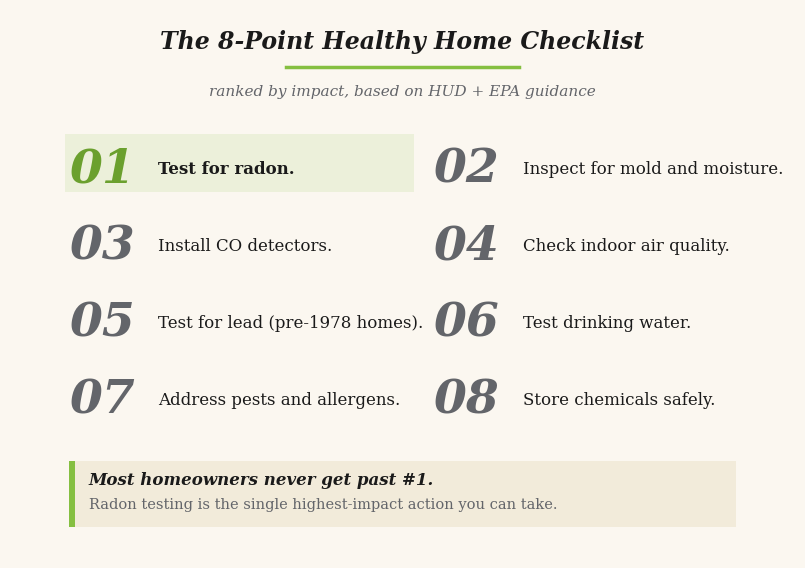
In order of impact, here is what every homeowner should check this June. The order matters: action #1 affects more homes and causes more harm than any other item on the list.
01. Test for radon
Single highest-impact action. Every home should be tested, regardless of state, age, or foundation type. If your level is above 4.0 pCi/L, mitigate.
02. Inspect for mold and moisture
Visual check of basements, bathrooms, attics, and around plumbing. Address any source of moisture immediately. Maintain 30-50% indoor humidity.
03. Install CO detectors
On every floor, near every sleeping area. Replace batteries annually. Replace the units every 5-7 years (they expire). Service fuel-burning appliances yearly.
04. Check indoor air quality
Consumer monitor for ongoing awareness. Professional testing if anyone in the home has chronic respiratory issues, after a renovation, or before a real-estate transaction.
05. Test for lead (if your home was built before 1978)
Lead-based paint, pre-1986 plumbing, and pre-1990 service lines are the three main exposure routes. Test before any renovation that disturbs paint.
06. Test your drinking water
Request your utility’s Consumer Confidence Report. Run additional testing if your home has a private well, you have young children, or you live in an area with known PFAS contamination.
07. Address pests and biological allergens
Seal entry points. Eliminate food and water sources. Use integrated pest management instead of broad-spectrum pesticides. Clean dust regularly with a HEPA vacuum.
08. Store chemicals safely
Move solvents, paints, pesticides, and pool chemicals outside the living envelope. Switch to low-VOC or third-party-certified safer alternatives. Ventilate during and after use. Never combine products.
A note from Protect Environmental
Five of the eight hazards on HUD’s list fall within what we do. Radon, mold, carbon monoxide, indoor air quality, and drinking water. Radon is where we focus most. It causes more long-term harm than any other home environmental risk, and it’s also the one most homeowners never get around to checking.
Our regional teams handle every part of the process. Testing. System design when mitigation is needed. Installation. Post-install verification. Yearly maintenance to keep the system working. All of it happens across the country, in homes like yours.
If you want to use Healthy Homes Month to find out what’s actually in your air, your water, and your home, we’ll come take a look. No cost. No commitment. Just an answer.
Get my free quote →
