
What is Water Week 2026?
Water Week 2026 runs April 12-18 and brings together water professionals, utilities, and communities to advocate for clean, safe drinking water nationwide. For homeowners with private wells, especially in New Jersey and Massachusetts, it is also the right moment to test for radon and other contaminants that enter the home through groundwater, a risk most well-water homeowners have never addressed.
Every April, Water Week brings water professionals, utility leaders, and advocates to Washington to push for clean, safe water in every community. This year it runs April 12-18.
But there is a water quality issue that no policy panel addresses because it starts inside your home, underground, before water ever reaches your tap. If your home runs on a private well, this article is for you.
The risk inside the risk
Most homeowners who have tested for radon think of it as an air problem. Radon seeps up from the soil, enters through foundation cracks, and accumulates in basements.
What fewer people know: radon is highly soluble in water. Groundwater moving through uranium-bearing bedrock, the geology that underlies large parts of New Jersey and Massachusetts, absorbs radon and carries it directly into your home through your well.
Then every time you turn on a faucet, take a shower, run the dishwasher, or start the washing machine, radon gas can escape from the water and enter the air you breathe.
Fix the air problem and miss the water source. The risk stays.
What this means for New Jersey homeowners
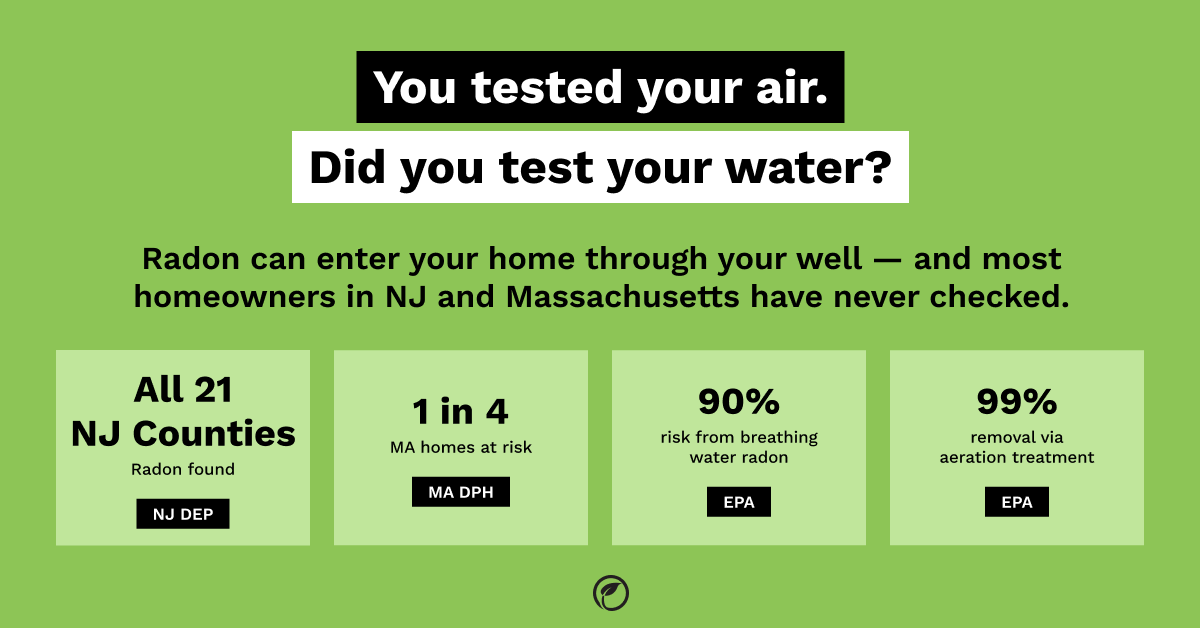
New Jersey is one of the most radon-active states in the country. Radon gas has been found in all 21 New Jersey counties, with the highest concentrations in the western and northern parts of the state, particularly in Sussex, Warren, Hunterdon, Morris, and Somerset counties. The bedrock geology in these areas, including the Reading Prong formation, is uranium-rich, which means private wells in these regions carry elevated radon contamination risk.
New Jersey
Why NJ well water is a radon concern
- Radon documented in all 21 counties
- Reading Prong: one of the most radon-prone geologies in the U.S.
- NJ Private Well Testing Act (PWTA) required at real estate sale
- No retesting required between sales — years can pass untested
- Northwestern NJ carries highest known well water risk
Source: NJ DEP / NJDWQI
Massachusetts
Why MA well water is a radon concern
- 1 in 4 MA homes may exceed EPA radon action level
- Bedrock wells: radon classified as a statewide concern
- 500,000+ MA residents rely on private wells
- No state requirement to test private well water
- Only 21% of MA well users tested water last year
Source: MA DPH / MassINC Polling Group 2023
New Jersey is also one of the few states with a mandatory Private Well Testing Act (PWTA), requiring standardized water testing at the point of a real estate sale. Since the law was enacted, it has identified tens of thousands of NJ wells with unsafe contaminant levels. But PWTA testing only happens at sale. If you have been in your home for years without retesting, your well has not been checked.
Well water and radon — key numbers
The risk most homeowners in NJ and Massachusetts have never tested for
Source: NJ DEP · MA Dept. of Public Health · U.S. EPA · EWG · MassINC Polling Group 2023
The two test approach
If your home is on a private well, two tests tell you most of what you need to know:
1. Radon in air — a short-term test placed in the lowest level of your home. Results in 48–96 hours. If elevated, your well water is the next thing to check. Learn about radon air testing.
2. Radon in water — a water sample sent to a certified lab. Results tell you whether radon is entering your home through your water supply and at what concentration.
Water testing can be done at any time of year. If your well has not been in regular use, flush the system for at least 20 minutes before sampling. A certified professional can walk you through the process from start to finish.
Check your home’s average radon risk by ZIP code using Protect Environmental’s National Radon Risk Search tool.
This week is the right moment
Water Week exists because clean water requires active attention not just from policymakers, but from homeowners. The water coming out of your tap deserves the same scrutiny as the air in your basement.
If your home runs on a private well in New Jersey or Massachusetts, this is the week to find out what is actually in it.
Ready to test your water?
Our certified teams in New Jersey and Massachusetts handle everything — testing, results, treatment, and installation. Book today.

