
Quick Answer
Tap water in the U.S. may contain PFAS (“forever chemicals”), lead from old service lines, chlorine and disinfection byproducts, and trace contaminants like nitrates or microplastics. Private well water faces a different list, including arsenic, uranium, radon, and bacteria. The EPA regulates municipal water at the treatment plant, but contamination can also enter through service lines and home plumbing.
Why Does Earth Day Belong Inside Your Home?
This week is Drinking Water Week, the national observance that runs May 3-9, 2026. It is led by the American Water Works Association, and most years, it focuses on celebrating the people who keep public water systems running.
That part matters. So does this part: most homeowners have no idea what’s actually in the water coming out of their tap. Some of that is reassuring (American tap water is among the most regulated in the world). Some of it should not be.
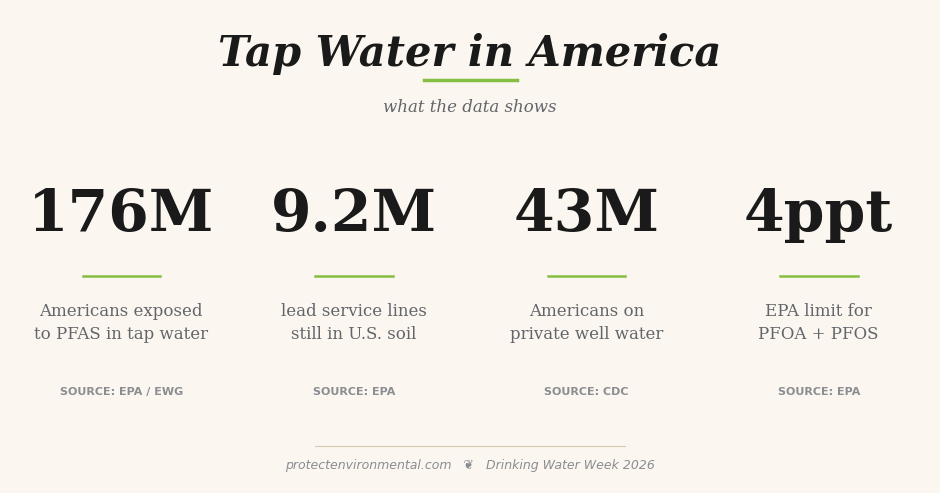
Earlier this year, new EPA monitoring data showed that roughly 176 million Americans are now drinking tap water with detectable levels of PFAS, the family of so-called “forever chemicals” that don’t break down in the body or the environment. That’s more than half the country.
So this Drinking Water Week, we want to actually answer the question most people don’t ask out loud: what’s in this stuff?
What is Drinking Water Week 2026?
Drinking Water Week is organized by the American Water Works Association (AWWA), and in 2026 it runs from Tuesday, May 3 through Sunday, May 9. It’s been observed since 1988, when Congress passed a joint resolution recognizing the first full week of May as Drinking Water Week.
The official AWWA framing is that it’s a chance for utilities to celebrate the work that goes into delivering safe water. Tours, classroom visits, social media campaigns. Most of the audience is municipal water professionals.
For homeowners, though, the week is also a useful reminder. If you have never thought carefully about your home’s water, this is a good week to start.
Two water supplies, two different risk lists
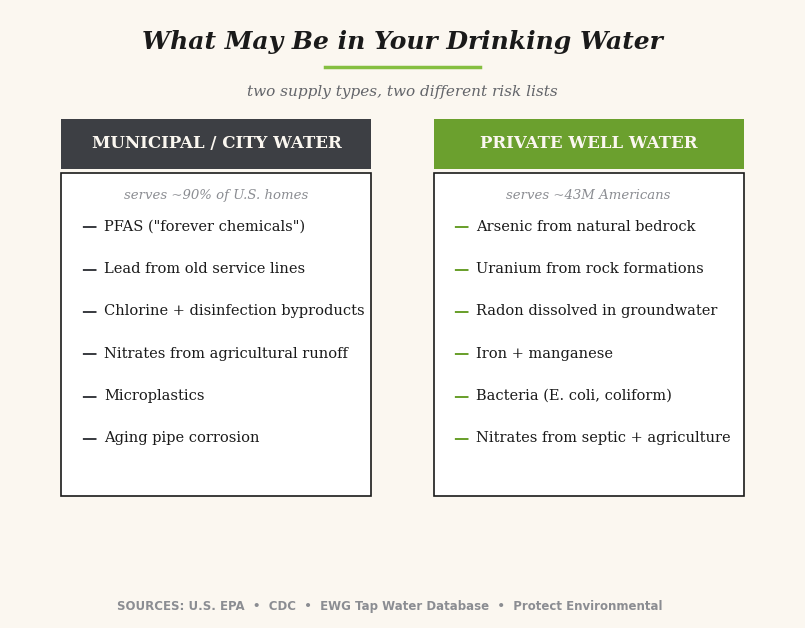
The first thing worth knowing is what kind of water you have. About 90% of U.S. households are connected to a municipal (“public” or “city”) water system that’s regulated by the EPA. The other roughly 43 million Americans, according to the CDC, are on private wells, which are not federally regulated. That regulatory difference matters because each supply faces a different set of contaminants.
If you’re on municipal water
Your utility tests for over 90 contaminants regulated under the federal Safe Drinking Water Act. They send you a Consumer Confidence Report once a year (usually in July). That covers a lot, but not everything. Items getting the most attention right now:
- PFAS (“forever chemicals”). In April 2024, the EPA set the first-ever national drinking water limit for six PFAS compounds, including a 4 parts per trillion ceiling for PFOA and PFOS. Compliance has since been pushed to 2031, and four of the six original limits may be rescinded. Until utilities are fully in compliance, tap water at the faucet may still exceed health-protective levels.
- Lead from service lines. The EPA estimates around 9.2 million lead service lines remain in the ground across the United States. Treatment plants don’t add lead. The pipe between the main and your home does, especially if it’s old or recently disturbed.
- Chlorine and disinfection byproducts. Chlorine keeps water safe in transit, but it can react with organic matter to form trihalomethanes and haloacetic acids, both of which are regulated but worth being aware of.
- Nitrates, microplastics, and pipe corrosion byproducts. Less talked about, but real, especially in agricultural regions and homes with aging plumbing.
If you’re on a private well
You are the test administrator. The EPA does not regulate private wells, which means whatever’s in your groundwater is your responsibility to find and treat. The list looks different:
- Arsenic and uranium from natural bedrock, especially in parts of New England, the Northeast, and the Mountain West.
- Radon dissolved in groundwater. Wells in uranium-rich geology, including parts of New Jersey and Massachusetts, can carry radon directly into your home through the tap. We covered this in detail in our April Water Week piece on private wells.
- Bacteria like E. coli and total coliform, especially after heavy rain or flooding events.
- Iron, manganese, and hardness minerals that are usually nuisance contaminants but can mask others.
- Nitrates from septic systems and agricultural runoff.
How water actually reaches your tap
There’s a four-step journey from source to glass, and it’s worth understanding because the federal regulatory framework only covers part of it.
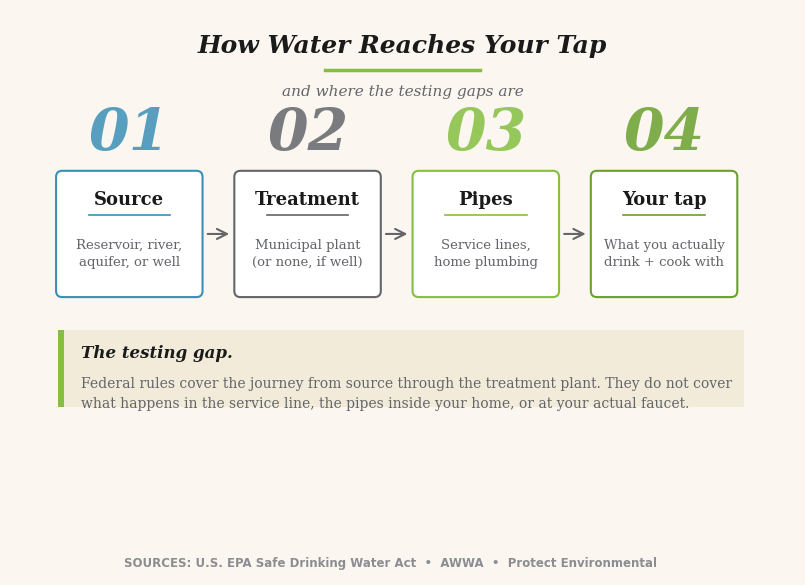
Federal Safe Drinking Water Act standards apply at the treatment plant. Once water enters the distribution system (the city mains), the service line into your house, and finally your home plumbing, things change. Lead can leach in from old service lines. Disinfection byproducts can form. Sediment can build up. Old galvanized pipes can corrode. None of this shows up in your utility’s annual report, because it happens after the water leaves the plant.
That’s why the only test that tells you what’s actually in the water you drink is a test from your own faucet.
How Protect Environmental thinks about home water testing
Protect Environmental and our legacy brands have been testing residential water for decades, with our deepest water expertise concentrated in two markets: Massachusetts and New Jersey.
Massachusetts
Cliff Cummings Water Services
A Protect Environmental Company
40+ years serving Central Massachusetts. 15,000+ customers. Specializes in arsenic, uranium, iron, manganese, radon-in-water, and bacteria — the contaminants common in Massachusetts groundwater. Full-stack service: testing, filtration system design and install, well pump and tank work, annual maintenance.
New Jersey
RAdata
A Protect Environmental Company
The first licensed radon and water testing business in New Jersey, with an in-house water testing laboratory. Handles New Jersey’s Private Well Testing Act (PWTA) requirements for real estate transactions, full panel water quality testing, and treatment design for the contaminants typical of NJ groundwater.
A practical drinking water checklist
Whether you’re on municipal water or a private well, here’s where to start this Drinking Water Week.
- If you’re on municipal water, look up your utility’s annual Consumer Confidence Report. They’re public and required by law.
- Look up your address in the EWG Tap Water Database to see what’s been detected in your local supply.
- Find out whether your home has a lead service line. Many utilities now publish public maps of known and suspected lead lines.
- If you’re on a private well, test annually for bacteria and nitrates at minimum. Test every two to five years for a full panel including metals.
- In radon-prone geology (most of NJ, much of MA, parts of PA and CO), test your well water for radon, separately from your air radon test.
- If you have well water and you’ve never had a full panel test done, schedule one. It’s the only way to know your baseline.
- If your home is older than 1986, assume there may be lead somewhere in the plumbing path and run cold water for 30 seconds before drinking first thing in the morning.
A note from Protect Environmental
Most weeks, your tap water gets none of your attention. That’s the privilege of living in a country with the regulatory infrastructure we have. But once a year, Drinking Water Week is a reasonable nudge to actually look.
If you’ve never had your home’s water tested, this is a good week to start. If you’re in Massachusetts or New Jersey, our local teams are the people to call.
Massachusetts team → New Jersey team →Frequently Asked Questions
Drinking Water Week 2026 runs from May 3 through May 9. It is the annual national observance led by the American Water Works Association (AWWA), recognizing the importance of safe, reliable drinking water and the work of water utilities and professionals across North America. The week has been observed since 1988 when Congress passed a joint resolution establishing it.
Tap water in the United States may contain PFAS (“forever chemicals”), lead from old service lines, chlorine and disinfection byproducts, nitrates, and trace amounts of microplastics. Private well water can also contain arsenic, uranium, radon, iron, manganese, and bacteria. The EPA regulates municipal water at the treatment plant, but contamination can also enter through service lines and home plumbing.
U.S. tap water is among the most regulated in the world, and most municipal supplies meet federal safety standards at the treatment plant. However, contamination can occur after treatment through aging service lines, household plumbing, and private wells that aren’t federally regulated. The only way to know what’s actually in your water is to test it at the faucet.
According to EPA monitoring data released in early 2026, approximately 176 million Americans drink tap water with detectable levels of PFAS, the family of synthetic “forever chemicals” that don’t break down in the environment or the human body. The EPA set a national limit of 4 parts per trillion for PFOA and PFOS in 2024, with utility compliance now extended to 2031.
Yes, especially if you have a private well, your home is older than 1986 (potential lead plumbing), or you’ve never had your tap water tested. Public water systems test at the plant, but contamination can enter after that point. A faucet-level test is the only way to know what’s actually coming out of your tap.
Start with your utility’s Consumer Confidence Report (free, sent annually). Look up your area in the EWG Tap Water Database. For specific concerns, professional testing identifies lead, PFAS, bacteria, arsenic, and other contaminants. Protect Environmental and its legacy brands, including Cliff Cummings Water Services in Massachusetts and RAdata in New Jersey, offer full residential water testing.

