
In this article
- 01What is Clean Air Month 2026
- 02What is indoor air quality
- 03The 6 biggest indoor air pollutants
- 04How to test indoor air quality at home
- 05How to improve indoor air quality
- 06When to call a professional
May is Clean Air Month, the American Lung Association’s annual reminder that clean air is not optional. Most of the conversation gets pointed outside, at smog, wildfire smoke, and emissions. But the air you breathe most of the time isn’t out there. It’s in your home.
The U.S. EPA estimates that indoor air can be two to five times more polluted than outdoor air. On occasion, more than 100 times worse. And the average American spends roughly 90% of their time indoors, which means indoor air quality is, for most people, the air quality that matters most.
This guide is a practical breakdown of what’s in your indoor air, how to test it, and what actually works to improve it. Some of the actions are free. Some are cheap. One of them, the most consequential one, is what we do for a living.
Quick Answer
Indoor air quality refers to the air inside and around homes and buildings, particularly as it relates to health and comfort. The U.S. EPA reports that indoor air can be 2-5 times more polluted than outdoor air. Common indoor air pollutants include radon, particulate matter, volatile organic compounds, mold, and carbon monoxide, most of which are testable and treatable.
What is Clean Air Month 2026?
Clean Air Month is the American Lung Association’s annual campaign each May to raise awareness about air quality and its impact on health. It was first declared in 1972, the year after the original Clean Air Act, and it’s been observed every May since.
The ALA uses the month to push for stronger air-quality protections, healthier homes, and reduced exposure to airborne pollutants. Their annual State of the Air report tracks ozone and particle pollution across every U.S. county. The point of the campaign is simple: every breath matters, and most Americans are taking thousands of those breaths every day inside their own houses without giving the air a second thought.
What is indoor air quality?
Indoor air quality (IAQ) refers to the air quality inside and around buildings and structures, especially as it relates to the health and comfort of the people inside. It’s measured by the concentration of pollutants in the air, the humidity level, the air’s circulation, and how well the building is ventilated.
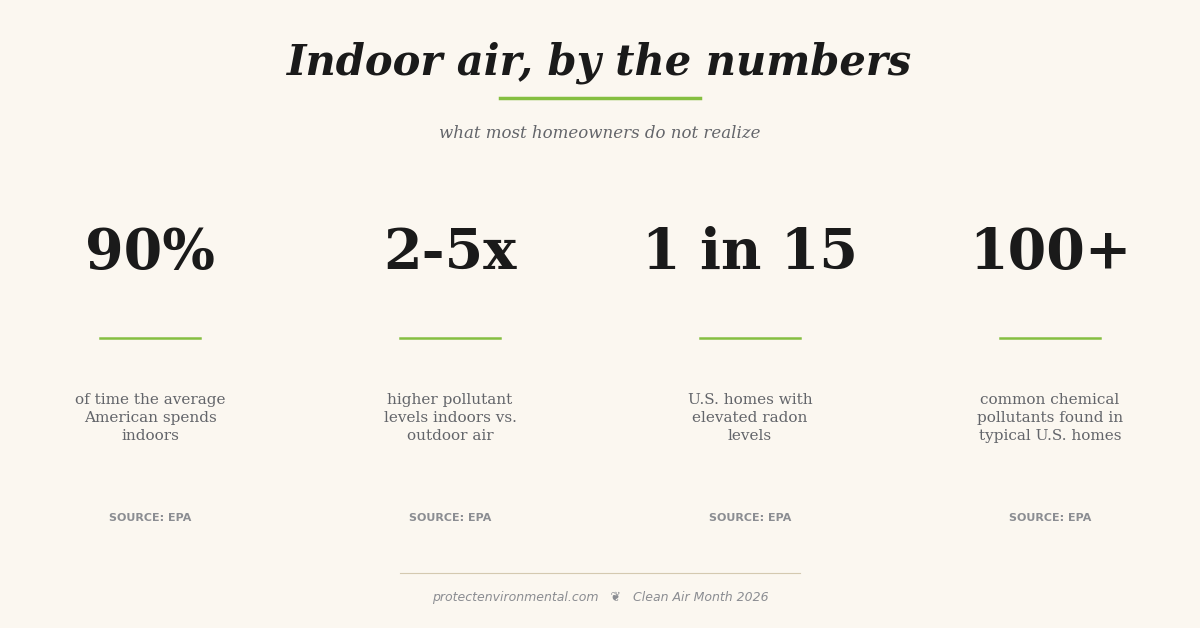
Per the U.S. EPA, poor indoor air quality is one of the top five environmental risks to public health in the United States. The World Health Organization reports that household air pollution causes an estimated 3.2 million premature deaths globally each year. Long-term exposure has been linked to lung cancer, asthma, heart disease, cognitive decline, and a range of other chronic conditions.
The 6 biggest indoor air pollutants in U.S. homes
Indoor air is a cocktail of dozens of pollutants, but a handful do most of the damage. Here are the ones EPA and the American Lung Association rank highest by health impact in typical U.S. homes.
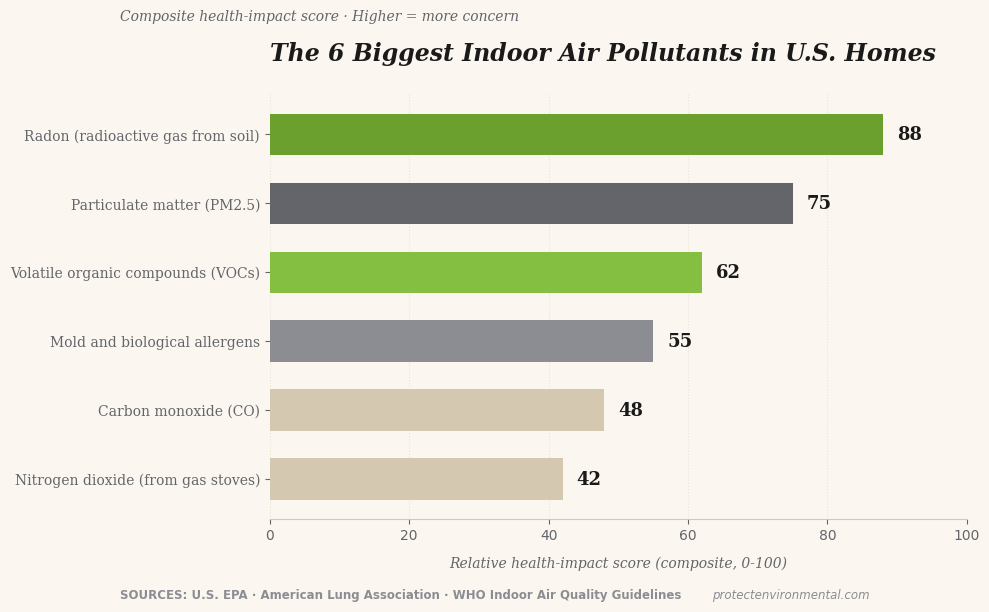
1. Radon
Radon is a naturally occurring radioactive gas that rises from the ground into homes through foundations and floors. It is the second leading cause of lung cancer in the United States and the leading cause among non-smokers. The EPA estimates it kills 21,000 Americans every year. About 1 in 15 U.S. homes has elevated levels — you can check the EPA radon zone map for your county’s baseline risk.
2. Particulate matter (PM2.5 and PM10)
Microscopic particles from cooking, candles, fireplaces, dust, pet dander, and outdoor sources that infiltrate the home. PM2.5 is small enough to penetrate deep into the lungs and bloodstream. Linked to asthma flare-ups, heart disease, and reduced lung function.
3. Volatile organic compounds (VOCs)
Off-gassed chemicals from paint, new furniture, cleaning products, air fresheners, and many building materials. Common ones include formaldehyde, benzene, and toluene. Short-term exposure causes headaches and dizziness; long-term exposure has been linked to several cancers and liver/kidney damage.
4. Mold and biological allergens
Includes mold spores, dust mites, pet dander, and pollen. Thrives in homes with high humidity or moisture problems. Major asthma and allergy trigger, and certain molds (like Stachybotrys chartarum) produce mycotoxins that can cause more serious respiratory illness.
5. Carbon monoxide (CO)
Colorless, odorless, and lethal at high concentrations. Typical sources include malfunctioning gas furnaces, water heaters, fireplaces, and attached garages. According to the CDC, around 400 Americans die from CO poisoning each year, mostly from preventable home incidents.
6. Nitrogen dioxide and gas-stove emissions
Gas stoves release NO₂, formaldehyde, and other irritants. Recent peer-reviewed research has linked unvented gas-stove use to higher rates of childhood asthma. The simplest fix is using a range hood that vents outside, every time you cook.
How to test indoor air quality in your home
You can’t fix what you haven’t measured. Indoor air quality testing breaks down into three tiers, from quick at-home checks to certified professional assessments.
Consumer-grade air quality monitors
Plug-in monitors give you a real-time, continuous reading on common pollutants; typically particulate matter (PM2.5), volatile organic compounds, CO2, humidity, and temperature. They’re widely available and easy to set up. Good for ongoing awareness of how your indoor air changes throughout the day, especially during cooking, cleaning, or wildfire smoke events. The catch: most consumer-grade devices aren’t certified for radon measurement, so they shouldn’t be used to make radon decisions. Treat them as a daily dashboard, not a definitive answer.
DIY single-pollutant test kits
For radon specifically, short-term kits (3–7 days) are widely available and simple to use. Place one on the lowest livable level of your home, follow the instructions, and mail it back to a lab for analysis. Long-term kits (90+ days) give a more reliable average, since radon levels fluctuate with weather, season, and ventilation patterns. The EPA Citizen’s Guide to Radon walks through the testing protocol step by step. DIY kits also exist for mold and VOCs, but tend to be less accurate than professional sampling.
Professional indoor air quality testing
For a certified, lab-grade reading, especially before a real estate transaction, after a renovation, or if someone in your home has respiratory issues, professional testing is the right call. A certified specialist assesses your specific home, runs multi-pollutant sampling using calibrated equipment, and delivers a defensible report with recommendations. Protect Environmental does this for homeowners across the United States, and the assessment is free.
How to improve indoor air quality
Once you know what is in your air, the actions to clean it up are surprisingly affordable. Here are the seven that move the needle most, ranked by impact:
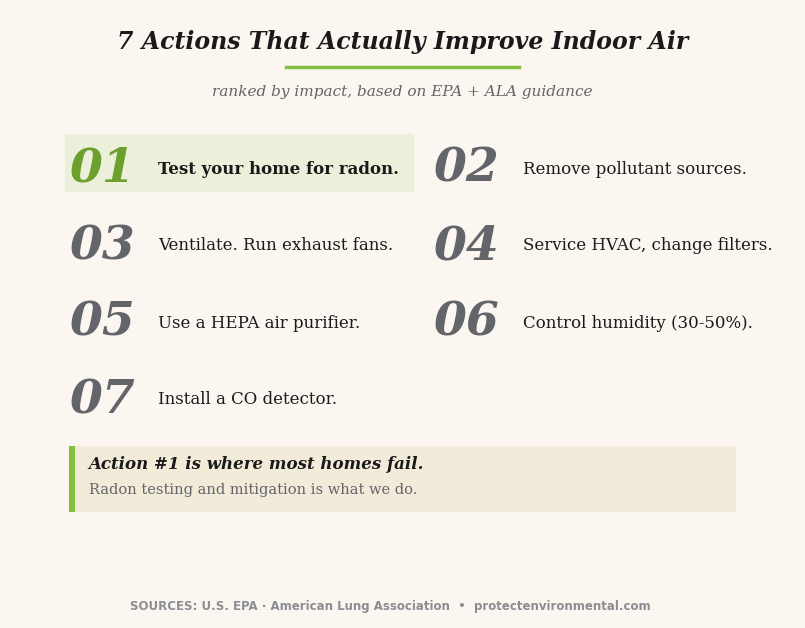
01. Test for radon
Single biggest IAQ action with the single biggest health upside, because radon is invisible and silently lethal in elevated homes. Every home should be tested. If yours is above 4.0 pCi/L, mitigate.
02. Remove or reduce pollutant sources
Source control is more effective than filtration. Use low-VOC paints and finishes. Avoid air fresheners, scented candles, and aerosol sprays. Store solvents, paints, and pesticides outside the living envelope (in a detached garage or shed, not the basement).
03. Ventilate aggressively
Open windows on opposite sides of the home to get cross-flow. Run kitchen exhaust fans every time you cook. Run bathroom exhaust fans during and after showers. For tightly sealed modern homes, consider a heat recovery ventilator (HRV) or energy recovery ventilator (ERV).
04. Service your HVAC and change filters
Use MERV 11 or MERV 13 filters in your HVAC system. Change them on the manufacturer’s schedule, usually every 1-3 months. Get the system serviced annually. Have ducts cleaned only when there’s visible mold, vermin infestation, or substantial dust accumulation, not on a regular schedule.
05. Use a HEPA air purifier
A true HEPA air purifier in the bedroom is the single highest-leverage purchase for the air you actually breathe (since you spend a third of your life in that room). Size it to the room. Don’t bother with ionizers or ozone-generating purifiers, which can do more harm than good.
06. Control humidity
Keep relative indoor humidity between 30-50%. Below 30% and you get dry skin, irritated airways, and increased viral transmission. Above 50% and you get dust mites and mold. Dehumidifiers and humidifiers are cheap and effective.
07. Install CO and radon detectors
Battery-powered CO detectors are required by code in most U.S. states. Continuous radon detectors are a relatively recent home-safety addition and increasingly affordable ($150-$300). They give you ongoing visibility into one of the two indoor air risks most likely to kill you.
A note from Protect Environmental
Protect Environmental specializes in the radon piece of the indoor air quality picture, because it’s the highest-impact single action a homeowner can take, and because most homes never get to it.
We test homes. We design and install mitigation systems when levels are elevated. We re-verify after install. We maintain systems annually so they keep working. And we do it across the United States through our network of regional teams.
Clean Air Month is a good moment to think about the air in your home. If you’ve never tested for radon, or it’s been more than two years since you did, we’ll come out and assess your home for free.
Get my free quote →Frequently Asked Questions
Clean Air Month is observed throughout the entire month of May each year. In 2026, it runs from May 1 through May 31. It is organized by the American Lung Association and has been observed every May since 1972, the year after the original Clean Air Act was passed.
Indoor air quality (IAQ) refers to the air inside and around buildings, especially as it relates to the health and comfort of the people inside. It is measured by the concentration of airborne pollutants, humidity, ventilation, and air circulation. The U.S. EPA classifies poor indoor air quality as one of the top five environmental health risks in the United States.
Yes. According to the U.S. EPA, indoor air is typically 2-5 times more polluted than outdoor air, and occasionally up to 100 times more polluted. Because the average American spends about 90% of their time indoors, indoor air is the air that matters most for daily health.
The six most common and consequential indoor air pollutants in U.S. homes are radon, particulate matter (PM2.5 and PM10), volatile organic compounds (VOCs), mold and biological allergens, carbon monoxide, and nitrogen dioxide from gas appliances. Radon ranks highest in long-term health impact, since it is the leading cause of lung cancer in non-smokers.
Yes. Long-term exposure to poor indoor air quality has been linked to asthma, lung cancer (especially from radon), heart disease, chronic respiratory illness, cognitive decline, and developmental issues in children. Short-term exposure can cause headaches, dizziness, eye and throat irritation, and worsened allergies. The EPA classifies indoor air pollution as one of the top five environmental health risks in the United States.
Slightly. A famous 1989 NASA study showed that certain houseplants can remove small amounts of VOCs from indoor air, but follow-up research has shown the effect in real homes is minimal. Plants are a great addition to a home for many reasons, but they cannot replace ventilation, source control, HEPA filtration, or radon mitigation. They are a supplement, not a strategy.

