
Quick Answer
Summer indoor air quality drops for four reasons: closed windows and AC reduce fresh air exchange, humidity climbs above the healthy 30-50% range, indoor pollutants concentrate in sealed homes, and radon behavior shifts. Testing only in summer gives a partial picture. Levels of some pollutants, including radon, can rise significantly by winter.
Why trust this guide
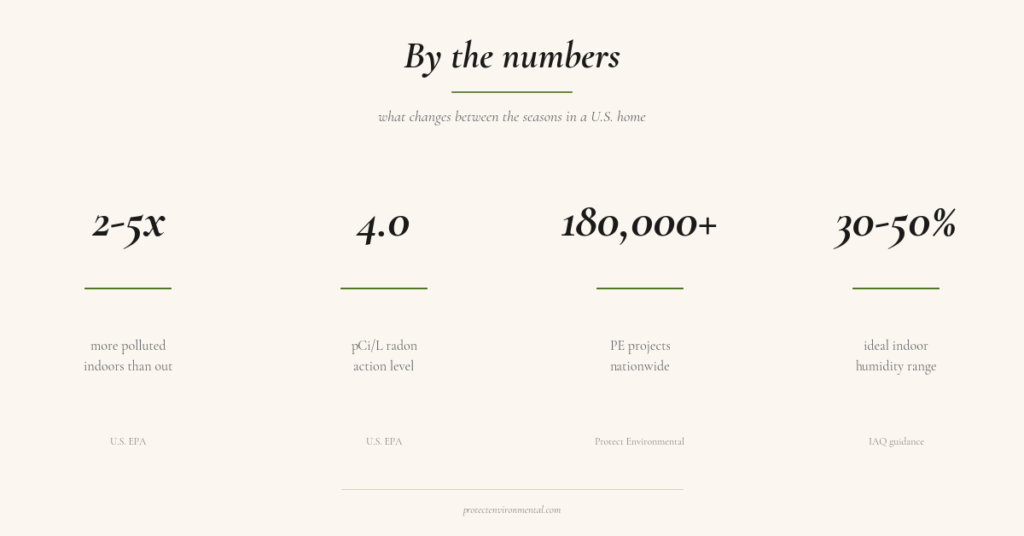
Protect Environmental has completed 180,000+ projects in 15+ years across all 50 U.S. states and 2 U.S. territories. All specialists are licensed and certified through the National Radon Proficiency Program (NRPP). This guide draws on real observed data from homes we’ve tested.
180,000+ projects • 50 U.S. states • NRPP certified • 15+ years
Summer is the season most people associate with fresh air. Windows open, breeze moving through the house, everyone spending time outside. In reality, for most American homes, the air inside gets quieter, stiller, and harder to breathe. Not because summer is dangerous, but because our homes work differently once the AC turns on.
According to guidance published on our indoor air quality resources, the U.S. EPA reports that indoor air can be 2 to 5 times more polluted than outdoor air. Summer amplifies this in ways that most homeowners never think about.
The four things that change indoors when it gets hot
1. Homes get sealed
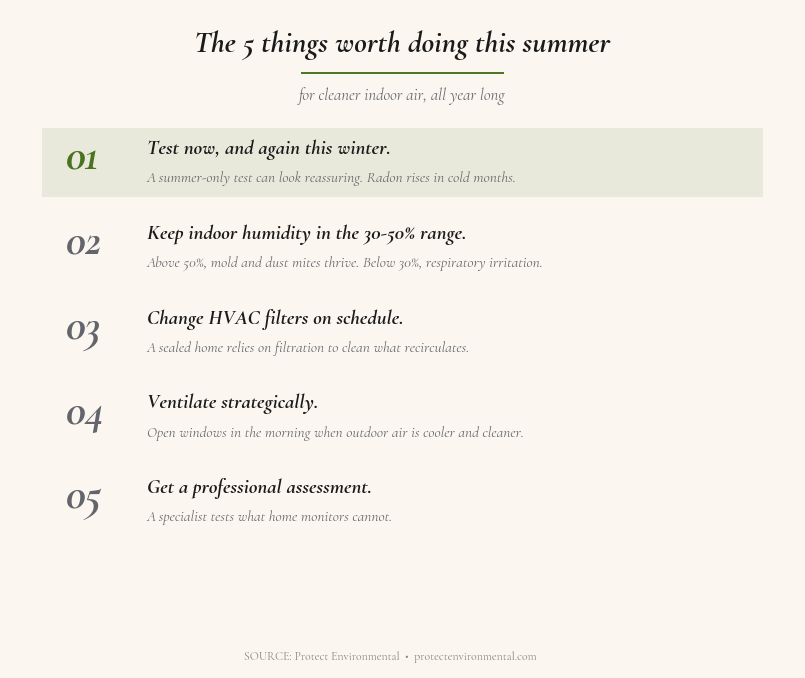
The moment the AC comes on, windows close and stay closed. From June through September, most homes operate as sealed containers. Fresh air exchange drops to almost nothing. Whatever pollutants are inside stay inside, recirculated through the HVAC system for months at a time.
The paint fumes from a spring project, the fabric off-gassing from new furniture, the residue from cleaning products, the moisture from cooking. In winter, homes are sealed too. But summer adds a second problem that winter does not.
2. Humidity climbs
Indoor humidity rises with outdoor humidity. In coastal, Southern, and Midwestern homes, indoor humidity routinely climbs above 60 percent in July and August. That number matters.
The generally accepted healthy range for indoor humidity is 30 to 50 percent. Above 50 percent, mold and dust mites begin to thrive. Above 60 percent, the risk climbs sharply. Bathrooms, basements, and areas around plumbing become vulnerable to hidden mold growth. Dust mite populations, one of the most common asthma and allergy triggers, double in humid rooms.
3. Indoor pollutants concentrate
Every home has volatile organic compounds. Off-gassing from furniture. Residue from cleaning agents. Fumes from stored paint or fuel. In cooler months, some of this dissipates or slows. Summer heat accelerates off-gassing. And because the home is sealed, there is nowhere for the compounds to escape.
The average home in the U.S. contains a mix of pollutants including particulate matter, volatile organic compounds, mold spores, carbon monoxide, and radon, per the Clean Air Month 2026 guide. Summer conditions concentrate several of these.
4. Radon behavior shifts, but does not disappear
Radon is often assumed to be a winter problem. That is partially true. Our own field data confirms it. In our reporting on when radon levels are highest, we have seen the same building test at 1.8 to 2.2 pCi/L in summer and 28.0 to 32.0 pCi/L in winter. The same home. The same soil. Very different results.
This is the trap most homeowners fall into. A summer test comes back low, so radon feels like it is not a problem. Then winter arrives. The heating system creates a stack effect that pulls soil gas, including radon, into the home. The EPA action level of 4.0 pCi/L gets exceeded, and no one knows.
The summer testing trap
This is worth stating plainly. If you tested for radon last summer and the result came back low, that is helpful information, but it is not a complete answer. On our radon levels by ZIP code tool, we write that levels fluctuate with weather and seasonal conditions. Our own recommendation, based on the pattern we see nationwide, is that if you test in the warm summer months, test again in the winter. Radon levels often rise in colder months due to pressure changes and the stack effect.
If you already have a mitigation system installed, that same logic applies. If your system was designed based on a summer test, winter performance may be different. We recommend retesting every 2 years even if you have a system, per the guidance on our mitigation maintenance page.
What to do about it
When to call a professional
You do not need a professional every year. But there are moments where one call saves years of guessing.
- You have never had a professional radon test. Or the last one was more than 2 years ago.
- You have a mitigation system that has not been serviced in over a year.
- Anyone in the home has been diagnosed with asthma, chronic respiratory issues, or unexplained fatigue.
- You have visible mold or a persistent musty odor.
- You have completed a major renovation in the last 12 months.
- You are buying or selling a home.
A note from Protect Environmental
The season is worth using. Homes are settled. Families are around. Winter is far enough away that decisions can be made without pressure. If it has been more than two years since your last professional look, or if this is your first, summer is a good moment to know for sure.
We come out, walk your home, and give you a clear answer. No cost. No commitment.
Get my free quote →Frequently Asked Questions
Summer indoor air quality drops because homes are sealed for AC, which cuts fresh air exchange. Humidity climbs above the healthy 30-50 percent range, which allows mold and dust mites to thrive. And summer heat accelerates the off-gassing of paints, furniture, and cleaning products. These effects concentrate pollutants in a home that has nowhere to release them.
Yes, but pair it with a winter test. Protect Environmental has observed the same building testing at 1.8 to 2.2 pCi/L in summer and 28.0 to 32.0 pCi/L in winter. A summer-only test can miss dangerously elevated winter levels. If you test in summer, we recommend testing again in the colder months.
Cold weather creates a stack effect. Warm indoor air rises and escapes from the upper part of the home, creating negative pressure at ground level. This pulls soil gas, including radon, up through the foundation. Snow and ice on the ground also form a barrier that pushes more radon into the home. Summer’s warmer temperatures reduce this effect but do not eliminate it.
For radon, we recommend testing every 2 years even if a mitigation system is installed, because seasonal fluctuations can affect performance. For general indoor air quality, a professional assessment is worth doing when you buy a home, after a major renovation, if health symptoms appear, or if you have never had one done. Otherwise, home monitors handle the day-to-day.
Sources & Further Reading
From Protect Environmental’s own resource library
- Protect Environmental. Indoor Air Quality at Home: A Clean Air Month 2026 Guide.
- Protect Environmental. When are radon levels the highest?
- Protect Environmental. Radon Levels by ZIP Code (search tool).
- Protect Environmental. Radon Mitigation for Home.
- Protect Environmental. Radon Mitigation System Maintenance.
- Protect Environmental. Indoor Air Quality Services.
Government and public-health authorities
- U.S. EPA. Indoor Air Quality (2-5x more polluted than outdoor air).
- U.S. EPA. Health Risk of Radon (4.0 pCi/L action level).
- U.S. EPA. A Citizen’s Guide to Radon.
- U.S. EPA. Mold and Health (humidity guidance).
- CDC. About Radon.
- National Radon Proficiency Program (NRPP). Certification standards.

