
Quick Answer
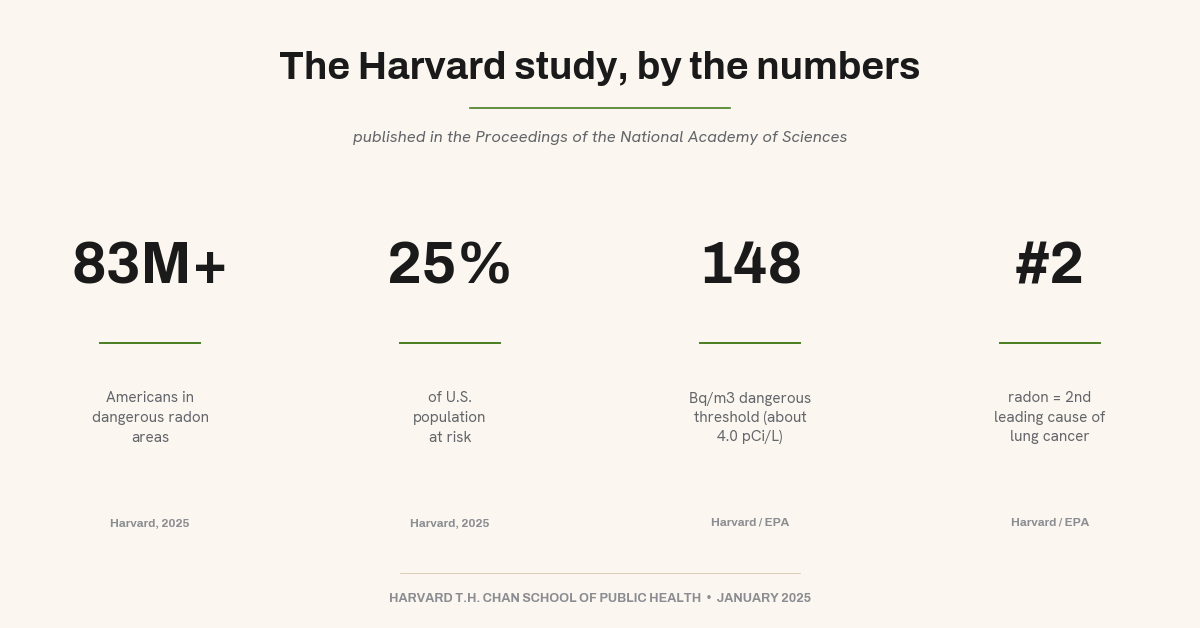
A 2025 Harvard study found that nearly 25 percent of the U.S. population, more than 83 million people, live in areas with radon levels at or above the dangerous threshold. The highest-risk areas include central Ohio, both Dakotas, Nebraska, parts of Iowa, and eastern Pennsylvania. Radon is the second leading cause of lung cancer in the United States.
A Harvard study published in the Proceedings of the National Academy of Sciences has renewed attention on one of the most preventable environmental health risks in American homes. Using millions of radon measurements collected between 2001 and 2021, researchers built the most detailed radon exposure map ever compiled for the lower 48 states. The finding: roughly 83 million Americans, close to one in four, live in areas where radon reaches or exceeds levels considered dangerous.
The study was led by former Harvard Chan postdoctoral researcher Longxiang Li, now a professor at Emory University, with Harvard Chan School co-authors Brent Coull, Carolina Zilli Vieira, and Petros Koutrakis.
What the study found
Radon is a radioactive gas produced by the natural decay of uranium in soil. It seeps up through foundations and accumulates indoors, and long-term exposure is the second leading cause of lung cancer in the United States after smoking. Per the Harvard team, radon has also been linked to breast cancer, stomach cancer, and stroke.
Earlier maps of radon risk were limited by patchy measurement data. The Harvard team compiled a national database of millions of measurements taken across two decades, then used predictive modeling to estimate exposure at the community level. The result is the highest-resolution look at U.S. radon risk to date.
The dangerous threshold used in the study is 148 becquerels per cubic meter (Bq/m3), which is approximately equivalent to the 4.0 pCi/L action level the EPA recommends for mitigation. Above that number, the researchers found, health risk climbs sharply.
Where the risk is highest
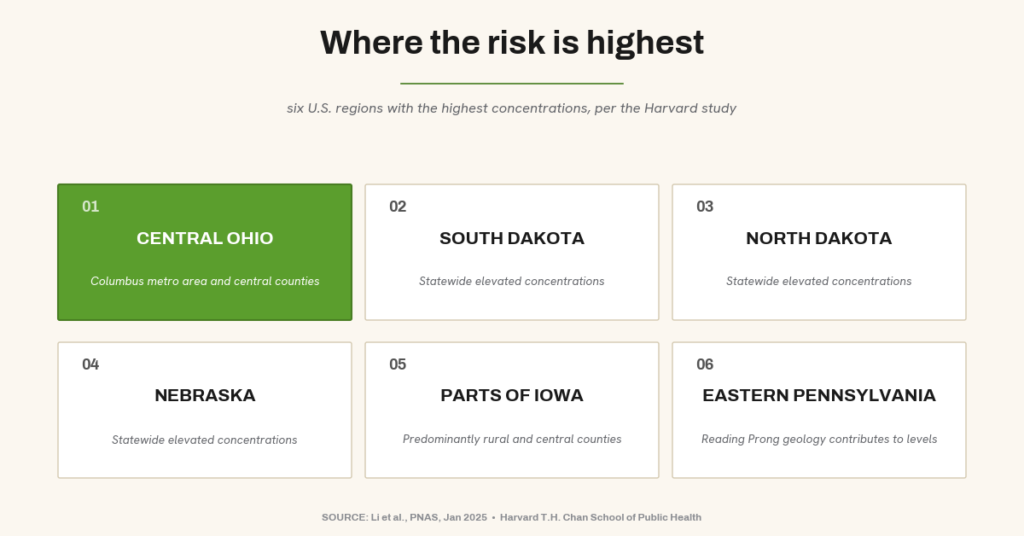
The Harvard team identified six U.S. regions with the highest radon concentrations. The pattern is driven by geology: uranium content in the soil, high-permeability soils that let gas move upward easily, and shallow bedrock that pushes soil gas toward the surface.
- Central Ohio including the Columbus metro area
- South Dakota and North Dakota statewide
- Nebraska statewide
- Parts of Iowa, predominantly rural and central counties
- Eastern Pennsylvania, where the Reading Prong geologic formation contributes to elevated levels
Every state has radon. What the map shows is where the risk is systemic rather than isolated. In these high-concentration regions, a randomly chosen home is far more likely to test above 4.0 pCi/L than a home in a low-risk region. But the researchers also emphasized that even in low-risk zones, individual homes can have dangerously high levels. The only way to know a specific home’s reading is to test it.
Why winter matters more than the map
The study also highlighted a seasonal pattern that every homeowner should understand. During winter, ventilation is reduced while homes are heated, and the temperature difference between warm indoor air and cold outdoor air creates negative pressure at ground level. That pressure difference draws soil gas, including radon, up through foundation cracks and into basements and lower living areas.
The practical implication: a home that tests low in summer can still have dangerous levels during heating season. Our own field observations align with this pattern. For the full seasonal context, see our guide on when radon levels are highest.
What to do if you live in a high-risk area
The Harvard team’s recommendation is straightforward: know your number. Regional maps show where risk is systemic. They cannot tell you what is happening in your specific home.
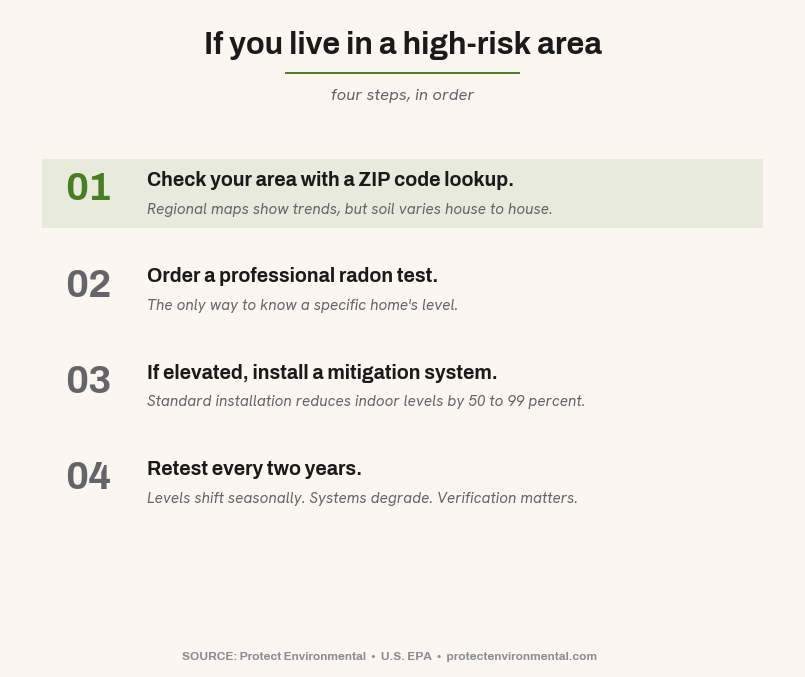
Start by checking your area with our radon levels by ZIP code tool. It gives you a regional baseline. Then order a professional test through our radon testing service. If the result comes back at or above 4.0 pCi/L, mitigation is straightforward and effective. Our page on radon mitigation for home covers how a standard system works. A properly designed system typically reduces indoor radon levels by 50 to 99 percent.
For homeowners in the six regions the Harvard team flagged, testing is not optional in any practical sense. It is the single decision that determines whether the elevated exposure risk in the ground under your home ever becomes an exposure risk to the people inside it.
A note from Protect Environmental
If your ZIP code sits inside one of the high-risk zones the Harvard team identified, testing is worth doing now. We come out, run the test, and give you a clear number. If the level is elevated, we walk you through what mitigation looks like for your specific home.
No cost for the quote. No commitment. Just a clear answer.
Get my free quote →Frequently Asked Questions
A 2025 study led by Harvard T.H. Chan School of Public Health researchers found that nearly 25 percent of the U.S. population, or more than 83 million people, live in areas with radon levels at or above the dangerous threshold of 148 Bq/m3, which is approximately equivalent to the EPA’s 4.0 pCi/L action level. The researchers used millions of radon measurements collected between 2001 and 2021 to build the most detailed U.S. radon exposure map to date.
Per the Harvard study, the highest radon concentrations are found in central Ohio, South Dakota, North Dakota, Nebraska, parts of Iowa, and eastern Pennsylvania. The pattern is driven by geology: uranium content in soil, high-permeability soils, and shallow bedrock all contribute to elevated levels.
Yes. The Harvard study specifically identified central Ohio, including the Columbus metro area, as one of the six highest-risk regions in the United States. Homeowners in central Ohio should test for radon regardless of home age, construction type, or whether the home has a basement.
Test your home. Regional maps show where radon risk is systemic, but they cannot tell you the reading in your specific home. If a professional test shows a level at or above 4.0 pCi/L, the EPA recommends mitigation. A standard mitigation system typically reduces indoor radon by 50 to 99 percent, and the EPA also recommends retesting every two years even after a system is installed.
Further Reading
- Harvard T.H. Chan School of Public Health. Millions in U.S. exposed to dangerous radon, study finds. Karen Feldscher, January 22, 2025.
- Li et al. Modeled national radon exposure across the contiguous United States. Proceedings of the National Academy of Sciences, January 2025.
- Protect Environmental. Radon Levels by ZIP Code (lookup tool).
- Protect Environmental. Residential Radon Services (hub).
- Protect Environmental. When are radon levels the highest?
