
Is indoor air worse than outdoor air?
When Detroit makes the news for its air, people pay attention. The Detroit, Warren and Ann Arbor region was ranked the sixth worst in the country for year round particle pollution in the American Lung Association’s 2025 State of the Airreport, as covered by Axios. Nearly half of all Americans now breathe air that earns a failing grade for ozone or particle pollution.
That headline is worth taking seriously. But it points at the sky, when the more immediate risk is usually under your own roof. Here is what the outdoor numbers miss.
This guide walks through real-world ranges, the highest recorded reading on the books, what level is considered dangerous, and how to know where your own home sits. If you have not yet tested, you can look up the average radon level by zip code to get a sense of local risk before scheduling a test.
Quick Answer
Outdoor air pollution is real, but the U.S. EPA reports that indoor air is often 2 to 5 times more polluted than the air outside. For most homes, the largest indoor air risk is radon, an invisible radioactive gas and the leading cause of lung cancer among people who never smoked. A short test is the only way to know your level.
Why radon is the indoor air risk most people miss
Smog and wildfire smoke are visible, which is part of why they make headlines. Radon does the opposite. It is a colorless, odorless radioactive gas that rises out of the soil and seeps into homes through cracks in the foundation, gaps around pipes, sump pits and crawl spaces. You cannot see it, smell it or taste it. Here is a closer look at what radon is.
It is also the part nobody puts on the evening news: radon is the leading cause of lung cancer among non smokers and is linked to about 21,000 lung cancer deaths in the United States every year, according to the EPA. The agency sets the action level at 4.0 pCi/L, the point at which a home should be fixed. The catch is that there are no early symptoms to warn you. The risk builds quietly, over years.
Often, yes. The U.S. EPA estimates that the air inside a typical home is two to five times more polluted than the air outside, and in some cases more than 100 times. Indoor air pollution sits among the agency’s top five environmental health risks. The reason is simple: we spend about 90 percent of our lives indoors, and modern, well sealed homes trap pollutants instead of letting them escape. So while a bad air day outside lasts a few hours, the air you breathe at home works on your lungs every day of the year.
What Detroit’s pollution ranking really means for your home
A regional pollution ranking is a useful prompt, not a personal result. The air outside is shared. The air inside your home is yours alone, and it depends on your soil, your foundation and how your house breathes.
In Michigan that distinction matters. The state’s environmental agency, EGLE, estimates that about 1 in 4 Michigan homes has elevated radon, compared with roughly 1 in 15 homes nationally, and elevated levels have turned up in all 83 counties. Across Metro Detroit, county averages tell the story:
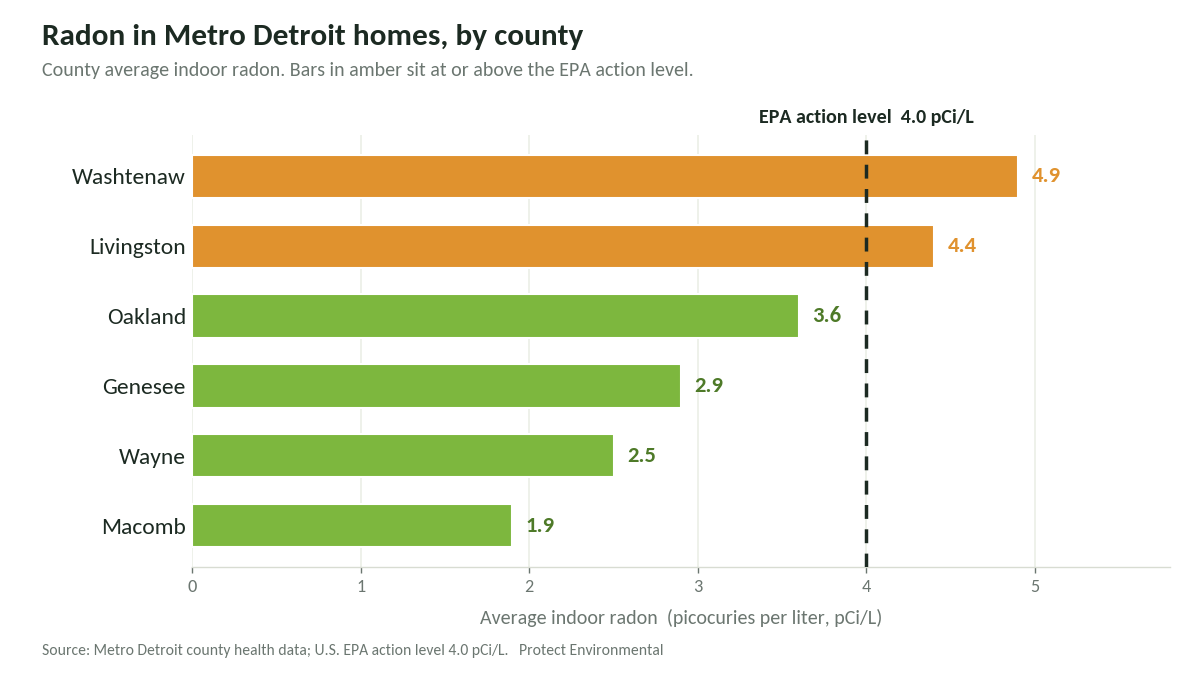
That last point is the one that matters most. A ranking cannot tell you which home is which. A test can.
How do you find out if the air in your home is safe?
Testing is straightforward and inexpensive. A radon test runs for a set period, usually 48 hours or longer, and a lab reports your level in pCi/L. If the result is at or above 4.0, a mitigation system vents the gas safely outside and brings levels down, often within a day of installation. You can review the different types of radon tests or have a certified team handle it for you.
Protect Environmental is a proud supporter of the American Lung Association and has helped homeowners across the country breathe easier at home. The first step is the easiest one.
Frequently Asked Questions
Yes. Particle pollution and smoke can drift indoors through windows, doors and ventilation, and it tends to linger once inside. But the pollutants that originate inside the home, radon chief among them, are usually the larger long term concern because the exposure is constant.
It often is. When homes are sealed against the cold and heating systems pull air upward, radon can concentrate at higher levels. Winter is one of the most reliable times of year to test.
The EPA recommends fixing any home that tests at or above 4.0 pCi/L, and suggests considering action between 2.0 and 4.0. There is no completely risk free level, so lower is always better.
A standard short term test typically runs 48 to 72 hours in the lowest lived in level of the home. Longer term tests give an even more accurate yearly picture.

