
Quick Answer
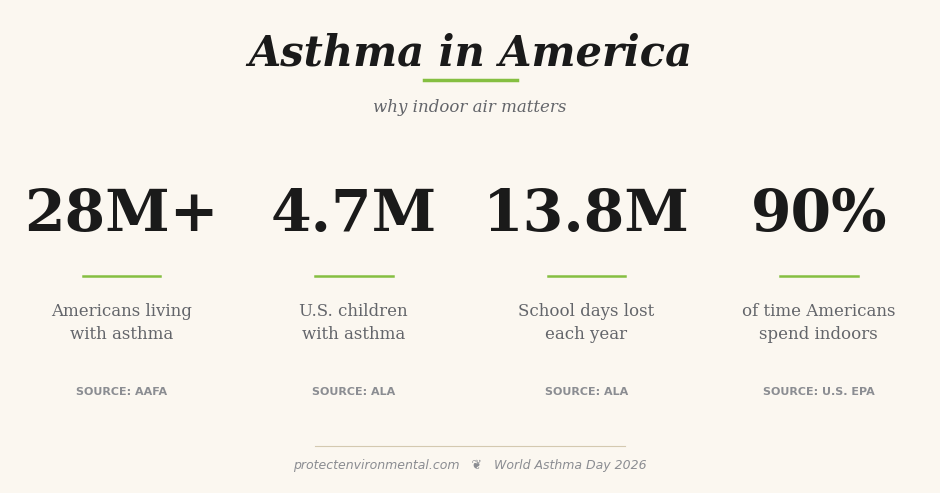
Common indoor asthma triggers include dust mites, mold, pet dander, cockroach allergens, tobacco smoke, particulate matter, and volatile organic compounds (VOCs). The U.S. EPA identifies these as the indoor pollutants most likely to cause or worsen asthma symptoms. Because Americans spend up to 90% of their time indoors, home air quality directly affects how often asthma flares.
Why Does World Asthma Day Belong Inside Your Home?
Today is World Asthma Day. It’s the global moment, set every year for the first Tuesday of May, when the asthma community talks about what’s working, what’s still broken, and what the rest of us can do about it.
The 2026 GINA theme is access to anti-inflammatory inhalers. Inhalers and care plans matter. Doctors matter. But there’s a parallel piece of this conversation that gets less attention, and it sits inside the home.
Most asthma flare-ups happen in the place where people spend the most time. According to the U.S. EPA, Americans spend up to 90% of their time indoors, and indoor allergens and irritants play a major role in triggering asthma attacks. So if you or someone you love has asthma, your home is part of the equation. This is what to look for.
What is World Asthma Day 2026?
World Asthma Day is organized by the Global Initiative for Asthma (GINA) and recognized in countries around the world. In 2026, it falls on Tuesday, May 5. The 2026 theme is “Access to anti-inflammatory inhalers for everyone with asthma, still an urgent need.”
It’s a fitting theme. Asthma affects more than 260 million people globally and over 28 million Americans, including 4.7 million children, according to the Asthma and Allergy Foundation of America and the American Lung Association. Asthma is responsible for roughly 13.8 million missed school days a year in the United States alone.
Why your home matters as much as your inhaler
If you live with asthma, you’ve probably built a list of things that set it off. Pollen on a windy day. A neighbor’s cat. Smoke from a backyard fire. That list is useful and it’s personal.
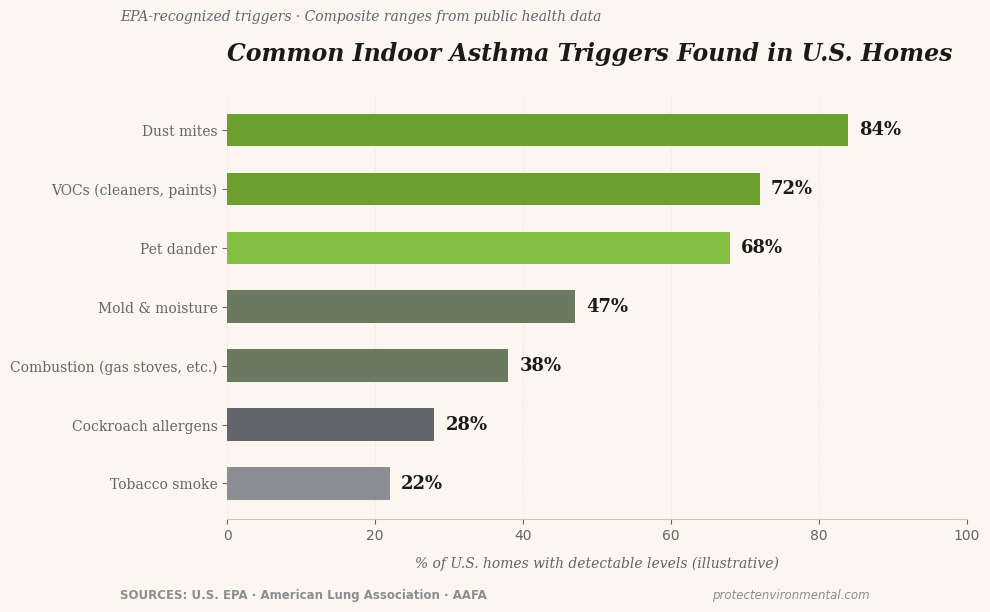
But there’s a second list most people never write down: the triggers inside their own home. The EPA’s environmental risk research identifies dust mites, mold, pet dander, environmental tobacco smoke, cockroach allergens, and particulate matter as indoor pollutants that can trigger asthma attacks. These are not exotic chemicals. They are present, in some amount, in nearly every home in the country.
And because the air inside your home is the air you breathe most of the day, what’s in it matters more than what’s outside, more often than not.
The 7 most common indoor asthma triggers
Based on EPA, American Lung Association, and AAFA guidance, these are the indoor environmental triggers worth knowing by name.
1. Dust mites
Dust mites are microscopic and live in mattresses, pillows, bedding, carpet, and upholstered furniture. Their droppings are one of the most common indoor allergens linked to asthma. They thrive in warmth and humidity above 50%.
2. Mold and moisture
Mold grows wherever there’s moisture, often where you can’t see it. Bathrooms, basements, crawl spaces, around leaky pipes, behind drywall after a flood. The EPA’s research on environmental asthma triggers specifically calls out mold and moisture from water-damaged homes as an asthma risk.
3. Pet dander
Dander is the tiny flakes of skin that pets shed. It sticks to fabric, floats in air, and accumulates in carpet and upholstery. Cat and dog dander are the most common, but birds and rodents shed allergens too.
4. Tobacco smoke
Secondhand smoke is a powerful asthma trigger. So is third-hand smoke, the residue that settles into walls, fabric, and dust long after the cigarette is out.
5. Cockroach allergens
Cockroach saliva, droppings, and body parts contain allergens that are a particularly significant trigger in dense urban housing. They can persist in dust for years.
6. Combustion byproducts
Gas stoves, fireplaces, kerosene heaters, and unvented appliances can release nitrogen dioxide (NO2), carbon monoxide, and fine particulate matter into the air. The American Lung Association notes that gas stoves without proper ventilation can be a significant indoor source of asthma-aggravating pollution.
7. VOCs from cleaning products, paints, and furnishings
Volatile organic compounds, or VOCs, are gases released by everyday products, cleaning sprays, air fresheners, paints, certain glues, new furniture, and synthetic carpets. Many irritate the airways and can trigger symptoms in people with asthma.
Indoor air triggers vs. indoor air hazards: what's the difference?
There’s an important distinction in indoor air quality that gets blurred a lot, and it’s worth being clear about.
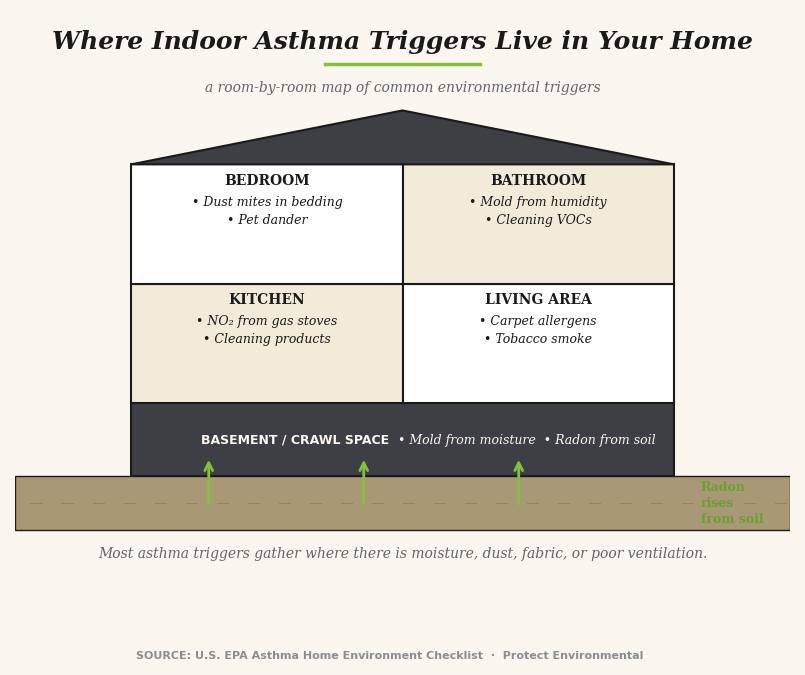
An asthma trigger is something that causes asthma symptoms or attacks. The list above covers the main ones. An indoor air hazard is anything in the air that can harm your health, even if it doesn’t trigger asthma. Some things appear on both lists. Some don’t.
Radon is a good example. Radon is not currently classified as an asthma trigger. It’s a colorless, odorless radioactive gas that rises from soil into homes, and it’s the second leading cause of lung cancer in the United States after smoking. So if you’re already paying attention to what’s in the air your family breathes because of asthma, radon is part of the same conversation. It’s just a different conversation.
If you’ve never tested for it, that’s worth doing. The EPA recommends every home be testedregardless of where you live or how new the home is.
An indoor air quality checklist for an asthma-aware home
If you live with asthma, or someone in your household does, here’s a starter list. Most of these are things you can do yourself this week.
- Keep indoor humidity between 30% and 50% to discourage dust mites and mold.
- Wash bedding in hot water weekly. Use allergen-proof mattress and pillow covers.
- Vacuum carpets with a HEPA filter vacuum and consider removing carpet from bedrooms.
- Don’t smoke or allow smoking inside your home.
- Run exhaust fans in the kitchen and bathroom, especially when cooking on gas or showering.
- Fix leaks fast. Anything wet for more than 48 hours can grow mold.
- Switch to fragrance-free, low-VOC cleaning products and avoid air fresheners and aerosol sprays.
- Get any visible mold professionally assessed if it covers more than 10 square feet or comes from a hidden water source.
- Test your home for radon if you haven’t recently. It’s inexpensive and a one-time data point that matters.
Where Protect Environmental fits in
A note from Protect Environmental
We’re not asthma doctors. Asthma management belongs with your physician, and the GINA 2026 message about access to inhalers is the right thing to focus on this week.
What we do is the air side: testing homes for what’s actually in the indoor environment, including conditions that overlap with asthma triggers (mold, water damage, ventilation, humidity) and conditions that don’t (radon, vapor intrusion). If you’ve been managing asthma without ever having your home’s indoor environment looked at, that’s a gap worth closing.
Request a quote →Frequently Asked Questions
World Asthma Day 2026 is observed on Tuesday, May 5. Organized annually by the Global Initiative for Asthma (GINA), it raises awareness of asthma worldwide. The 2026 theme is “Access to anti-inflammatory inhalers for everyone with asthma, still an urgent need.” Asthma affects more than 260 million people globally and over 28 million Americans.
The most common indoor asthma triggers are dust mites, mold, pet dander, cockroach allergens, tobacco smoke, particulate matter, and volatile organic compounds (VOCs) from cleaning products, paints, and gas appliances. The U.S. EPA classifies these as the indoor pollutants most likely to cause or worsen asthma symptoms in homes.
Mold can trigger asthma attacks in people who already have asthma, and ongoing exposure can worsen symptoms. Some research also links early childhood mold exposure to a higher risk of developing asthma. Mold thrives where there’s moisture, so controlling humidity, fixing leaks promptly, and addressing water damage are the most effective ways to limit indoor mold.
Yes, humidity can trigger asthma. High humidity, generally above 50%, encourages dust mites and mold, both of which are indoor asthma triggers. Very humid air itself can also feel harder to breathe. Very dry air, below 30%, can irritate airways too. The EPA recommends keeping indoor humidity between 30% and 50% for healthier indoor air.
Air quality is considered bad for asthma when fine particulate matter (PM2.5), ozone, nitrogen dioxide, or known indoor allergens are elevated. Outdoors, AQI readings above 100 typically affect sensitive groups including people with asthma. Indoors, the warning signs are visible mold, persistent dampness, smoke residue, strong chemical odors, and obvious dust accumulation.
Radon is not currently classified as an asthma trigger. Radon is a radioactive gas that rises from soil into homes and is the second leading cause of lung cancer in the United States. So while radon and asthma are separate issues, both fall under the broader category of indoor air quality, and the EPA recommends every home be tested for radon regardless of asthma status.

