
In this article
- 01What is Lung Cancer Action Week 2026
- 02The leading cause in non-smokers
- 03Lung cancer types, stages, and treatment
- 04Warning signs you shouldn’t ignore
- 05How to test your home for radon
- 06What if your radon test comes back high
This week is Lung Cancer Action Week. Buildings across the country are lit up turquoise. The American Lung Association’s LUNG FORCE campaign is running, and the message they want every American to hear is simple.
Lung cancer is the leading cause of cancer death in the United States. About every two minutes, someone is diagnosed. And it is not just a smoker’s disease. Roughly 10 to 20% of lung cancer cases occur in people who have never smoked at all.
If you have never picked up a cigarette in your life, that statistic should land. The leading reason it happens is also the most fixable, and it has nothing to do with your habits.
Quick Answer
Radon is the leading cause of lung cancer in non-smokers and the second leading cause overall, after smoking. The U.S. EPA estimates radon causes about 21,000 lung cancer deaths each year in the United States. Lung Cancer Action Week, observed each May, includes home radon testing among the American Lung Association’s seven recommended actions to reduce lung cancer risk.
What is Lung Cancer Action Week 2026?
Lung Cancer Action Week is the awareness initiative of the American Lung Association’s LUNG FORCE program, observed annually in early May. In 2026, it runs from May 5-11. The week is paired with Turquoise Takeover, which is the broader month-long campaign that encourages communities, landmarks, and individuals to wear turquoise, the LUNG FORCE signature color, to raise lung cancer awareness.
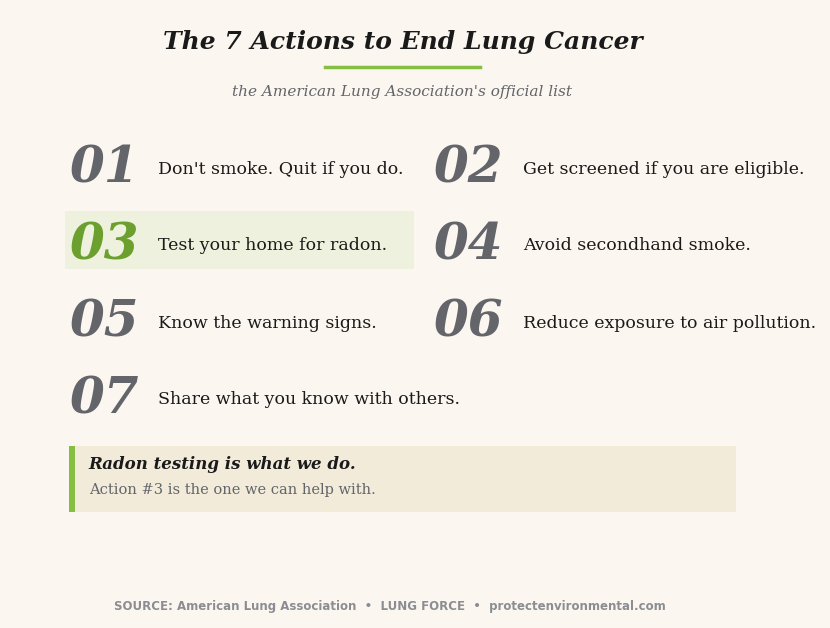
The American Lung Association uses the week to publish its seven actions to end lung cancer, a list aimed at homeowners, patients, caregivers, and the general public. We’ll get to all seven, but here’s the one most people overlook.
Action #3 on the ALA's list: test your home for radon
Sitting at number three on the American Lung Association’s official list of actions, between “get screened” and “avoid secondhand smoke,” is “test your home for radon.” Most people never get past number one.
Radon is a colorless, odorless, tasteless radioactive gas that rises from the natural decay of uranium in soil and rock. It seeps up through foundations, floors, and any opening in contact with the ground, and it accumulates inside homes. According to the U.S. EPA, radon is responsible for roughly 21,000 lung cancer deaths per year in the United States. That is more than drunk driving. More than home fires. More than drowning.
Why this matters more if you have never smoked
If you smoke, your single biggest controllable risk factor for lung cancer is the cigarette. Quit and your risk drops dramatically over time. The math is straightforward.
If you don’t smoke, the math is different. With smoking off the table, the leading remaining causes of lung cancer cluster around environmental and genetic factors. Radon is at the top of that list. The U.S. EPA estimates that radon is the leading cause of lung cancer among non-smokers, responsible for the majority of lung cancer cases in people who never smoked.
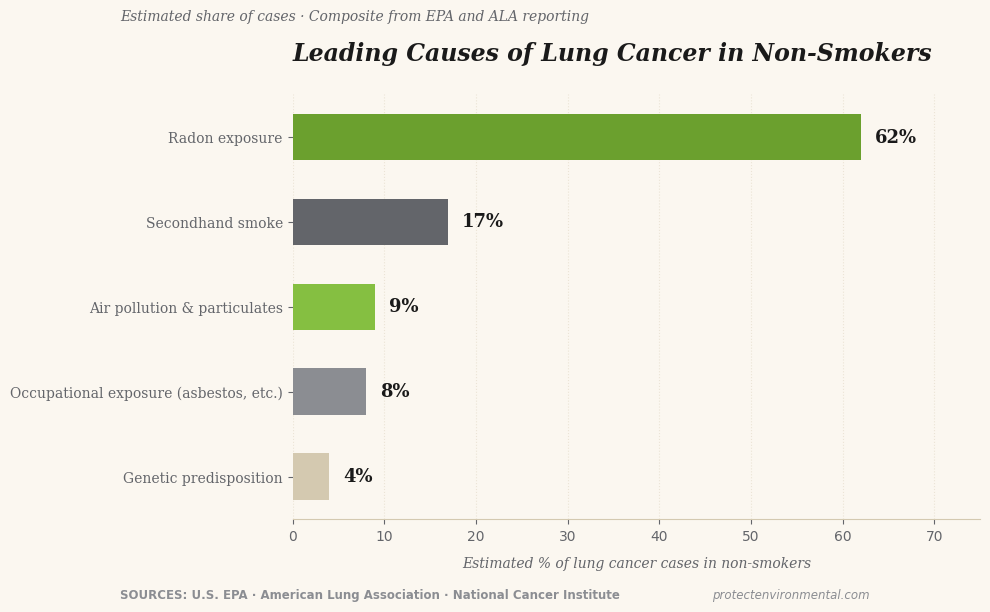
And here is the part that gets to people: radon does not announce itself. There is no smell, no visible warning, no symptom in real time. The first signal something is wrong is, frequently, a lung cancer diagnosis years or decades later. The exposure is silent. The result is not.
Lung cancer in numbers
A few stats from the American Lung Association, the EPA, and the National Cancer Institute that frame why this conversation matters this week:
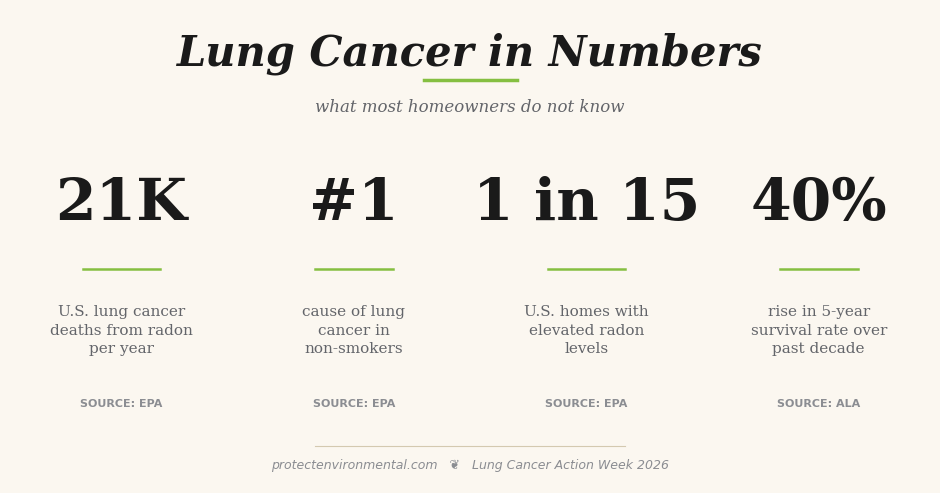
- Lung cancer is the leading cause of cancer deaths in the United States, killing more Americans each year than breast, prostate, and colon cancer combined.
- Roughly 10 to 20% of lung cancer cases occur in people who have never smoked.
- 21,000 lung cancer deaths per year are attributable to radon, per EPA estimates.
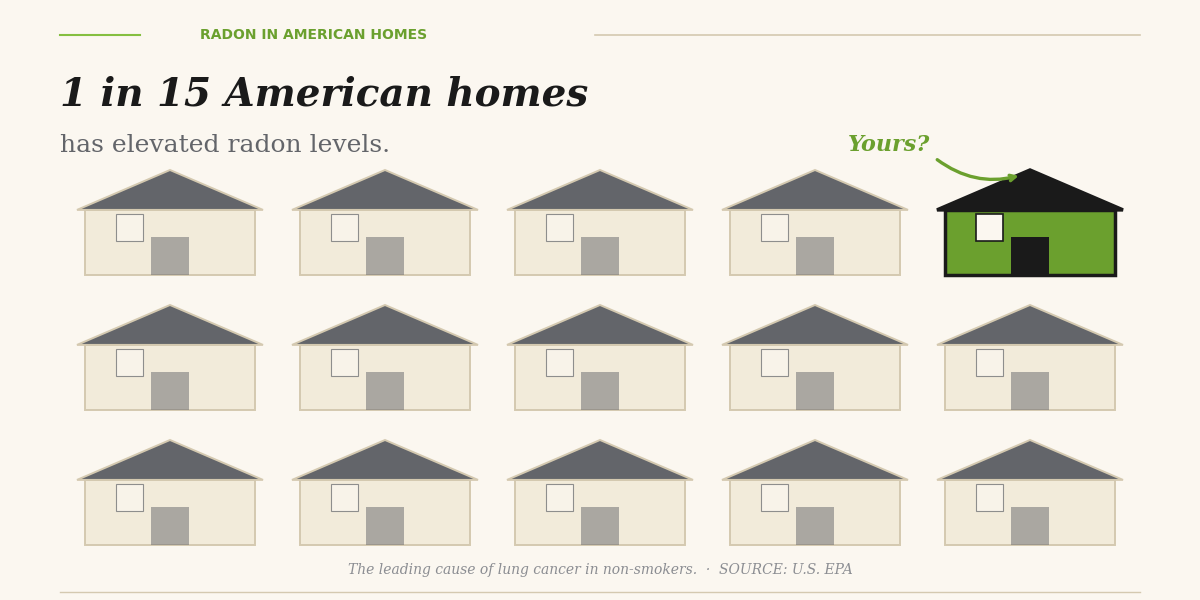
- About 1 in 15 U.S. homes has elevated radon levels above the EPA’s action threshold of 4 picocuries per liter (pCi/L).
- There is good news, too: the 5-year lung cancer survival rate has risen by nearly 40% over the past decade, driven by earlier screening and better treatments.
Warning signs of lung cancer to know
Lung cancer often develops silently and produces no symptoms in its earliest stages. When symptoms do appear, they are easy to mistake for less serious conditions like a stubborn cold or a respiratory infection. The American Lung Association recommends learning these warning signs and not ignoring them, especially if they persist:
- A cough that does not go away or worsens over time.
- Chest pain, shortness of breath, or wheezing.
- Coughing up blood or rust-colored sputum.
- Hoarseness or persistent voice changes.
- Unexplained weight loss or loss of appetite.
- Recurring respiratory infections, like bronchitis or pneumonia.
- Fatigue or weakness that does not improve.
Symptoms can be different in women than in men. Women are more likely to be diagnosed with adenocarcinoma, which often develops in the outer regions of the lungs, where it may produce subtler early symptoms. If something feels off, talk to your doctor. Early detection is the single biggest factor in survival.
Lung cancer basics: types and stages
When those symptoms show up in someone you know or in yourself, the next questions are usually clinical. What kind of lung cancer is it? How far has it spread? Here’s the vocabulary in plain terms, sourced from the American Lung Association and the National Cancer Institute.
Small cell vs. non-small cell lung cancer
Lung cancer is divided into two main categories based on how the cells appear under a microscope.
- Non-small cell lung cancer (NSCLC). The most common form, accounting for about 80-85% of all lung cancer cases. It tends to grow and spread more slowly than small cell, which gives screening and treatment more time to work.
- Small cell lung cancer (SCLC). Accounts for roughly 10-15% of cases. It is strongly associated with smoking and tends to grow faster and spread earlier, which makes early detection critical.
Common subtypes of non-small cell lung cancer
Within NSCLC, three subtypes account for nearly all cases.
- Adenocarcinoma. The most common subtype overall, especially in non-smokers and in women. It usually develops in the outer parts of the lungs.
- Squamous cell carcinoma. Often forms in the central airways. More strongly linked to smoking.
- Large cell carcinoma. Less common, can appear anywhere in the lungs and tends to grow quickly.
How lung cancer is staged
Staging is the medical shorthand for how far the cancer has spread. The American Cancer Society and National Cancer Institute use a 1-4 scale.
- Stage 1. Cancer is in one lung only and has not spread to lymph nodes.
- Stage 2. Cancer is still in one lung but may have spread to nearby lymph nodes.
- Stage 3. Cancer has spread to lymph nodes in the chest, sometimes on both sides.
- Stage 4. Also called metastatic lung cancer. Cancer has spread beyond the lungs to other parts of the body. Stage 4 is the most advanced stage.
The earlier the stage at diagnosis, the better the prognosis. The 5-year survival rate for stage 1 lung cancer can exceed 60%, while stage 4 survival rates have historically been much lower, though they have been steadily climbing thanks to advances in immunotherapy and targeted therapy.
How to test your home for radon
Testing your home for radon is inexpensive, simple, and a one-time data point that gives you real information. The EPA recommends that every home in the United States be tested, regardless of geographic location, age of the home, or whether the basement is finished or unfinished.
Short-term test (3 to 7 days)
A short-term test is the fastest way to get an initial reading. You place the test kit in the lowest livable level of your home, leave it for the recommended exposure period, and send it to a lab. Available at hardware stores and online for under $30.
Long-term test (90+ days)
A long-term test gives a more accurate picture of your home’s average radon level over time. Radon levels fluctuate seasonally and with weather, so a longer test smooths out variation. Recommended if your short-term test came back near or above the EPA action level.
Professional testing
For a certified, lab-grade reading, especially for a real estate transaction or before installing a mitigation system, professional testing is the right path. Protect Environmental and our regional teams handle this across multiple U.S. markets.
What if your radon test comes back high?
The EPA’s action level is 4.0 pCi/L. If your test comes back at or above that, the EPA recommends reducing it through a process called radon mitigation. If it comes back between 2.0 and 4.0 pCi/L, the EPA still recommends considering mitigation, since no level of radon is technically safe.
A radon mitigation system is essentially a custom-engineered ventilation setup that pulls radon from beneath your foundation and vents it harmlessly above the roofline before it can enter your living space. Properly installed systems are highly effective, often reducing indoor levels by 50-99%. The cost ranges from roughly $1,000 to $2,500 for a typical home, comparable to a single home-improvement project, and it lasts decades.
A note from Protect Environmental
Protect Environmental and our network of legacy brands have built our work around the radon-and-lung-cancer connection. We test homes. We design and install mitigation systems. We re-verify them after install. And we maintain them annually so they keep working a decade later.
If you’ve never tested your home, Lung Cancer Action Week is a fitting moment to start. Action #3 on the ALA’s list is the one we can help with.
Test your home →Frequently Asked Questions
Lung Cancer Action Week 2026 runs from May 5–11. It is organized by the American Lung Association’s LUNG FORCE program, observed annually in early May. The week is paired with Turquoise Takeover, a month-long awareness campaign that encourages people to wear turquoise and illuminate landmarks turquoise to raise awareness about lung cancer prevention, screening, and research.
Radon is the leading cause of lung cancer in non-smokers in the United States. According to the U.S. EPA, radon, a naturally occurring radioactive gas that rises from soil into homes, is responsible for approximately 21,000 lung cancer deaths each year. Among lung cancer cases in people who have never smoked, radon exposure accounts for the majority of attributable risk.
Yes. Radon is classified as a Group 1 carcinogen by the World Health Organization and the U.S. EPA. When inhaled, radon’s radioactive decay products damage lung tissue at the cellular level, increasing cancer risk over time. The EPA estimates radon causes around 21,000 U.S. lung cancer deaths annually, making it the second leading cause of lung cancer overall, after smoking.
The EPA’s action level is 4.0 picocuries per liter (pCi/L) of indoor air. At or above this level, the EPA recommends mitigation. Between 2.0 and 4.0 pCi/L, the EPA still recommends considering mitigation, because no radon level is technically safe. The average outdoor radon level is 0.4 pCi/L, while the average indoor level in the U.S. is 1.3 pCi/L.
Test your home for radon using a short-term test kit (3-7 days) or a long-term test (90+ days). Short-term kits are available at hardware stores and online for under $30. For a certified, lab-grade reading, especially before a real estate transaction or mitigation system installation, hire a licensed professional radon testing service. The EPA recommends every home be tested regardless of location.
Lung cancer often produces no symptoms in early stages. Warning signs include a persistent cough, chest pain, shortness of breath, coughing up blood, hoarseness, recurring respiratory infections, unexplained weight loss, and unusual fatigue. Symptoms can be subtler in women, who are more likely than men to develop adenocarcinoma. The American Lung Association recommends seeing a doctor about any symptom that lasts more than two weeks.

