
What is National Public Health Week 2026?
National Public Health Week 2026 runs April 6-12 under the theme “Ready. Set. Action.” One of the most preventable public health threats in American homes is radon, a colorless, odorless radioactive gas that causes more than 21,000 deaths per year. Testing and mitigation are proven, accessible, and can protect any home.
Good Health Doesn't Just Happen
That’s the message behind National Public Health Week 2026, organized by the American Public Health Association. Running April 6-12, NPHW is a national moment to recognize the systems, science, and people that keep communities healthy — and to take action on what still needs attention.
At Protect Environmental, we’re part of this conversation for a specific reason. The air inside your home is one of the most overlooked public health issues in the country. And the invisible gas responsible for more than 21,000 American deaths a year is one most people have never tested for.
That gas is radon. Here’s what you need to know and what you can do today. Start with our full radon guide if you’re new to the topic.
What Makes This a Public Health Issue?
Public health is not just what happens in hospitals or at the policy level. It is built on what happens in the places where people live, breathe, and sleep every day.
Radon is a naturally occurring radioactive gas that forms when uranium breaks down in soil and rock beneath your home. It seeps up through foundations, gathers indoors, and has no odor, color, or taste. The EPA lists it among the top five environmental risks to public health. The U.S. Surgeon General has called it a serious national health threat. And the American Lung Association which Protect Environmental is proud to partner with urges every homeowner to test.
Figure 1: Sources: EPA, American Lung Association, CDC
Here is where the numbers land:
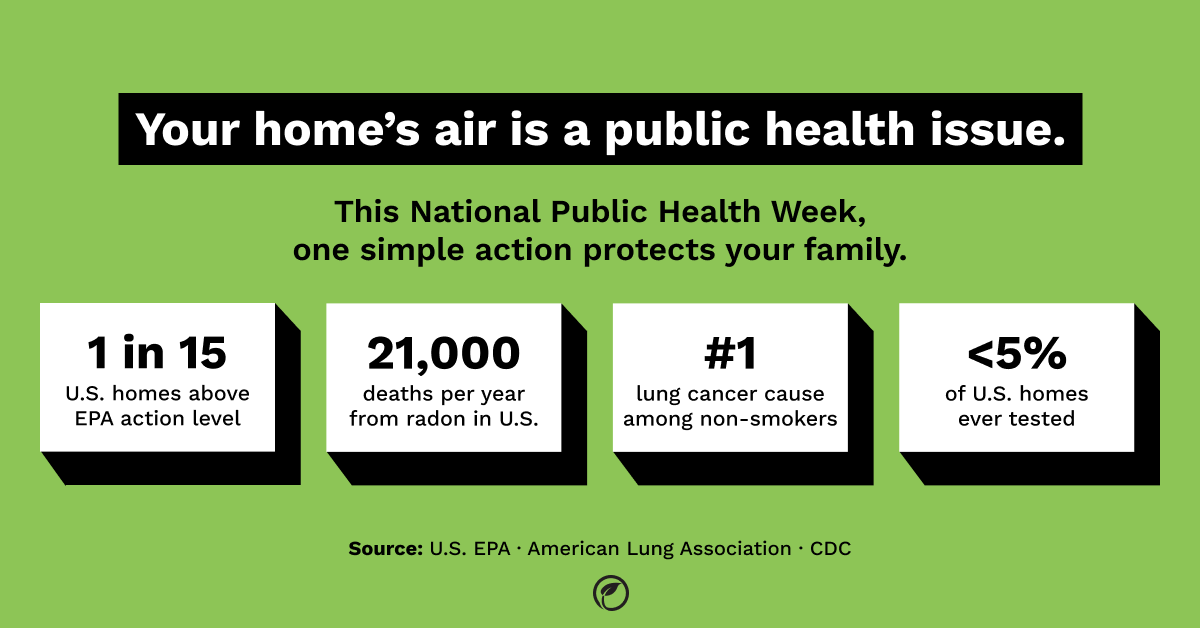
Those numbers are large. The good news: this is a solvable problem. Testing is simple and affordable. Mitigation, when needed, takes less than a day.
Ready: Know What's in Your Air
Being ready starts with a test. Radon behaves differently in every home, two houses next door to each other can have completely different levels. Age, construction type, and geography are not reliable predictors. The only way to know is to test your specific home.
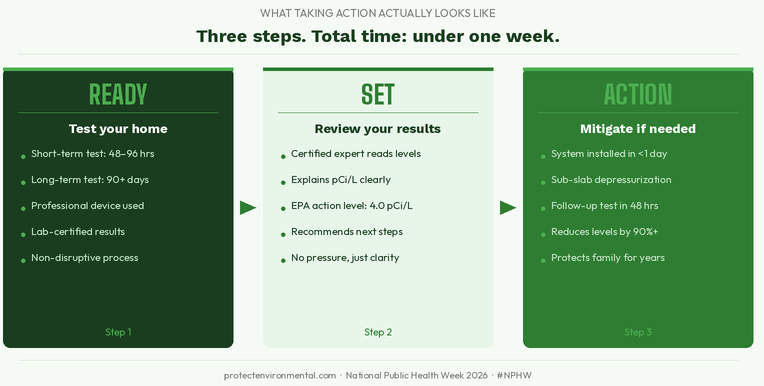
Short-term tests run 48 to 96 hours. Long-term tests run 90+ days and give a clearer picture of your year-round exposure. Both options are low cost and non disruptive. You can also use our National Radon Risk Search tool to check average levels reported in your ZIP code though nothing replaces an actual test of your home.
The EPA action level is 4.0 pCi/L. At that point, the health risk of continued exposure outweighs the cost of mitigation. Some experts recommend considering action even between 2.0 and 4.0 pCi/L.
Set: What Mitigation Actually Looks Like
If your test comes back elevated, the fix is straightforward. A radon mitigation system creates a pathway for radon to escape before it accumulates inside your home. The most common approach is a sub-slab depressurization uses a pipe and fan to draw radon from beneath your foundation and vent it safely outside.
Installation takes less than a day. Systems are designed around your home’s specific structure, foundation type, and test results. After installation, a 48-hour follow-up test confirms the system is working.
Protect Environmental has completed more than 200,000 soil gas projects across all 50 states. Our teams include RAdata in New Jersey, Radon Be Gone in Columbus, Ace Radon in Denver, and Cliff Cummings in Boston, each bringing national expertise and local knowledge to every project. See all residential radon services here.
Action: One Thing You Can Do Right Now
National Public Health Week is asking all of us to do something. Here’s what that looks like for your home:
- Test your home if you have not done so in the past two years or ever.
- Check if your child’s school has been tested. The EPA estimates more than 70,000 classrooms have elevated radon levels.
- Use our radon ZIP code search tool to understand the average risk in your community.
- Share this article with someone who hasn’t thought about radon yet. That conversation matters.
Public health is built on individual choices that add up. Testing your home is one of the most direct actions you can take for your family’s long-term health — and it costs less than a tank of gas.
Ready to take action? Schedule a radon test or request a quote at protectenvironmental.com.
Questions? Browse our FAQ or read the top 8 things every homeowner should know about radon.
Test My Home!
Professional radon testing is the first step to making your home a safe place to breathe.

