
Quick Answer
Radon mitigation systems need light, regular maintenance to keep working. Check the fan’s pressure gauge monthly, listen for changes in fan noise, and have the system inspected every two years. Most radon fans last about five to ten years before they need replacing. Re-test your radon levels every two years to confirm protection.
A radon mitigation system is one of those things that fades into the background once it is installed. The fan hums quietly outside, the pipe runs up the side of the house, and life goes on. If yours was put in eight, ten, or fifteen years ago, there is a fair chance no one has looked at it since. That is exactly when a quiet maintenance check pays off, because the parts that do the work do not last forever, and a system that has stopped pulling radon out of your home gives no obvious warning.
Do radon mitigation systems need maintenance?
Yes, though not much. A standard active soil depressurization system has one moving part, the fan, and one thing to watch, the pressure gauge on the pipe. There is no filter to change and no fluid to top off. Maintenance is mostly a matter of confirming the system is still moving air, catching a worn fan before it fails, and re-testing your radon level on a regular schedule. Think of it the way you think of a sump pump or a water heater. It runs on its own for years, and a short yearly look keeps a small issue from turning into a real one.
Some homeowners ask whether radon work counts as preventive maintenance. In practice it does. Keeping the system running and testing the air on a schedule is preventive care for your home’s health, in the same category as servicing the furnace or having the chimney swept.
How an aging radon system shows its age
An older system rarely fails all at once. It drifts. A few signs are worth knowing:
The gauge reads even
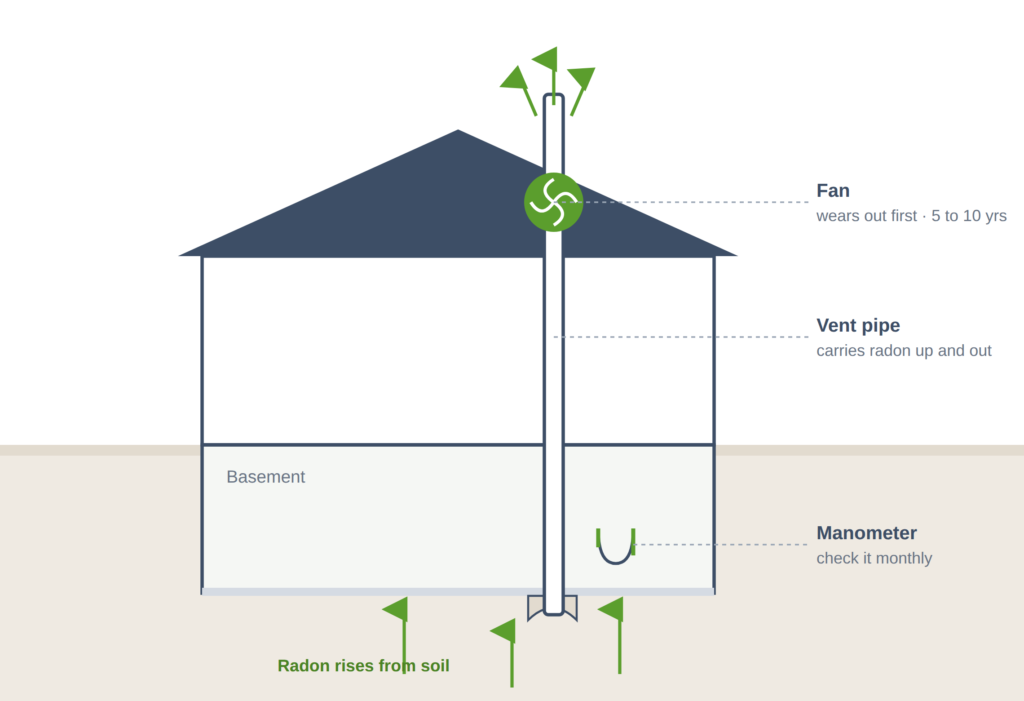
The clear U-shaped manometer should show liquid at two different heights. Level on both sides means the system has lost suction.
The fan gets loud
A new fan is nearly silent. Grinding, humming, or vibration usually means the motor bearings are wearing out.
The fan is warm or quiet
A fan that has stopped spinning often feels warm to the touch and produces no airflow at all.
Cracks in the pipe
Years of weather and sun can split older PVC or loosen a glued joint, which lets the system leak the suction it needs.
Your last test is old
A system can look fine and still be underperforming. The only way to know your level is to measure it again.
None of these mean an emergency. They mean it is time for a closer look.
The radon fan is the part that wears out first
The fan is the heart of the system and the component most likely to need attention as the years add up. Radon fans run continuously, around the clock, for the life of the system. Most are built to last roughly five to ten years, though some go longer and a few give out sooner depending on the model, the climate, and how hard the system has to work.
When a fan reaches the end of its life, the fix is straightforward. A technician removes the old fan and installs a new one of the correct size, matched to your home and soil conditions. It is a single-visit repair in most cases. If your fan is original to a system installed more than a decade ago, replacing it is often the single most valuable thing you can do for an older setup, and it restores the system to full strength.
A simple radon system maintenance schedule
You do not need special tools or training for the day-to-day part. Here is the rhythm that keeps an older system honest;
The monthly glance at the manometer takes about ten seconds and is the single best habit you can build. Everything else follows from it.
What radon system maintenance costs
Routine upkeep is inexpensive, and most of it is free if you do the monthly and yearly checks yourself. The two costs to plan for are testing and the eventual fan replacement.
A follow-up radon test is modest, in the range you would expect for any home test kit or short professional measurement. A fan replacement is the larger line item, and the price depends on the fan size your home needs and the labor to install it. A professional inspection of an older system, where a technician checks suction, airflow, and the condition of every component, is also available and is a smart step before buying or selling a home.
The point worth remembering is that a working system is far cheaper than a fresh installation. Maintaining what you have protects the investment you already made, and that protection is worth real money in several ways:
When to repair and when to replace an older system
Most older systems do not need replacing. They need a tune-up. Test first, then decide. If a re-test comes back high, a professional can tell you whether a repair, a fan upgrade, or a design change is the right answer. You are rarely starting from zero.
Usually just a repair
- A worn or noisy fan
- A cracked pipe or loose joint
- A system that tests fine but is overdue for a check
- An original fan past the ten-year mark
Sometimes a redesign
- The original system was undersized or poorly placed
- A renovation changed how air moves through the home
- Repeated tests stay high after a fan replacement
- No suction point can keep levels below the action level
Yes, but very little. The main tasks are checking the pressure gauge, listening to the fan, having the system inspected every year or two, and re-testing your radon level every two years. The fan is the only moving part and is the component most likely to need replacement over time.
Most radon fans last about five to ten years of continuous operation. Lifespan varies with the fan model, the climate, and how hard the system works. A fan that is louder than it used to be, or one that has gone silent, is usually nearing the end of its life and should be replaced.
The EPA recommends re-testing every two years, and after any major renovation. Re-testing is the only reliable way to confirm your system is still keeping radon at a safe level, since a system can look fine and still be underperforming.
Routine checks are free if you do them yourself. The costs to plan for are a follow-up radon test, which is modest, and an eventual fan replacement, which depends on the fan size your home needs and the labor involved. Maintaining a system is far less expensive than installing a new one.
Not sure when your fan was last checked?
Protect Environmental and our local service teams inspect, service, and re-fan radon systems nationwide, no matter who installed them.
Schedule My System Check Find My Local Team
