
Quick Answer
Yes. The EPA recommends radon testing before buying a home because 1 in 15 U.S. homes has elevated radon levels, and testing is the only way to know. Order the test during the inspection contingency period. If levels reach 4.0 pCi/L or higher, the EPA recommends mitigation, which is negotiable between buyer and seller before closing.
Buying a house is already a long list of decisions. Radon testing sounds like an easy one to skip. It shouldn’t be. Radon is a colorless, odorless, radioactive gas that seeps up from the soil into homes, and long-term exposure is the leading environmental cause of lung cancer in the United States. The tricky part: you cannot see it, smell it, or feel it. The only way to know a home’s level is to test.
The good news is that testing during a home purchase is straightforward, inexpensive relative to the transaction, and it gives you real leverage at the negotiating table. This guide walks through when to test, how the test works, what the number means, and who typically pays for what.
Why radon matters in a home purchase
The EPA reports that nearly 1 in 15 U.S. homes has an elevated radon level, and radon is responsible for approximately 21,000 lung cancer deaths per year in the United States. Radon does not discriminate by home age or construction type. Old and new homes, sealed and drafty homes, homes with basements and homes on slabs, can all have elevated levels. The pattern is set by the soil under the foundation, not the roof over your head.
According to our overview on residential radon services, radon becomes trapped in homes because indoor air pressure is typically lower than the pressure in the surrounding soil. That difference acts like a vacuum, drawing gas up through foundation cracks, plumbing penetrations, sump pits, and any other opening. Over the years you live in a home, that exposure adds up.
When during the transaction should you test?
The short answer: during the inspection contingency period. This is the window between accepting the offer and closing when you still have the legal right to negotiate repairs, credits, or walk away. Test outside that window and you have information but no leverage.
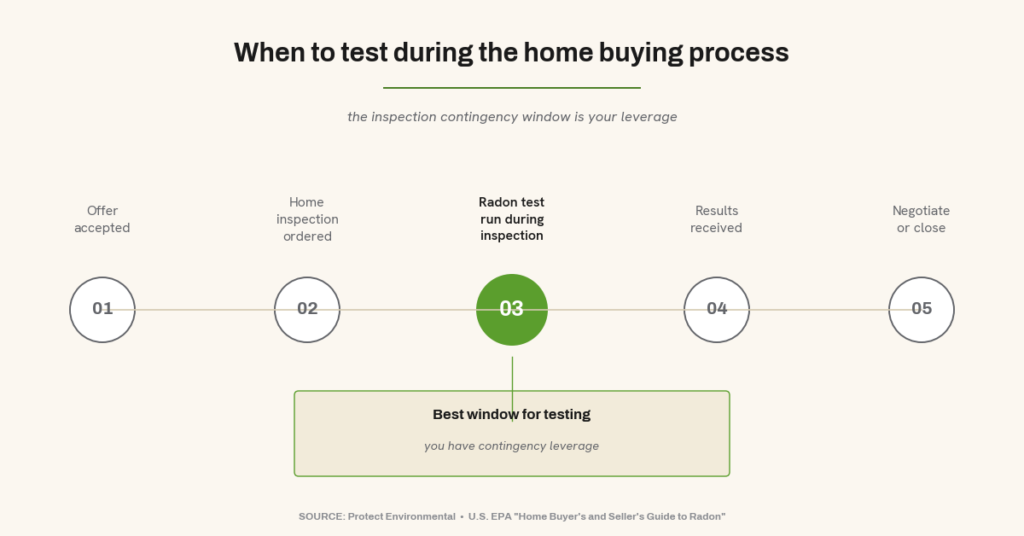
Per the EPA’s Home Buyer’s and Seller’s Guide to Radon, every buyer should know the radon level of the home they are considering. If the seller has a prior test on file, ask for it. State disclosure laws vary. Some states require sellers to disclose known radon levels; others do not. Even where disclosure is required, the seller’s prior test may be old, seasonal, or done under different living conditions.
Radon levels fluctuate with weather, season, and how the home is operated. We routinely recommend a fresh test even when a seller’s result exists, especially if that result was taken in a different season. For the full context on how season affects readings, see our guide on when radon levels are highest.
How the test works
Two main types of tests come up in a real estate transaction: short-term and long-term. Short-term tests, per the EPA, run from 2 to 90 days. Long-term tests run more than 90 days and give a seasonal average. Real estate transactions typically use short-term tests because closings do not wait 90 days.
Per our detailed guide on radon testing basics, short-term testing during real estate transactions is commonly done with either a charcoal test kit sent to a certified lab, or with an electronic continuous monitor operated by a licensed professional. The professional route gives you a result faster (often within 48 hours) and produces a report with multiple readings taken across the testing period.
Two ground rules for a valid test, regardless of method. First, closed-house conditionsmust be maintained for the entire testing period, meaning windows stay closed and only normal HVAC operation is allowed. Disturbing or tampering with the test device is illegal in some states. Second, the device must be placed on the lowest livable level of the home. If the seller is living in the home during the test, the EPA guide recommends taking additional steps to confirm testing conditions were not violated.
What if the results come back elevated?
The EPA action level is 4.0 pCi/L. If the home tests at or above that number, mitigation is recommended. This does not mean walking away from the home. Radon mitigation is a well-established, straightforward process. A properly designed and installed system typically reduces indoor levels by 50 to 99 percent.
According to our page on radon mitigation for home, a standard system uses PVC piping and a small fan to create negative pressure beneath the foundation, drawing radon gas out from the soil and venting it above the roofline before it enters the home. Installation takes about one business day.
What matters for a buyer is not whether the home has radon (any home can), but what you do with the information. You have three options: request the seller install a system before closing, negotiate a credit and install a system after closing, or walk away. Which one makes sense depends on your local market, your leverage, and how much room the price has to move.
Who pays for the test and mitigation?
For the full breakdown, see our dedicated page on who pays for radon mitigation. The short version:
- The radon test is most often paid for by the buyer, typically bundled with the home inspection cost.
- The mitigation system, if needed, is negotiable. The seller is not legally obligated to pay for a mitigation system in most jurisdictions. However, buyers can and frequently do request that the seller cover the cost as a condition of closing, and many sellers agree because a system also protects the home’s future marketability.
Homes with untreated radon can see a drop in market value once the elevated level is disclosed, because buyers see it as both a health risk and an added expense. That reality gives buyers real leverage during the transaction, and it explains why most negotiations resolve with the seller either paying for mitigation or offering a credit at closing.
Working with your home inspector
Most home inspectors either offer radon testing as an add-on service or subcontract it to a certified radon professional. Both approaches can work. Two things to confirm:
- The person conducting the test is certified through the National Radon Proficiency Program (NRPP) or your state’s equivalent radon program. This matters for accuracy and for the credibility of the result if it becomes part of a negotiation.
- The testing device meets ANSI/AARST measurement standards. Continuous monitors are more reliable than passive kits for real estate transactions because they cannot be tampered with without leaving a data trail.
If the home inspector does not offer testing, or if you want a second opinion, you can hire a certified radon professional directly. Our team works with buyers, sellers, and their inspectors on transaction timelines. We can typically run a test and deliver results before your closing date.
A note from Protect Environmental
If you are in the middle of a transaction and need help fast, we come out, run the test, and deliver results in time for you to negotiate. Our team works with home inspectors, real estate agents, and buyers on tight closing timelines.
No cost for the quote. No commitment. Just a clear answer.
Get my free quote →Frequently Asked Questions
Yes. The EPA and the U.S. Surgeon General both recommend radon testing before purchase because 1 in 15 U.S. homes has elevated radon levels, and radon cannot be detected without a test. Testing during the inspection period gives you time to negotiate mitigation, credits, or a decision to walk away before closing.
During the inspection contingency period. This is the window between accepting the offer and closing when you can still legally negotiate repairs or back out. Testing outside this window gives you information but no leverage. Most buyers order the radon test at the same time as the general home inspection.
Often, yes. Confirm that whoever conducts the test is certified through the National Radon Proficiency Program (NRPP) or your state’s equivalent, and that the device meets ANSI/AARST measurement standards. Continuous monitors are preferred over passive kits during real estate transactions because they are harder to tamper with.
The EPA recommends mitigation at 4.0 pCi/L or higher. Any result at or above that number is considered elevated and requires action. Lower results are not automatically safe, since the EPA states there is no known safe level of radon, but 4.0 pCi/L is the threshold at which mitigation is strongly recommended.
The buyer typically pays for the radon test, often bundled with the general home inspection. In some cases the seller may have a recent test on file and provide those results, but a fresh test is generally recommended during the transaction because radon levels fluctuate with weather and season.
The seller is not legally obligated to pay for radon mitigation in most jurisdictions. However, buyers can and frequently do request that the seller cover the cost as a condition of closing, and many sellers agree because untreated radon can lower the home’s market value with future buyers. Mitigation cost can also be handled as a closing credit.
Usually yes, if the radon test is conducted during the inspection contingency period. The inspection contingency in most purchase contracts allows the buyer to renegotiate or withdraw based on findings during that window. Consult your real estate agent and contract for the specific terms that apply to your transaction.
Further Reading
- Protect Environmental. Residential Radon Services (hub).
- Protect Environmental. 8 Things Every Homeowner Needs to Know About Radon Testing.
- Protect Environmental. Who Pays for Radon Mitigation - Buyer or Seller?
- U.S. EPA. Home Buyer’s and Seller’s Guide to Radon (PDF).
- U.S. EPA. Radon and Real Estate Resources.

