
Radon is invisible and odorless, which makes the question deceptively practical: how high can radon levels actually get? The honest answer is, much higher than most homeowners realize. EPA estimates radon causes about 21,000 lung cancer deaths every year in the United States, and individual homes have tested anywhere from background outdoor levels (around 0.4 pCi/L) to thousands of times higher.
This guide walks through real-world ranges, the highest recorded reading on the books, what level is considered dangerous, and how to know where your own home sits. If you have not yet tested, you can look up the average radon level by zip code to get a sense of local risk before scheduling a test.
Quick Answer
Indoor radon levels can range from less than 1 pCi/L to over 2,700 pCi/L in the most extreme case ever recorded. The highest indoor radon reading ever documented in a U.S. home was 2,700 picocuries per liter (pCi/L), measured in 1984 at the Watras home in Pennsylvania. The EPA recommends action at 4.0 pCi/L.
The Short Answer: How High Can Radon Levels Get?
Indoor radon concentration is measured in picocuries per liter (pCi/L) in the United States and Becquerels per cubic meter (Bq/m³) internationally. One pCi/L equals about 37 Bq/m³.
In normal homes, levels typically fall between 0.4 and 4.0 pCi/L. In homes with elevated radon, readings of 10 to 50 pCi/L are not unusual. Levels above 100 pCi/L are rare but well documented. The all-time record in a U.S. home is 2,700 pCi/L, measured in the Watras home in Pennsylvania in 1984, the case that launched modern radon awareness.
There is no theoretical ceiling. Radon levels are driven by uranium concentrations in the soil and rock under the home, the home’s foundation type, weather conditions, and how tightly the home is sealed. Two homes on the same street can read very differently.
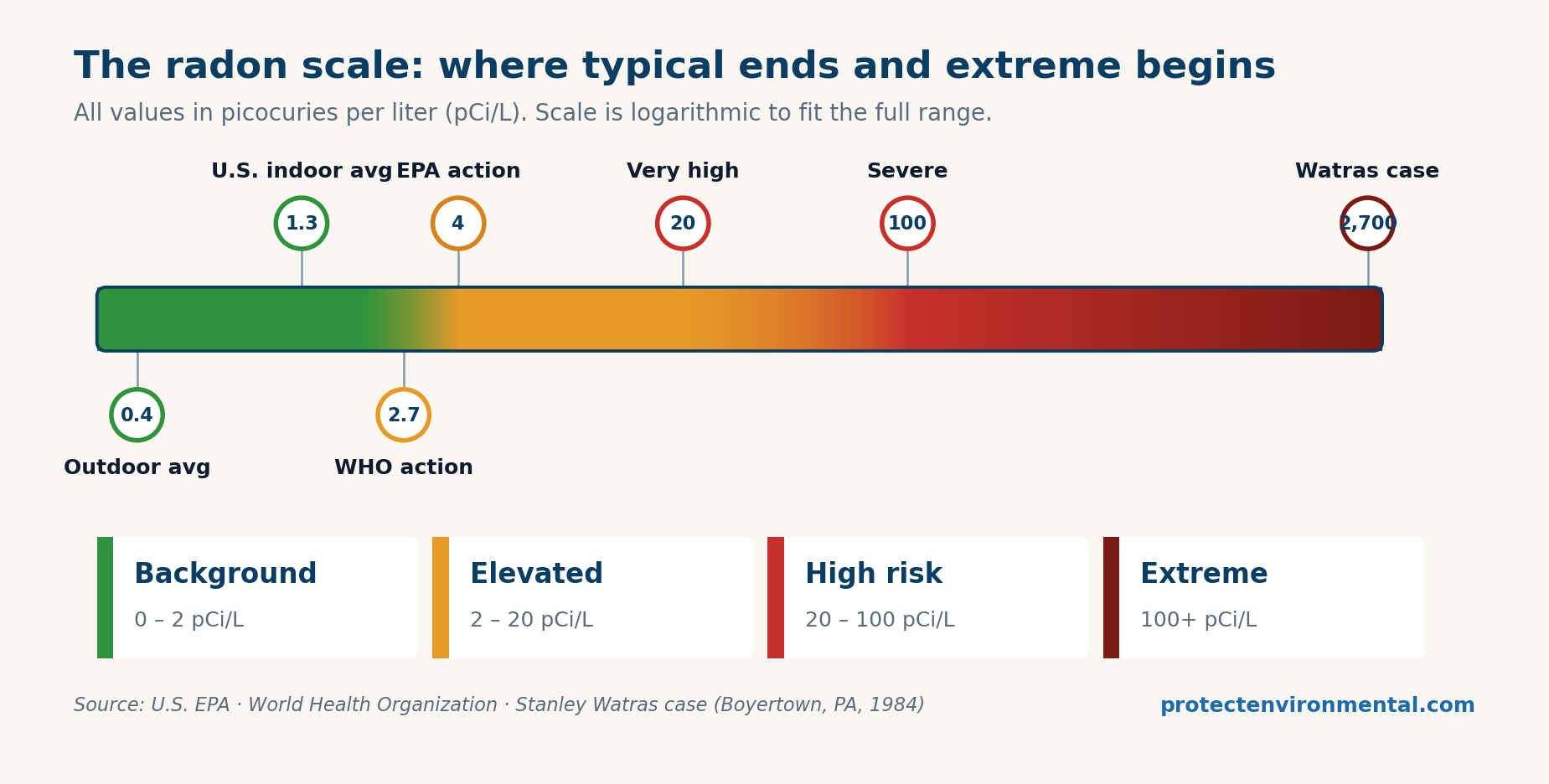
Radon Level Reference Chart
Here is how the major benchmarks line up:
| Benchmark | Concentration (pCi/L) | Concentration (Bq/m³) |
|---|---|---|
| Outdoor air, U.S. average | 0.4 | ~15 |
| Indoor air, U.S. average | 1.3 | ~48 |
| WHO reference level | 2.7 | 100 |
| EPA action level | 4.0 | 148 |
| Elevated | 4 to 20 | 148 to 740 |
| High | 20 to 100 | 740 to 3,700 |
| Very high | 100+ | 3,700+ |
| Highest recorded U.S. home | 2,700 | ~100,000 |
Sources: U.S. EPA, World Health Organization (2009 Handbook on Indoor Radon), Pennsylvania DEP.
The Highest Radon Level Ever Recorded
The story of how researchers learned how high radon could climb starts with one engineer. In December 1984, Stanley Watras was a construction worker at the Limerick Nuclear Power Plant in southeastern Pennsylvania. He kept setting off the radiation detectors on his way into the plant, before any radioactive material was on site. Investigators traced the contamination to his clothes, then to his home.
When the EPA tested the Watras home in Boyertown, they found radon at 2,700 pCi/L, roughly 675 times the EPA action level. The Watras family was living in the radiation equivalent of working a uranium mine. The home sat directly over the Reading Prong, a uranium-rich geological formation that runs through Pennsylvania, New Jersey, and New York.
The EPA turned the house into a temporary lab, used it to develop early mitigation techniques, and within two years had established the 4.0 pCi/L action level that the U.S. still uses today. The Watras case directly led to the 1988 Indoor Radon Abatement Act and the modern radon industry. To date, no higher reading has been confirmed in a residential U.S. home.
What Counts as a Dangerous Radon Level?
There is no level of radon that is officially “safe.” Both the EPA and the World Health Organization treat radon as a linear, no-threshold risk: every increase in exposure raises lung cancer risk somewhat. WHO estimates that lung cancer risk increases by about 16% for every 100 Bq/m³ (2.7 pCi/L) of long-term exposure.
That said, regulators give homeowners practical thresholds to act on:
- 4.0 pCi/L (148 Bq/m³): EPA action level. Mitigate.
- 2.7 pCi/L (100 Bq/m³): WHO reference level. Consider mitigation, especially if anyone in the home smokes.
- 2.0 to 3.9 pCi/L: EPA recommends "considering" mitigation. Many homeowners choose to.
- Below 2.0 pCi/L: Considered acceptable. Retest every two years.
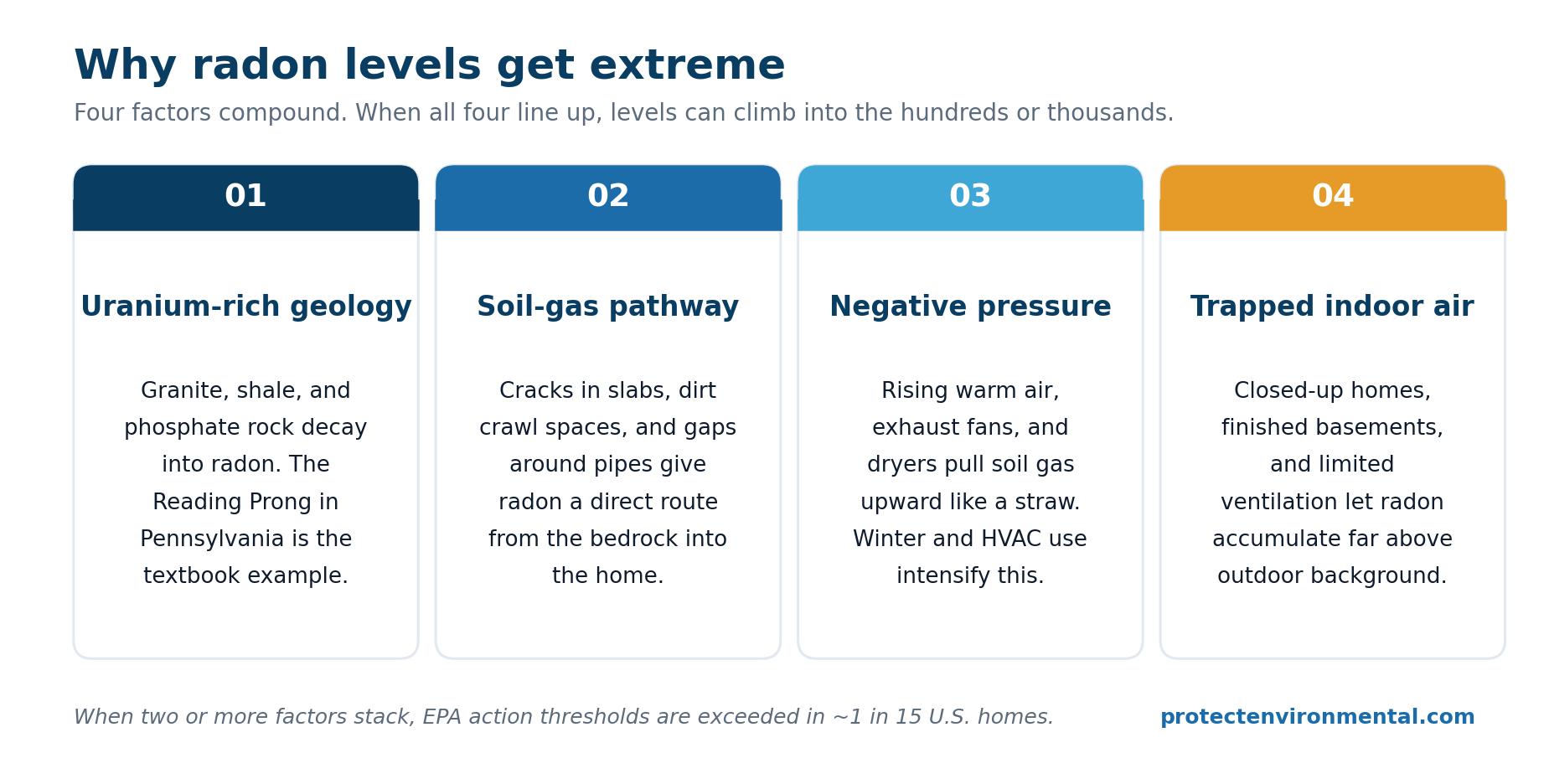
What Makes Radon Levels Climb So High?
Most homes that test above 50 pCi/L share a combination of the following factors. Understanding why some homes have far higher radon concentrations than others helps explain why testing is the only way to know your own number.
Local geology
Soils and bedrock rich in uranium release more radon. Granite, shale, glacial till, and the Reading Prong region of the Northeast all produce higher concentrations than sedimentary lowlands.
Foundation type and condition
Basements and slab-on-grade homes pull more radon than well-ventilated crawl spaces. Cracks in the foundation, gaps around plumbing penetrations, sump pits, and unsealed expansion joints all act as direct entry points.
Soil moisture, frost, and barometric pressure
Frozen ground caps the soil and forces radon sideways into nearby basements. Heavy rain and falling barometric pressure both push more radon indoors. That is why radon levels are typically highest in winter and why a single-season test can mislead.
Home tightness and HVAC
Newer, energy-efficient homes hold radon longer than drafty older homes. Modifications like finishing a basement, adding HVAC, or replacing windows can change radon airflow patterns and unexpectedly raise levels.
Well water
Private well water drilled into uranium-bearing bedrock can carry dissolved radon. The gas releases into indoor air during showers, dishwashing, and laundry. This is most common in granite-dominated regions of New England and the mid-Atlantic.
Where in the Home Are Radon Levels Highest?
Because radon enters from the ground, concentrations are almost always highest in the lowest occupied level of the home. In a typical two-story house with a basement, radon levels can be two to five times higher in the basement than on the second floor.
If you finish a basement, install bedrooms below grade, or spend significant time on the lowest level, the radon level there matters more than the level upstairs. Testing should always be done in the lowest lived-in area of the home.
How Do You Know If Your Home Has a High Reading?
There is no way to predict your home’s level without measuring it. Two neighboring homes can differ by an order of magnitude. Professional radon testing uses continuous radon monitors that record hourly data over 48 hours under closed-house conditions, which gives a more reliable result than a single charcoal canister.
Use this quick decision guide to interpret any test result:
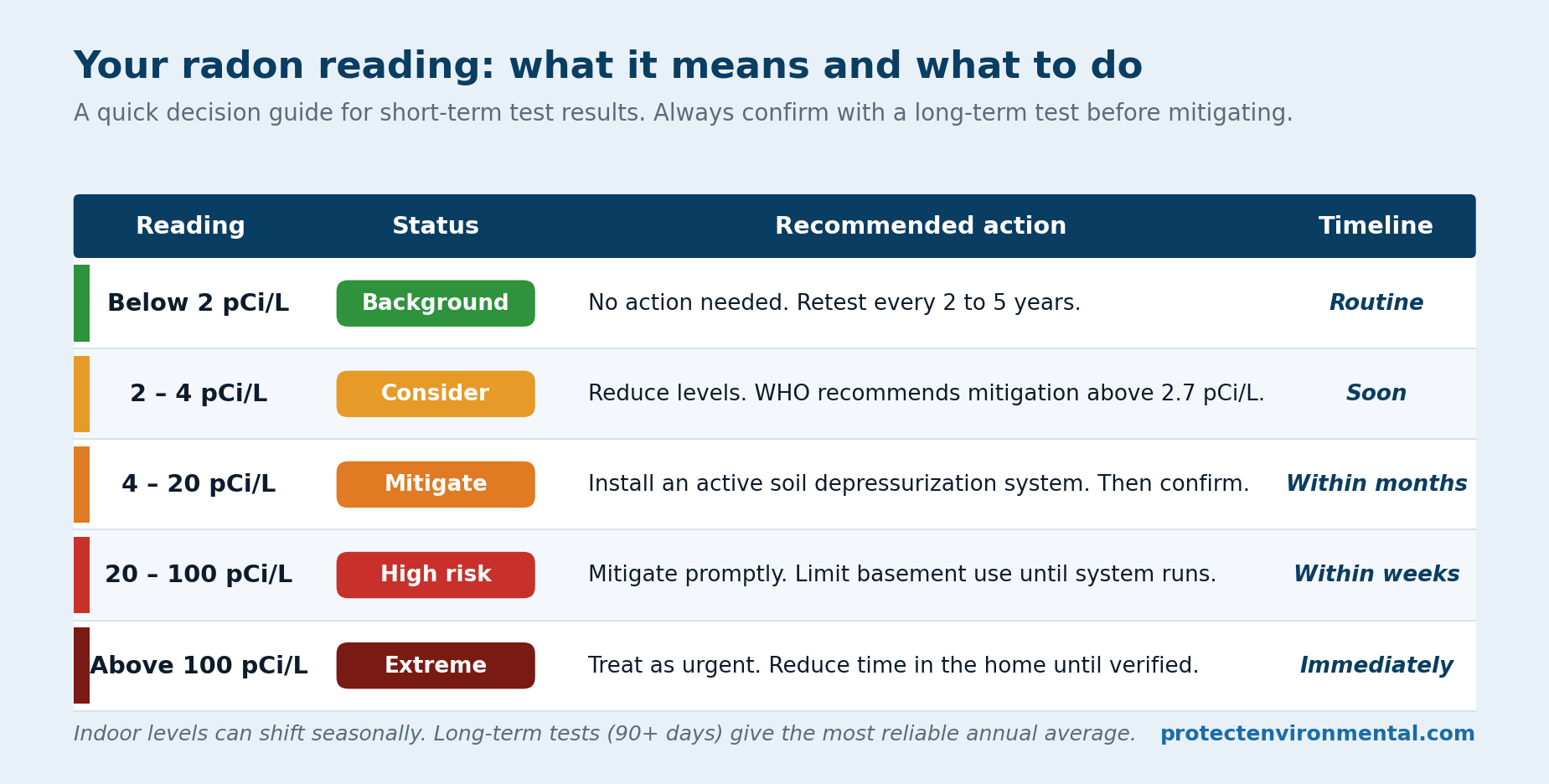
What to Do If Your Radon Level Is High
A high radon reading is not a reason to panic. Modern mitigation is well understood and effective. A properly designed system can reduce radon levels by 50 to 99%, and most installations are completed in a single day.
The standard approach is active soil depressurization: a sealed pipe drawn through the foundation slab and a quiet fan that vents radon-rich soil gas above the roofline before it can enter the home. A post-mitigation test confirms the reduction.
If a level of 10, 50, or 100+ pCi/L makes you wonder whether you should move out, the short answer is no, mitigation works even at extreme levels. The Watras family’s 2,700 pCi/L home was brought below 4.0 pCi/L and they moved back in.
Find out where your home stands.
Certified continuous radon monitors. NRPP-certified technicians. Clear next steps whether your reading is 1 pCi/L or 100.
Frequently Asked Questions
The highest documented residential radon level in the United States was 2,700 pCi/L, measured in 1984 at the Watras home in Boyertown, Pennsylvania. The reading led directly to the EPA’s 4.0 pCi/L action level and the modern radon industry.
Yes, 20 pCi/L is five times the EPA action level and warrants prompt mitigation. Long-term exposure at 20 pCi/L carries a lung cancer risk roughly equivalent to smoking half a pack of cigarettes a day.
Any reading above 4.0 pCi/L is considered too high by the EPA and should be mitigated. Many homeowners and the World Health Organization recommend acting at 2.7 pCi/L. There is no level that is officially safe, just levels that are lower risk.
Yes, though it is uncommon. Levels above 100 pCi/L have been documented in homes built on uranium-rich geology like the Reading Prong, in areas with strong soil gas pressure, or where structural cracks open a direct pathway from soil into the basement.
Radon concentrations can fluctuate significantly within a single day depending on weather, soil moisture, HVAC use, and how the home is sealed. Radon levels are usually highest in winter when homes are closed up. A continuous monitor captures these swings; a single short-term test may not.
There is no level of radon that is technically “safe.” Outdoor air sits around 0.4 pCi/L and represents background exposure. The EPA’s 4.0 pCi/L action level is the practical threshold for mitigation, but lower is always better.

