
The numbers in the 2026 Indoor Environments Association (AARST) Radon Report Card for Illinois are striking. Out of 108,909 pre-mitigation tests recorded statewide, 43% came back at or above 4 pCi/L, the level at which the EPA recommends taking action. Another 25% measured between 2 and 4 pCi/L, the range where the EPA suggests considering mitigation. That means roughly two-thirds of tested Illinois homes had radon at a level worth doing something about. If you own a home in Chicago or Cook County, those numbers should matter to you.
Quick Answer
In Illinois, 43% of tested homes have radon levels at or above the EPA action level of 4 pCi/L, according to the 2026 AARST Radon Report Card. Chicago homeowners face elevated risk due to the region’s soil composition and basement-heavy housing stock. Testing is the only way to know your home’s level, and mitigation reliably brings high readings down.
pre-mitigation
EPA action level
IL lung cancer cases / yr
radon-induced cancer
What the 2026 Illinois Radon Report Card Shows
Each year, the Indoor Environments Association (AARST) publishes a state-by-state Radon Report Card that compiles testing data, health outcomes, and policy benchmarks. The 2026 Illinois edition covers a population of 12.7 million across 5.4 million existing housing units, plus more than 20,000 new units built in the past year.
The radon distribution among tested Illinois homes:
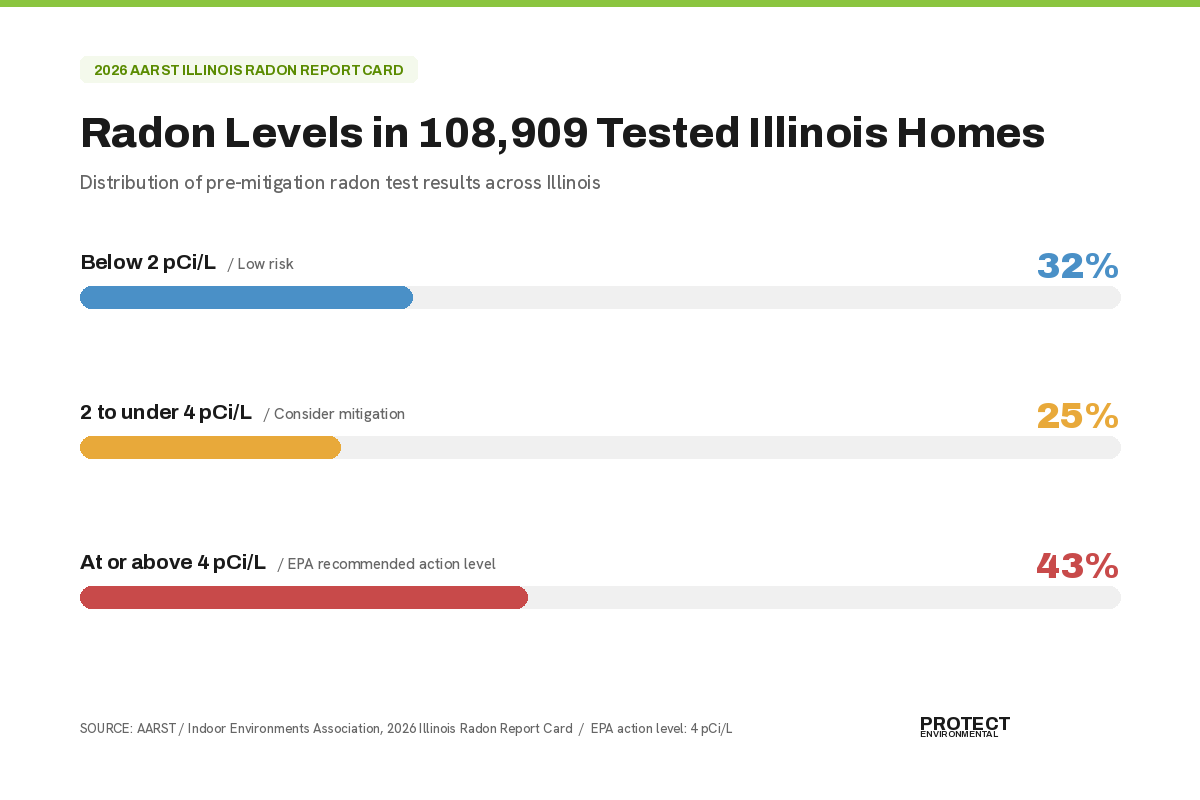
The health and economic costs the report attributes to radon are substantial. Illinois sees an estimated 1,476 radon-induced lung cancer cases per year, with annual medical costs near $297 million and an additional $311 million in lost wages and productivity. According to the American Lung Association, radon is the leading cause of lung cancer among non-smokers nationally.
What This Means for Chicago Homeowners
Chicago and the surrounding Cook County area sit in a region of the country known for elevated radon potential. Several factors make homes here especially prone to higher levels:
- Glacial soil composition. The soils across northern Illinois are relatively permeable, which lets radon move from underground up into homes more readily than in some other regions.
- Basement-heavy housing stock. Chicago’s older neighborhoods are full of finished and semi-finished basements that put living space at or below grade, where radon concentrations are typically highest.
- Older foundations. Homes built before modern radon awareness often have foundation cracks, sump pits, and utility penetrations that provide easy entry points.
- Newer infill construction. Even recent builds can test high if passive radon controls weren’t properly installed or if the home’s design overwhelms them.
One important note for Illinois: the state requires radon-resistant new construction in all counties for all residential builds, using a modified version of IRC Appendix F. That means homes built in recent years should have passive radon controls already in place, but those controls don’t always do the full job, and the only way to know is to test.
After 35+ years of installing systems across Chicagoland, I can tell you this: high radon is the rule here, not the exception. The good news is the fix is straightforward.
Illinois' Radon Laws You Should Know
Illinois has more rigorous radon regulations than most U.S. states. The 2026 Report Card confirms:
- State license required for radon professionals. Anyone testing or mitigating radon in Illinois must be licensed through the Illinois Emergency Management Agency (IEMA).
- Homebuyer protection through notification and disclosure. Sellers must disclose known radon information and any prior test results to prospective buyers.
- Radon system requirement for new residential construction in all counties, statewide.
- School testing recommended, with radon system requirements also recommended for new school construction.
For Chicago homebuyers, this means you should expect the seller to disclose any prior radon test results, and you have every right to test independently as part of your due diligence. For sellers, knowing your radon levels in advance (and addressing them if needed) makes the transaction smoother.
What to Do If You Live in Chicago or Cook County
Radon is one of the few environmental risks at home that has a clear, affordable fix. Two steps.
1. Test your home.
Short-term DIY test kits (3 to 7 days, around $20 to $30) are widely available and give you a fast snapshot. Long-term tests (90+ days) provide a more accurate picture of year-round levels. Continuous radon monitors give ongoing real-time readings. If you’re buying or selling, Illinois law requires testing by a licensed professional.
2. Mitigate if your level is at or above 4 pCi/L (and consider it at 2 to 4 pCi/L).
A radon mitigation system, typically an active soil depressurization (ASD)system, pulls radon from beneath your foundation through a sealed pipe and vents it safely above the roofline. Most installations take less than a day, and a properly designed system reliably brings indoor radon well below the EPA action level. Our Chicago radon and vapor intrusion teamhas installed more than 20,000 systems across Chicagoland since 1986, originally as E&A Environmental Consultants and now as part of Protect Environmental’s Illinois operations.
If a level of 10, 50, or 100+ pCi/L makes you wonder whether you should move out, the short answer is no, mitigation works even at extreme levels. The Watras family’s 2,700 pCi/L home was brought below 4.0 pCi/L and they moved back in.
Frequently Asked Questions
A short-term test runs 2 to 7 days and is the fastest option. A long-term test runs 90+ days and gives a more accurate picture of year-round levels. Continuous radon monitors provide real-time readings and can run indefinitely.
Yes. Illinois requires sellers to provide a Disclosure of Radon Hazards form to prospective buyers, including any known radon test results and any mitigation work that has been done.
Tom Krone
Manager of Operations, Chicago / IEMA-Licensed Radon Professional
Tom leads Protect Environmental’s Chicago operations from the company’s Bolingbrook office. With more than 35 years in the radon industry, Tom has overseen the installation of more than 20,000 radon mitigation systems across the Greater Chicago area, originally with E&A Environmental Consultants, founded in 1986 and now part of Protect Environmental.
View Full Profile →Worried About Radon in Your Chicago Home?
Tom and the Chicago team have installed more than 20,000 radon systems across Chicagoland. Get a free, no-pressure estimate and find out exactly what your home needs.
Get a Free Chicago Radon Estimate
