
Quick Answer
Indoor environmental health is the quality of the air you breathe and the water you drink inside your home. This Earth Day, the most meaningful action homeowners can take is testing for radon in indoor air and contaminants in household water, the two most common invisible threats to a safe, healthy home.
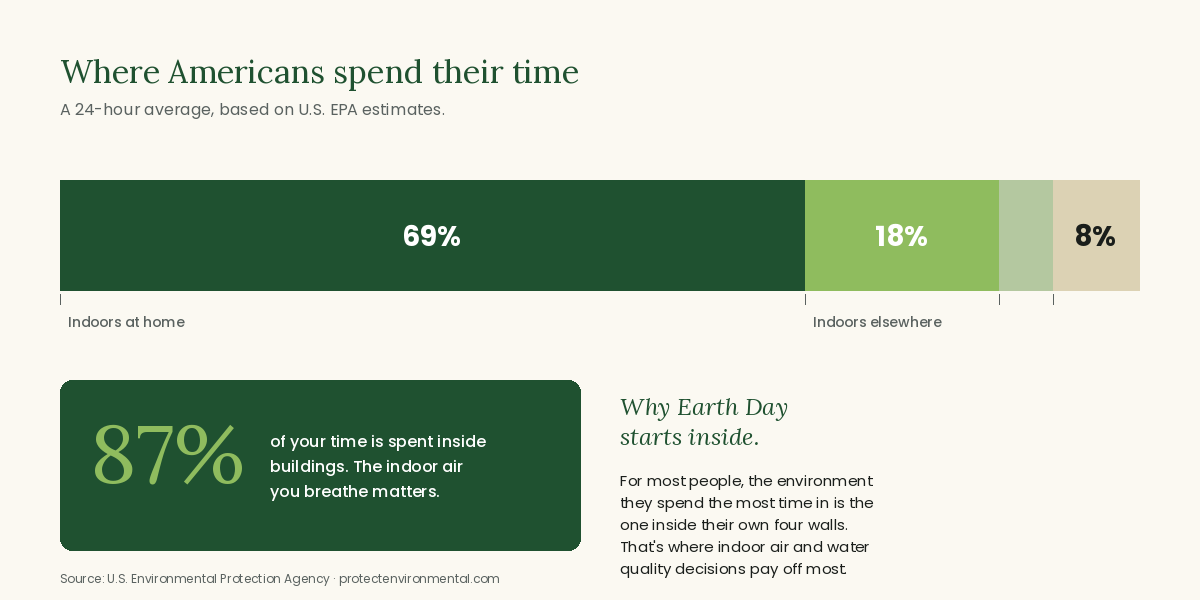
- Americans spend roughly 90% of their time indoors (U.S. EPA)
- Radon causes an estimated 21,000 lung cancer deaths per year in the U.S. (EPA)
- The EPA action level for indoor radon is 4.0 pCi/L
- More than 43 million Americans rely on private wells for drinking water (CDC)
- Protect Environmental has completed 200,000+ soil gas projects across all 50 U.S. states
Why Does Earth Day Belong Inside Your Home?
Earth Day usually brings to mind forests, oceans, and carbon emissions. All of that matters. But for most people, the environment they spend the most time in is the one inside their own four walls. The U.S. EPA estimates that Americans spend roughly 90% of their time indoors, which means the air you breathe at home has a far bigger day-to-day impact on your health than the air outside.
That reframes Earth Day in a useful way. Protecting the planet is a long project. Protecting the environment inside your home is something you can do this week, and the results are measurable.
At Protect Environmental, we see this every day. Families learn that their house has elevated radon months after moving in. Homeowners with private wells discover levels of arsenic, uranium, or bacteria they had no idea were there. Most of these issues never show up without a test, because you cannot see, smell, or taste them. Earth Day is a good reminder to look.
What Is Indoor Environmental Health?
Indoor environmental health is the quality of the air, water, and surfaces inside buildings and how they affect the people living and working there. It covers everything from dust and mold to radon gas, volatile organic compounds, and contaminants in tap or well water.
For homeowners, two specific threats stand out. They are the most common, the most dangerous, and the most invisible:
- Radon in indoor air
- Contaminants in drinking and bathing water
Both are routine. Both are fixable. And both are usually overlooked until someone decides to test.
Why Is Radon the Invisible Earth Day Story Most People Miss?
Radon is a naturally occurring radioactive gas that forms as uranium breaks down in soil. It seeps into homes through foundation cracks, sump pits, crawl spaces, and well water. According to the U.S. Environmental Protection Agency, radon is the second leading cause of lung cancer in the United States and the leading cause among non-smokers. It is linked to an estimated 21,000 lung cancer deaths every year.
The tricky part is that radon cannot be detected by your senses. It has no color, no odor, and no taste. A family can live in a home with levels many times above the EPA action level of 4.0 pCi/L and never know.
The good news: testing is straightforward, and mitigation works. A properly designed radon mitigation system can reduce levels by 99% or more. If you have never tested your home, or if your last test was more than two years ago, Earth Day is a natural prompt to schedule one. See our overview of what radon is and the different types of radon tests to pick the right option for your household. If you already have a system, learn more about radon mitigation for the home and when re-testing is recommended.
Is Water Quality Part of Indoor Environmental Health?
Yes. Water is the second pillar of indoor environmental health. More than 43 million Americans rely on private wells for their drinking water, according to the CDC, and private wells are not regulated by the EPA the way public systems are. That means the person responsible for testing is the homeowner.
Common contaminants vary by geography:
- Arsenic and uranium in parts of New England and the Mountain West
- Nitrates in agricultural regions
- Radon in water in areas with high soil radon
- Lead from older plumbing, regardless of source
- Bacteria like E. coli after flooding or well damage
Many of these contaminants have no taste and no smell. Like radon, the only way to know is to test. A certified lab test gives you a baseline, and if anything is elevated, targeted treatment (reverse osmosis, carbon filtration, UV, arsenic-specific media, and others) can bring levels back to safe ranges.
What Can Homeowners Do This Earth Day?
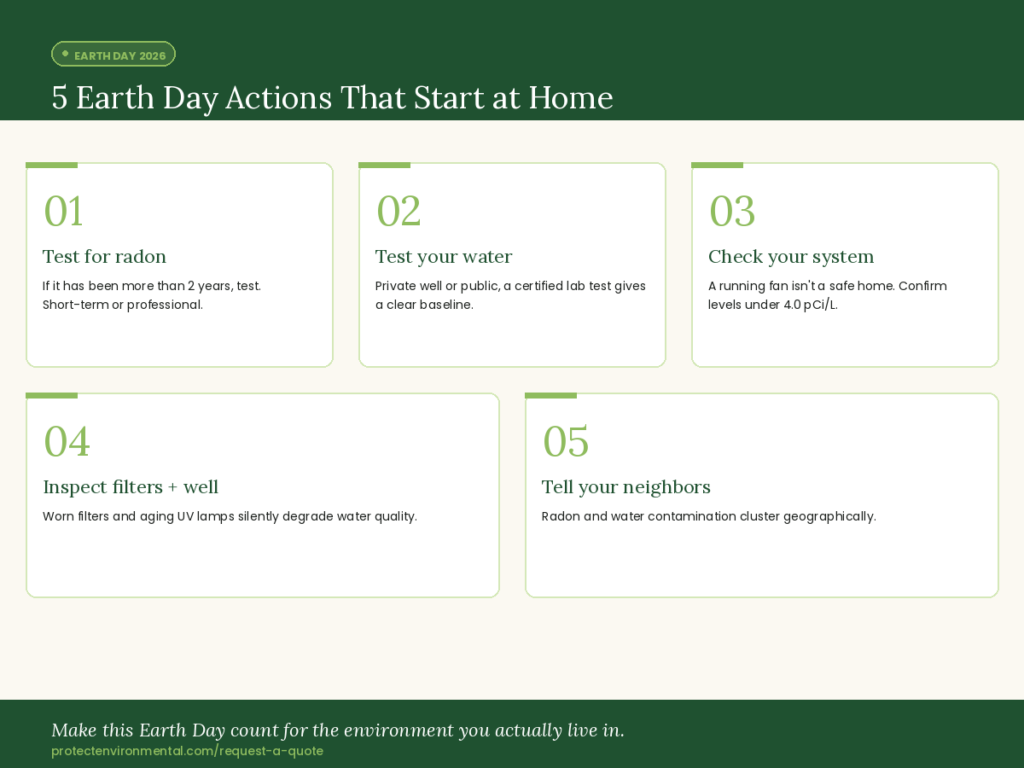
Every year, Earth Day produces a lot of generic advice. Here is a practical list focused on the environment you can actually control: the one inside your home.
How Does Protect Environmental Support Healthy Homes?
Protect Environmental is a national environmental services company focused on healthy, safe indoor environments. Since our founding in 2005, our teams have completed more than 200,000 soil gas projects across all 50 U.S. states and two U.S. territories, making us the largest soil gas contractor in the country.
That scale matters for three reasons:
- Certified laboratories. Our in-house labs handle radon analysis and water quality panels with consistent quality control, not outsourced processing.
- Uniform standards. Every technician is certified through the National Radon Proficiency Program or equivalent state licensing, following the same national protocols wherever you live.
- Comprehensive services. Radon testing, radon mitigation, vapor intrusion mitigation, indoor air quality assessments, and water testing and treatment, all from one team.
Our work is led by Kyle Hoylman, Executive Chairman and co-founder. Kyle is a cancer survivor, chair of the Kentucky Board of Radon Safety, and a member of the EPA Radon Leadership Committee. His personal story drives our national mission: reduce radon exposure in the homes, schools, and workplaces where people spend 90% of their lives.
If you are ready to protect the environment inside your home, request a professional radon test or water quality assessment. Our technicians serve homeowners in every U.S. state with the same certified standards, in-house lab analysis, and long-term service commitment.
Make this Earth Day count for the environment you live in.
Schedule a professional radon test or water quality assessment. Certified technicians and in-house labs, serving homeowners nationwide.
Request a Quote →
