

Quick Answer
Radon is common across Colorado, where about half of homes test above the EPA action level of 4.0 pCi/L. The Front Range, including Denver, sits on uranium-rich soil that releases radon into homes. Because levels vary house to house, the only way to know yours is to test, then mitigate if it is high.
If you own a home in Denver or anywhere along the Front Range, radon is one health risk worth taking seriously, and one of the easiest to deal with. Colorado consistently ranks among the highest-radon states in the country. The good news is that radon is measurable and fixable, and Colorado offers more homeowner support than most states. This guide covers why the state tests so high, what the numbers actually mean, the local rules you should know, and how to test and fix a Denver home.
Why is radon so common in Colorado?
Radon forms naturally as uranium in the soil breaks down. According to the Colorado Department of Public Health and Environment, radon in Colorado moves from uranium-bearing granite deposits in the soil up into the air, and elevated levels have been found in every part of the state. A few things make the Front Range especially prone to it:
- Uranium-rich geology. The granite and rocky soils common across Colorado contain more uranium than the national average, so more radon is produced underfoot.
- Basements and tight homes. Many Denver-area homes have basements and finished lower levels, the part of a house where radon collects, and modern, well-sealed construction holds it in.
- Climate and heating. Long heating seasons keep homes closed up, and the pressure difference between a warm house and cold soil pulls radon indoors.
If you want to learn the basics first, our What is Radon guide is a good companion to this page.
How high is radon in Colorado, really?
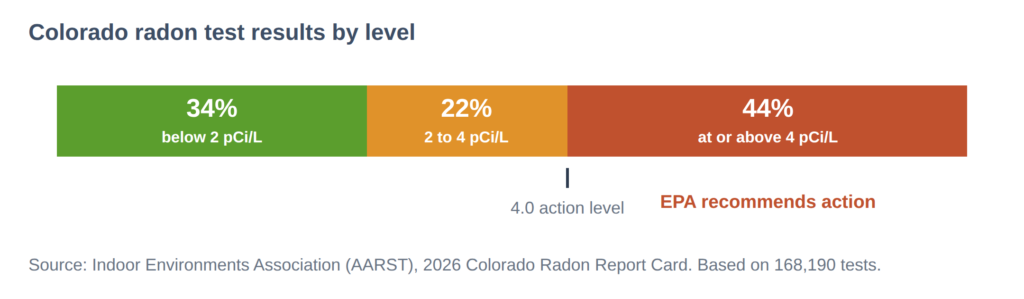
The numbers are striking. In the 2026 Radon Report Card from the Indoor Environments Association (AARST), based on more than 168,000 Colorado tests, 44 percent of results came in at or above the 4.0 pCi/L action level, and another 22 percent fell in the elevated 2 to 4 range. CDPHE puts it simply: about half of Colorado homes test above the level where the EPA recommends action.
That exposure has real consequences. CDPHE attributes roughly 500 lung cancer deaths a year in Colorado to radon, which is the second leading cause of lung cancer after smoking. None of this is cause for alarm, but it is a strong reason to find out where your own home stands.
What this means for Denver homeowners
Radon does not follow city limits or neighborhood lines. Two houses on the same Denver block can test very differently depending on soil, foundation, and construction. That is why CDPHE encourages every homeowner to test regardless of a neighbor’s results. Whether you are in central Denver, Aurora, Lakewood, Boulder, Fort Collins, or Colorado Springs, the guidance is the same: do not assume, measure. You can check average radon levels for your zip code to understand local risk, then test your own home to get your real number.
Colorado radon rules every homeowner should know
Colorado has more radon structure in place than many states, which works in your favor:
- Real estate disclosure is required. Colorado requires a radon brochure and disclosure in home sales and rental agreements, so radon usually comes up during a transaction. See CDPHE’s radon and real estate resources.
- Professionals must be certified and licensed. Colorado requires radon measurement and mitigation pros to be certified through the NRPP or NRSB and licensed by the Colorado Department of Regulatory Agencies (DORA). It is fair to ask any contractor for both.
- Schools are tested. Colorado requires radon testing in public schools, part of a broader push to take indoor air seriously statewide.
- Help is available. CDPHE offers free radon test kits and a Low Income Radon Mitigation Assistance program for qualifying homeowners.
How to test your Colorado home
Testing is simple, inexpensive, and the only way to know your level. Radon is measured in picocuries per liter (pCi/L), and the U.S. EPA recommends acting at 4.0 or higher.

You have a few options. Colorado homeowners can request a free test kit through CDPHE, use a short-term kit for a quick snapshot, or have a professional run a documented test, which is the standard during a home sale. The EPA recommends re-testing every two years either way.
What if your radon level is high? Mitigation in Denver and Colorado
An elevated result is not an emergency, and it is very fixable. Radon mitigation, the process of lowering radon, most often uses active soil depressurization: a fan and a sealed pipe draw radon from beneath the foundation and vent it safely above the roofline. A well-designed mitigation system can bring even a high Colorado reading down below the action level and keep it there.
On cost, CDPHE reports that a typical mitigation system for an existing single-family Colorado home runs roughly 1,300 to 3,000 dollars, with passive systems costing much less to activate, and the state’s Low Income Radon Mitigation Assistance program can help qualifying homeowners. Most systems install in about a day, followed by a verification test. Protect Environmental’s Denver radon team is NRPP certified and Colorado licensed, and serves the metro area and the wider Front Range. Once a system is in, a little ongoing maintenance keeps it working for years.
Frequently asked questions
Yes. Colorado is one of the highest-radon states in the country. About half of homes test above the EPA action level of 4.0 pCi/L, and the Indoor Environments Association found 44 percent of Colorado tests at or above that level. Radon is found in every part of the state, so testing is recommended for every home.
Denver and the Front Range sit on uranium-rich soil that produces radon, and many homes test elevated. Levels vary significantly from house to house, even on the same block, so a neighbor’s result does not predict yours. The only way to know your Denver home’s level is to test it.
Yes. Colorado requires a radon brochure and disclosure as part of real estate transactions and rental agreements. Radon testing is a common step in Colorado home sales, and buyers often request a test or mitigation as a condition of purchase.
According to CDPHE, a typical mitigation system for an existing single-family Colorado home runs roughly 1,300 to 3,000 dollars, and activating a passive system with a fan costs much less. Costs vary by home size and design, so it is worth getting more than one bid. Colorado also offers a low-income assistance program.
Find out where your Colorado home stands
A certified, Colorado-licensed local team can test your Denver or Front Range home and, if your level is high, design the system to bring it down.
Request My Free Quote Find My Denver Team
