Categories
Blog

How High Can Radon Levels Get? Limits & Risks Explained

Radon is invisible and odorless, which makes the question deceptively practical: how high can radon levels actually get? The honest answer is, much higher than most homeowners realize. EPA estimates radon causes about 21,000 lung cancer deaths every year in the United States, and individual homes have tested anywhere from background outdoor levels (around 0.4 pCi/L) to thousands of times higher.


This guide walks through real-world ranges, the highest recorded reading on the books, what level is considered dangerous, and how to know where your own home sits. If you have not yet tested, you can look up the average radon level by zip code to get a sense of local risk before scheduling a test.

Quick Answer

Indoor radon levels can range from less than 1 pCi/L to over 2,700 pCi/L in the most extreme case ever recorded. The highest indoor radon reading ever documented in a U.S. home was 2,700 picocuries per liter (pCi/L), measured in 1984 at the Watras home in Pennsylvania. The EPA recommends action at 4.0 pCi/L.

The Short Answer: How High Can Radon Levels Get?

Indoor radon concentration is measured in picocuries per liter (pCi/L) in the United States and Becquerels per cubic meter (Bq/m³) internationally. One pCi/L equals about 37 Bq/m³.

In normal homes, levels typically fall between 0.4 and 4.0 pCi/L. In homes with elevated radon, readings of 10 to 50 pCi/L are not unusual. Levels above 100 pCi/L are rare but well documented. The all-time record in a U.S. home is 2,700 pCi/L, measured in the Watras home in Pennsylvania in 1984, the case that launched modern radon awareness.

There is no theoretical ceiling. Radon levels are driven by uranium concentrations in the soil and rock under the home, the home’s foundation type, weather conditions, and how tightly the home is sealed. Two homes on the same street can read very differently.

Radon Level Reference Chart

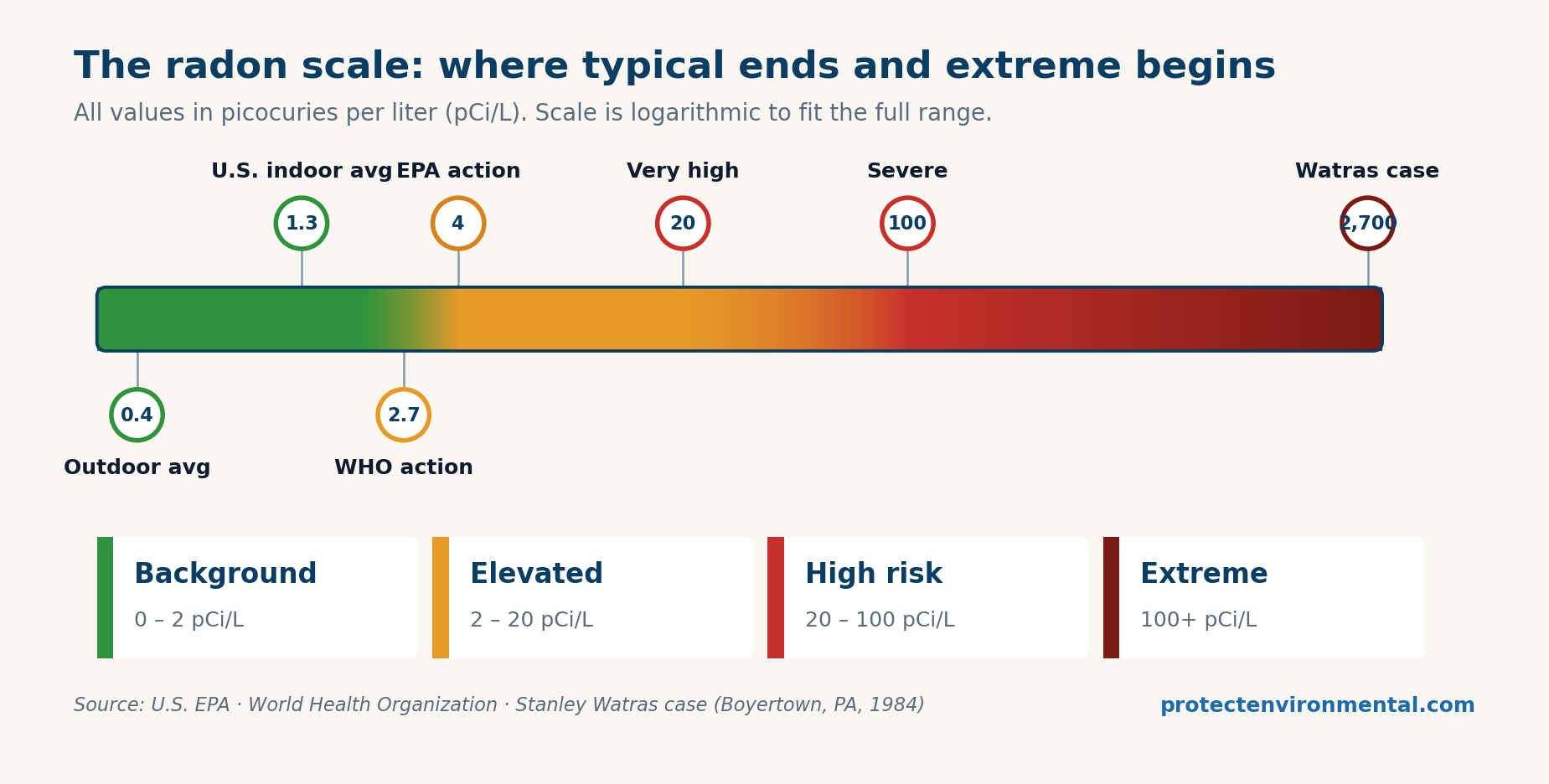
Here is how the major benchmarks line up:

Benchmark Concentration (pCi/L) Concentration (Bq/m³)
Outdoor air, U.S. average0.4~15
Indoor air, U.S. average1.3~48
WHO reference level2.7100
EPA action level4.0148
Elevated4 to 20148 to 740
High20 to 100740 to 3,700
Very high100+3,700+
Highest recorded U.S. home2,700~100,000

Sources: U.S. EPA, World Health Organization (2009 Handbook on Indoor Radon), Pennsylvania DEP.

The Highest Radon Level Ever Recorded

The story of how researchers learned how high radon could climb starts with one engineer. In December 1984, Stanley Watras was a construction worker at the Limerick Nuclear Power Plant in southeastern Pennsylvania. He kept setting off the radiation detectors on his way into the plant, before any radioactive material was on site. Investigators traced the contamination to his clothes, then to his home.

When the EPA tested the Watras home in Boyertown, they found radon at 2,700 pCi/L, roughly 675 times the EPA action level. The Watras family was living in the radiation equivalent of working a uranium mine. The home sat directly over the Reading Prong, a uranium-rich geological formation that runs through Pennsylvania, New Jersey, and New York.

The EPA turned the house into a temporary lab, used it to develop early mitigation techniques, and within two years had established the 4.0 pCi/L action level that the U.S. still uses today. The Watras case directly led to the 1988 Indoor Radon Abatement Act and the modern radon industry. To date, no higher reading has been confirmed in a residential U.S. home.

What Counts as a Dangerous Radon Level?

There is no level of radon that is officially “safe.” Both the EPA and the World Health Organization treat radon as a linear, no-threshold risk: every increase in exposure raises lung cancer risk somewhat. WHO estimates that lung cancer risk increases by about 16% for every 100 Bq/m³ (2.7 pCi/L) of long-term exposure.

That said, regulators give homeowners practical thresholds to act on:

What Makes Radon Levels Climb So High?

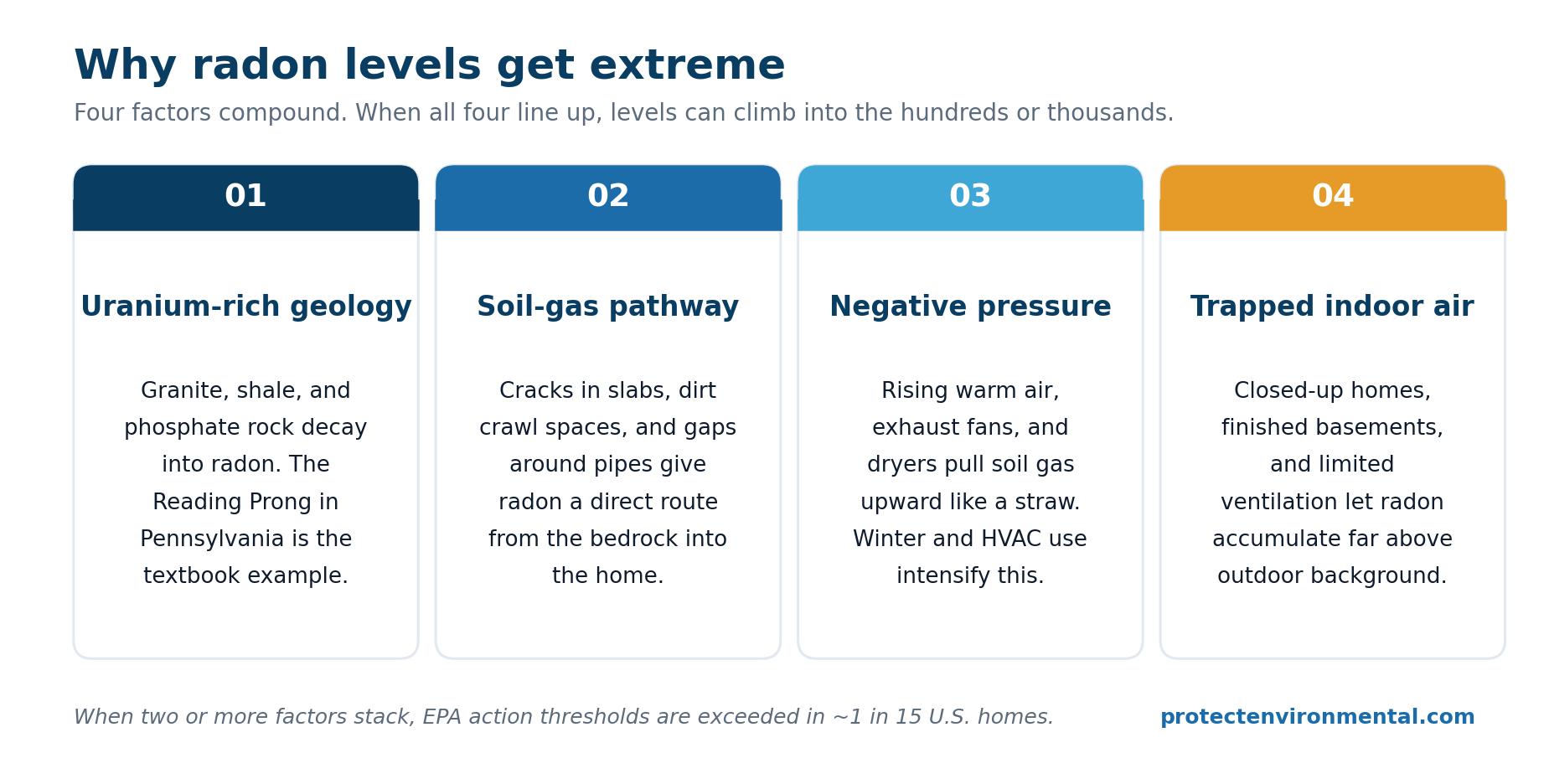
Most homes that test above 50 pCi/L share a combination of the following factors. Understanding why some homes have far higher radon concentrations than others helps explain why testing is the only way to know your own number.

Local geology

Soils and bedrock rich in uranium release more radon. Granite, shale, glacial till, and the Reading Prong region of the Northeast all produce higher concentrations than sedimentary lowlands.

Foundation type and condition


Basements and slab-on-grade homes pull more radon than well-ventilated crawl spaces. Cracks in the foundation, gaps around plumbing penetrations, sump pits, and unsealed expansion joints all act as direct entry points.

Soil moisture, frost, and barometric pressure


Frozen ground caps the soil and forces radon sideways into nearby basements. Heavy rain and falling barometric pressure both push more radon indoors. That is why radon levels are typically highest in winter and why a single-season test can mislead.

Home tightness and HVAC


Newer, energy-efficient homes hold radon longer than drafty older homes. Modifications like finishing a basement, adding HVAC, or replacing windows can change radon airflow patterns and unexpectedly raise levels.

Well water


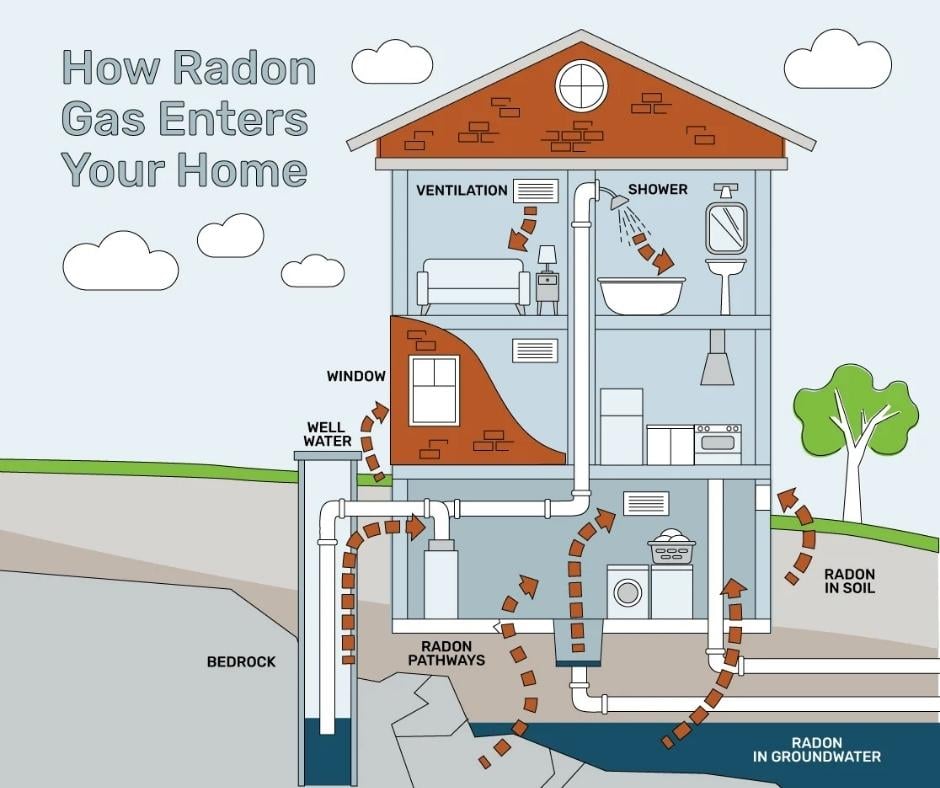
Private well water drilled into uranium-bearing bedrock can carry dissolved radon. The gas releases into indoor air during showers, dishwashing, and laundry. This is most common in granite-dominated regions of New England and the mid-Atlantic.

Where in the Home Are Radon Levels Highest?

Because radon enters from the ground, concentrations are almost always highest in the lowest occupied level of the home. In a typical two-story house with a basement, radon levels can be two to five times higher in the basement than on the second floor.

If you finish a basement, install bedrooms below grade, or spend significant time on the lowest level, the radon level there matters more than the level upstairs. Testing should always be done in the lowest lived-in area of the home.

How Do You Know If Your Home Has a High Reading?

There is no way to predict your home’s level without measuring it. Two neighboring homes can differ by an order of magnitude. Professional radon testing uses continuous radon monitors that record hourly data over 48 hours under closed-house conditions, which gives a more reliable result than a single charcoal canister.

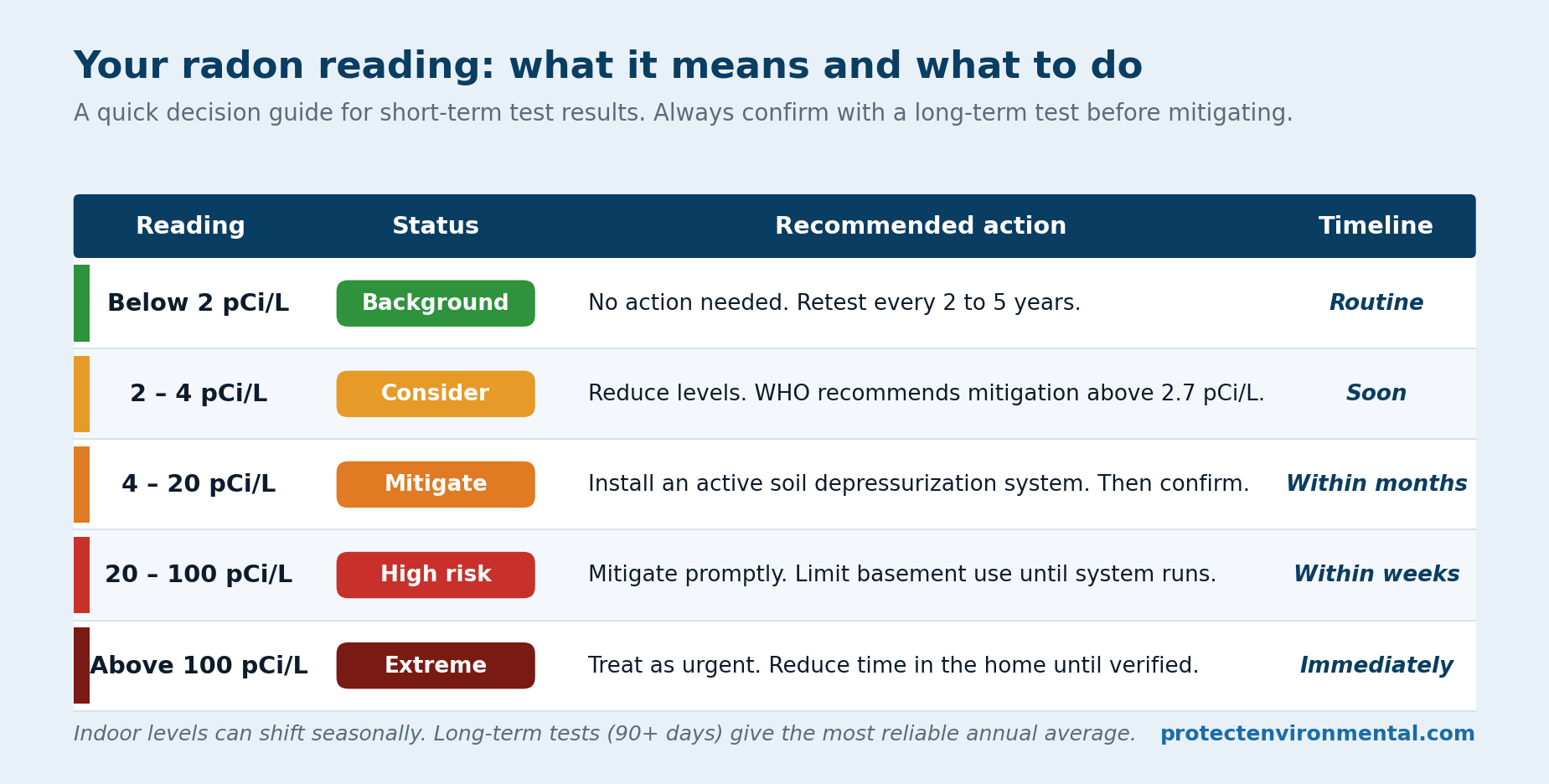
Use this quick decision guide to interpret any test result:

What to Do If Your Radon Level Is High

A high radon reading is not a reason to panic. Modern mitigation is well understood and effective. A properly designed system can reduce radon levels by 50 to 99%, and most installations are completed in a single day.

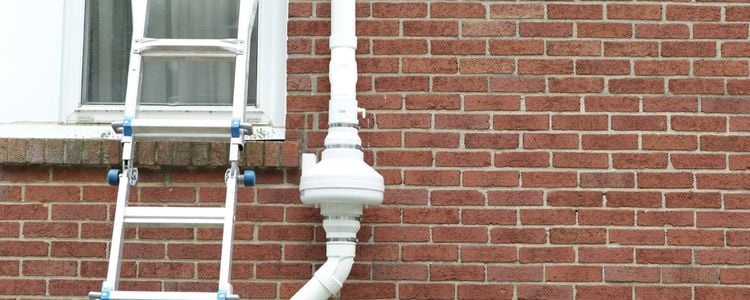
The standard approach is active soil depressurization: a sealed pipe drawn through the foundation slab and a quiet fan that vents radon-rich soil gas above the roofline before it can enter the home. A post-mitigation test confirms the reduction.

If a level of 10, 50, or 100+ pCi/L makes you wonder whether you should move out, the short answer is no, mitigation works even at extreme levels. The Watras family’s 2,700 pCi/L home was brought below 4.0 pCi/L and they moved back in.

Find out where your home stands.

Certified continuous radon monitors. NRPP-certified technicians. Clear next steps whether your reading is 1 pCi/L or 100.

Frequently Asked Questions

The highest documented residential radon level in the United States was 2,700 pCi/L, measured in 1984 at the Watras home in Boyertown, Pennsylvania. The reading led directly to the EPA’s 4.0 pCi/L action level and the modern radon industry.

Yes, 20 pCi/L is five times the EPA action level and warrants prompt mitigation. Long-term exposure at 20 pCi/L carries a lung cancer risk roughly equivalent to smoking half a pack of cigarettes a day.

Any reading above 4.0 pCi/L is considered too high by the EPA and should be mitigated. Many homeowners and the World Health Organization recommend acting at 2.7 pCi/L. There is no level that is officially safe, just levels that are lower risk.

Yes, though it is uncommon. Levels above 100 pCi/L have been documented in homes built on uranium-rich geology like the Reading Prong, in areas with strong soil gas pressure, or where structural cracks open a direct pathway from soil into the basement.

Radon concentrations can fluctuate significantly within a single day depending on weather, soil moisture, HVAC use, and how the home is sealed. Radon levels are usually highest in winter when homes are closed up. A continuous monitor captures these swings; a single short-term test may not.

There is no level of radon that is technically “safe.” Outdoor air sits around 0.4 pCi/L and represents background exposure. The EPA’s 4.0 pCi/L action level is the practical threshold for mitigation, but lower is always better.

Categories
Blog

Indoor Air Pollution: Why the Air Inside Is the Bigger | Detroit

Is indoor air worse than outdoor air?

When Detroit makes the news for its air, people pay attention. The Detroit, Warren and Ann Arbor region was ranked the sixth worst in the country for year round particle pollution in the American Lung Association’s 2025 State of the Airreport, as covered by Axios. Nearly half of all Americans now breathe air that earns a failing grade for ozone or particle pollution.


That headline is worth taking seriously. But it points at the sky, when the more immediate risk is usually under your own roof. Here is what the outdoor numbers miss.

This guide walks through real-world ranges, the highest recorded reading on the books, what level is considered dangerous, and how to know where your own home sits. If you have not yet tested, you can look up the average radon level by zip code to get a sense of local risk before scheduling a test.

Quick Answer

Outdoor air pollution is real, but the U.S. EPA reports that indoor air is often 2 to 5 times more polluted than the air outside. For most homes, the largest indoor air risk is radon, an invisible radioactive gas and the leading cause of lung cancer among people who never smoked. A short test is the only way to know your level.

Why radon is the indoor air risk most people miss

Smog and wildfire smoke are visible, which is part of why they make headlines. Radon does the opposite. It is a colorless, odorless radioactive gas that rises out of the soil and seeps into homes through cracks in the foundation, gaps around pipes, sump pits and crawl spaces. You cannot see it, smell it or taste it. Here is a closer look at what radon is.

It is also the part nobody puts on the evening news: radon is the leading cause of lung cancer among non smokers and is linked to about 21,000 lung cancer deaths in the United States every year, according to the EPA. The agency sets the action level at 4.0 pCi/L, the point at which a home should be fixed. The catch is that there are no early symptoms to warn you. The risk builds quietly, over years.

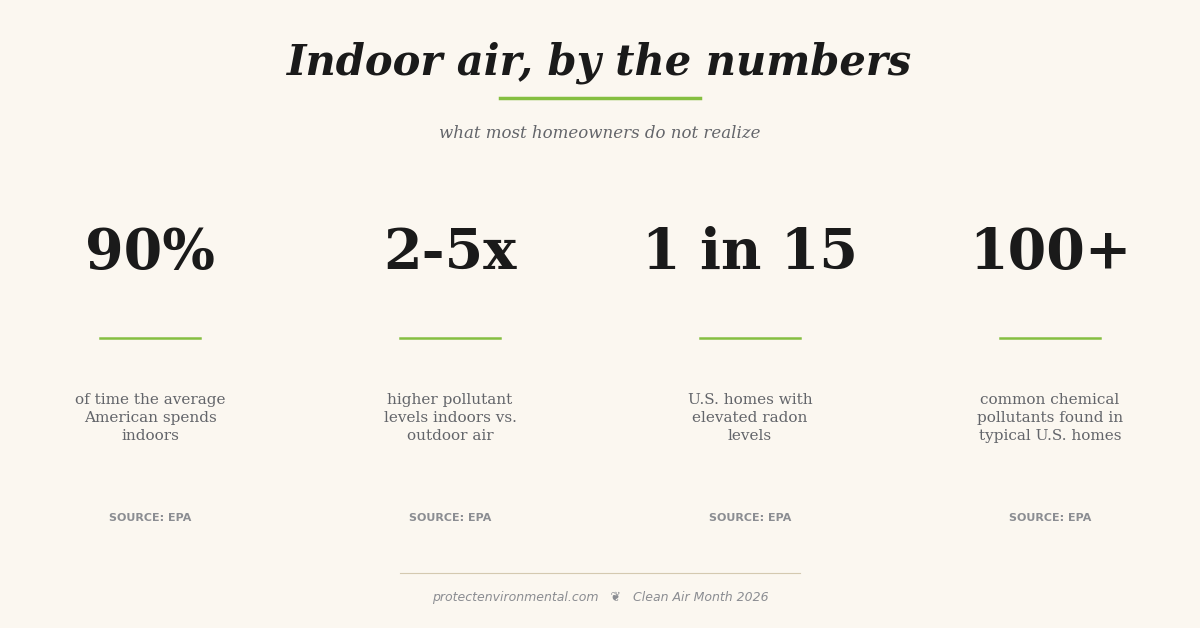
Often, yes. The U.S. EPA estimates that the air inside a typical home is two to five times more polluted than the air outside, and in some cases more than 100 times. Indoor air pollution sits among the agency’s top five environmental health risks. The reason is simple: we spend about 90 percent of our lives indoors, and modern, well sealed homes trap pollutants instead of letting them escape. So while a bad air day outside lasts a few hours, the air you breathe at home works on your lungs every day of the year.

What Detroit’s pollution ranking really means for your home

A regional pollution ranking is a useful prompt, not a personal result. The air outside is shared. The air inside your home is yours alone, and it depends on your soil, your foundation and how your house breathes.

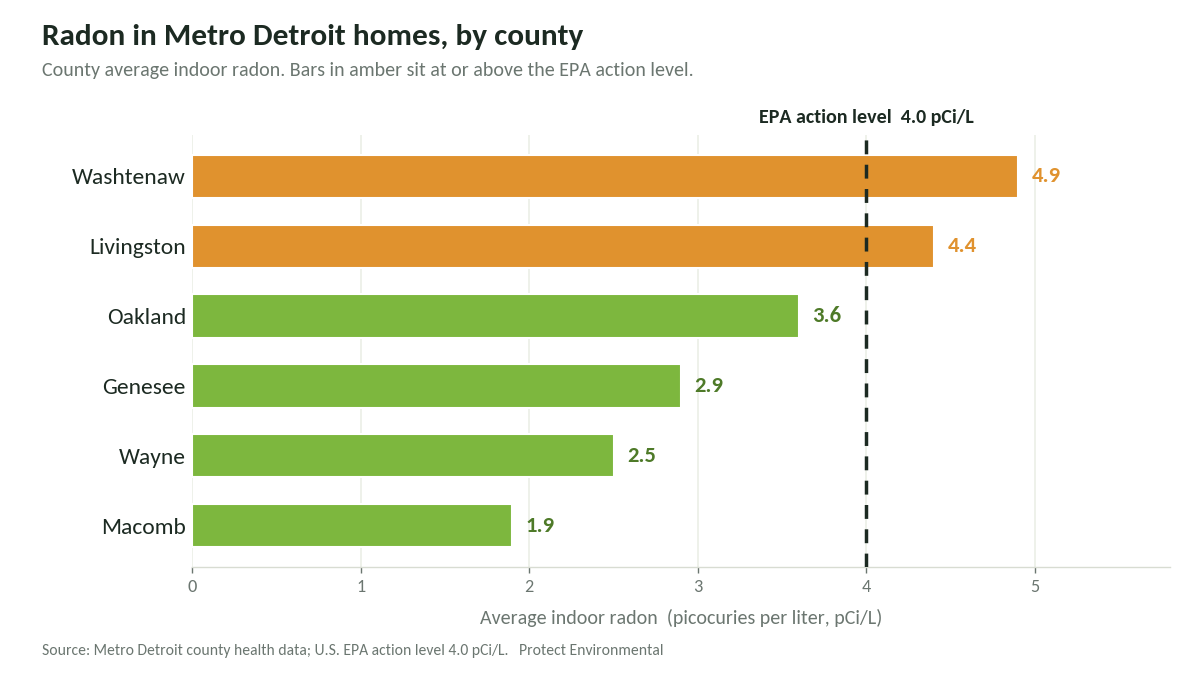
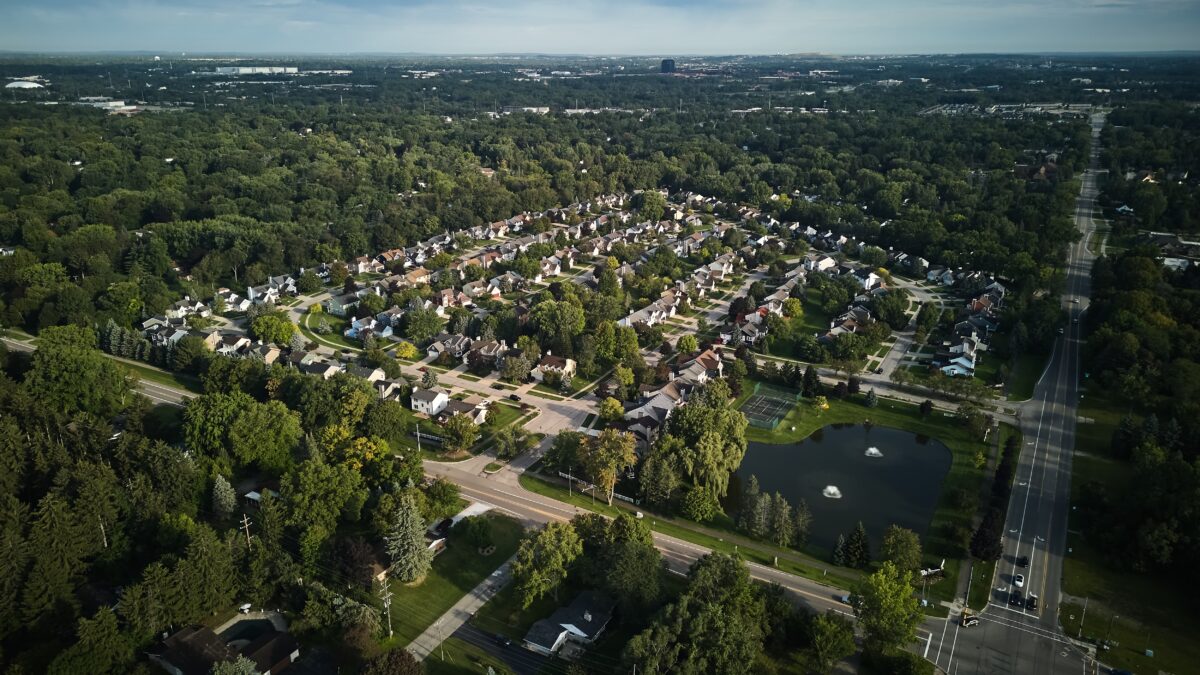
In Michigan that distinction matters. The state’s environmental agency, EGLE, estimates that about 1 in 4 Michigan homes has elevated radon, compared with roughly 1 in 15 homes nationally, and elevated levels have turned up in all 83 counties. Across Metro Detroit, county averages tell the story:

That last point is the one that matters most. A ranking cannot tell you which home is which. A test can.

How do you find out if the air in your home is safe?

Testing is straightforward and inexpensive. A radon test runs for a set period, usually 48 hours or longer, and a lab reports your level in pCi/L. If the result is at or above 4.0, a mitigation system vents the gas safely outside and brings levels down, often within a day of installation. You can review the different types of radon tests or have a certified team handle it for you.

Protect Environmental is a proud supporter of the American Lung Association and has helped homeowners across the country breathe easier at home. The first step is the easiest one.

Frequently Asked Questions

Yes. Particle pollution and smoke can drift indoors through windows, doors and ventilation, and it tends to linger once inside. But the pollutants that originate inside the home, radon chief among them, are usually the larger long term concern because the exposure is constant.


It often is. When homes are sealed against the cold and heating systems pull air upward, radon can concentrate at higher levels. Winter is one of the most reliable times of year to test.


The EPA recommends fixing any home that tests at or above 4.0 pCi/L, and suggests considering action between 2.0 and 4.0. There is no completely risk free level, so lower is always better.


A standard short term test typically runs 48 to 72 hours in the lowest lived in level of the home. Longer term tests give an even more accurate yearly picture.

Categories
Blog

When are radon levels highest?

If you are asking when radon levels are highest, you likely know enough about radon gas to understand that it is not something you want in your home at any time of year. Conducting a radon test is the first step in understanding your risk of radon exposure. Our advice? If you have never tested your home, go ahead and test, regardless of what time of year. Radon levels are almost always going to be higher in the colder winter months, so we also recommend conducting follow-up testing during the winter season to get a full picture of radon in your home year-round.

Why should you test for radon?

Radon is a known human carcinogen, the leading cause of lung cancer among non-smokers. This naturally occurring, radioactive, gas is created from the breakdown of uranium underground and seeps into buildings from small cracks in the foundation or plumbing. Testing for radon is the only way to know your risk of exposure.

Radioactive radon particles are harmful to your lungs when breathed. Its radioactive properties can damage or mutate lung cells, which can result in cancer. More than 21,000 people die from radon-induced lung cancer every year. Exposure to radon is preventable with proper testing and mitigation in homes and buildings.

When are radon levels the highest?

On average, radon levels are the highest in the colder months, or the heating season. Radon levels are naturally affected by the changing seasons, atmospheric pressure, and precipitation throughout the year. However, temperature fluctuations have the greatest impact on indoor radon levels due to the differences in pressure put on the home.

a cozy wooden cabin tucked in the trees surrounding by snow

Why are radon levels higher in the winter?

Weather changes

Changing weather conditions can impact your indoor air quality. Various weather patterns are caused by atmospheric pressure changes. This can impact the air pressure in the soil as well, causing soil gases, including radon, to be pushed up toward the foundation of your home. These kinds of conditions could increase the possibility for radon and other soil gases to enter your home.

Snow barrier

The snow and ice also affect radon entry into buildings. When there is snow or ice surrounding the building, a barrier is created above the soil. Radon gas below the soil is then sealed under the ground below the foundation of the home. Radon, and other soil gases, will follow the path of least resistance. With a blanket of snow and ice surrounding your home, the path of least resistance is often cracks and openings in the foundation.

Thermal stack effect

A fundamental building science element is the thermal stack effect. This effect describes the movement of air inside and outside of the home due to natural laws of pressure. Cold air is more dense than warm air, meaning cold air falls and warm air rises. This law of pressure is always present, regardless of the season.

When a home or building is heated in the winter, warm indoor air naturally rises. Because warm air is less dense than cold air, it rises upward, escaping through the roof, vents, or other openings at the top of your home.

As warm air escapes, cold air is pulled in from below, much like a hot air balloon. The pressure difference creates a vacuum-like effect that sucks in the colder air from outside and from beneath the foundation.

Anything in the air below the foundation, regardless of the safety or quality of it, can be pulled into your home as a part of the process of the structure “breathing”. It is possible that hazardous soil gases are present, compromising your indoor air quality. Dangerous soil gas, including radioactive radon, can be sucked into homes and buildings at a faster rate during the colder months because of the thermal stack effect.

The thermal stack effect explains why radon levels are almost always higher in the winter. Simply put, outdoor air is being pulled into the home quicker and more frequently in the winter than in the summer. For this reason, the potential for being exposed to higher levels of radon in your home is greater in the colder winter months.

When Are Radon Levels Highest

Sealed Homes

When temperatures are more desirable, windows are opened creating more airflow throughout the home or building. Airflow can help dilute the radon gas buildup indoors and can improve your overall indoor air quality. Within tightly sealed buildings, there are few ways for gas particles to escape. Radon gas can then become more concentrated and build up to dangerous levels indoors.

Why test for radon in the winter?

Radon levels can and will fluctuate over time and with the changing seasons. Seasonal variability, stack effect, tightly sealed homes, and snowy barriers help us understand why radon and other soil gas levels are almost always higher in the colder months.

We have seen seasonal test results increase from a range of 1.8 – 2.2 pCi/L in the summer to a range of 28.0 – 32.0 pCi/L in the winter in the same building. The EPA recommends mitigation if the radon level is 4.0 pCi/L or higher. If you have only tested your home in the summer months, you may be unaware that your breathing air contains dangerous levels of radioactive radon in the winter.

The only way to know if your radon levels have fluctuated in the winter is to test. Also, if you have never tested or have not tested in the last five years, you should request a professional radon test as soon as possible.


Do I need a Radon Test

Why Do Radon Levels Fluctuate?

Radon levels can vary throughout the year due to various environmental and structural factors. Most of the time, these fluctuations occur without homeowners realizing it, making regular testing crucial for safety. 

Here are the main factors that influence radon levels:

  • Weather Changes: Radon levels can rise due to atmospheric pressure shifts during storms or high winds. Lower outdoor air pressure creates a suction effect that pulls radon gas from the soil into homes, primarily through foundation cracks or gaps.
  • Seasonal Variations: Radon levels peak during colder months, mainly because homes are sealed for heating and trapping radon indoors. The “stack effect,” where warm indoor air rises and escapes, pulling in radon-laden air from the ground, is especially prominent in winter.
  • Soil Moisture and Composition: Saturated or frozen soil can trap radon gas, causing it to accumulate. Conversely, dry, loose soil allows radon to escape into the atmosphere more quickly. Seasonal changes in soil moisture, like heavy rain or freezing conditions, can influence radon entry into homes​.
  • Home Ventilation: Proper ventilation can reduce radon levels by allowing fresh air to dilute indoor radon. During warmer months, when windows are open, radon concentrations typically decrease. In contrast, tightly sealed homes, particularly in winter, can lead to radon buildup.
  • Building Activity: Construction near homes, including foundation work or digging, can disrupt the soil and create new pathways for radon to enter. Retesting for radon is often recommended after such activities​.

Understanding these factors is crucial for homeowners to make informed decisions about when and how often to test for radon. This ensures that any seasonal or environmental fluctuations are addressed before they become a health risk.

radon mitigation system on red brick wall with a ladder leaning against the wall next to it by a window

How to reduce your risk of radon exposure all year long

If your radon levels are elevated, installing a mitigation system is the next step. You will want to make sure your mitigation system is installed by a qualified professional who is certified and/or licensed. Unfortunately, mitigation systems can be completely ineffective if installed incorrectly or designed for a lower pressure level in the home.

  1. Test for radon in different seasons or conduct a long-term test to understand how radon levels fluctuate in your home.
  2. If levels are elevated, work with a qualified professional to install a radon mitigation system in your home.
  3. Have your mitigation system serviced annually by a qualified professional to ensure your system continues to function correctly.
  4. If you have a mitigation system, test every two years to ensure that you are continuing to be protected against radon exposure.

“A properly designed and installed mitigation system is essential in preventing exposure to cancer-causing radon gas. Unfortunately, many radon contractors fail to take the seasonal pressure differential variances within the home into consideration when designing the system, leading to the homeowner being unknowingly exposed to unsafe levels of radon during certain times of the year.” 

– Kyle Hoylman, CEO of Protect Environmental

Is your radon mitigation system affected during the colder months?

If you had a mitigation system installed in the warmer months, test again during the winter season to make sure your system is continuing to keep you safe with the cold weather changes. If your mitigation system was designed for a lower pressure level during the warmer months, it could be essentially ineffective and elevated radon levels could still be in your home or building.

We recommend testing every two years, even if you have a mitigation system installed, because of these seasonal fluctuations. Consider testing in the colder months or conduct a long-term radon test to get a complete picture of the radon levels in your home year-round.

Key Takeaways:

  • Radon levels can and will be affected by seasonal variability.
  • Indoor radon levels are normally at the highest in the winter or colder months because of the thermal stack effect, a snowy barrier, and tightly sealed homes.
  • Cold temperatures increase the pressure within the home, meaning more air is being pulled in from the ground, which elevates the risk of radon entering the home.
  • Test your home and other buildings in the colder months to get a complete picture of radon exposure.
  • Test your home every two years to ensure your radon mitigation system continues to protect your home from radon in higher pressure conditions caused by colder temperatures.
Categories
Blog

Indoor Air Quality at Home: Clean Air Month 2026 Guide

In this article

  • 01What is Clean Air Month 2026
  • 02What is indoor air quality
  • 03The 6 biggest indoor air pollutants
  • 04How to test indoor air quality at home
  • 05How to improve indoor air quality
  • 06When to call a professional

May is Clean Air Month, the American Lung Association’s annual reminder that clean air is not optional. Most of the conversation gets pointed outside, at smog, wildfire smoke, and emissions. But the air you breathe most of the time isn’t out there. It’s in your home.


The U.S. EPA estimates that indoor air can be two to five times more polluted than outdoor air. On occasion, more than 100 times worse. And the average American spends roughly 90% of their time indoors, which means indoor air quality is, for most people, the air quality that matters most.


This guide is a practical breakdown of what’s in your indoor air, how to test it, and what actually works to improve it. Some of the actions are free. Some are cheap. One of them, the most consequential one, is what we do for a living.

Quick Answer

Indoor air quality refers to the air inside and around homes and buildings, particularly as it relates to health and comfort. The U.S. EPA reports that indoor air can be 2-5 times more polluted than outdoor air. Common indoor air pollutants include radon, particulate matter, volatile organic compounds, mold, and carbon monoxide, most of which are testable and treatable.

What is Clean Air Month 2026?

Clean Air Month is the American Lung Association’s annual campaign each May to raise awareness about air quality and its impact on health. It was first declared in 1972, the year after the original Clean Air Act, and it’s been observed every May since.

The ALA uses the month to push for stronger air-quality protections, healthier homes, and reduced exposure to airborne pollutants. Their annual State of the Air report tracks ozone and particle pollution across every U.S. county. The point of the campaign is simple: every breath matters, and most Americans are taking thousands of those breaths every day inside their own houses without giving the air a second thought.

What is indoor air quality?

Indoor air quality (IAQ) refers to the air quality inside and around buildings and structures, especially as it relates to the health and comfort of the people inside. It’s measured by the concentration of pollutants in the air, the humidity level, the air’s circulation, and how well the building is ventilated.

Per the U.S. EPA, poor indoor air quality is one of the top five environmental risks to public health in the United States. The World Health Organization reports that household air pollution causes an estimated 3.2 million premature deaths globally each year. Long-term exposure has been linked to lung cancer, asthma, heart disease, cognitive decline, and a range of other chronic conditions.

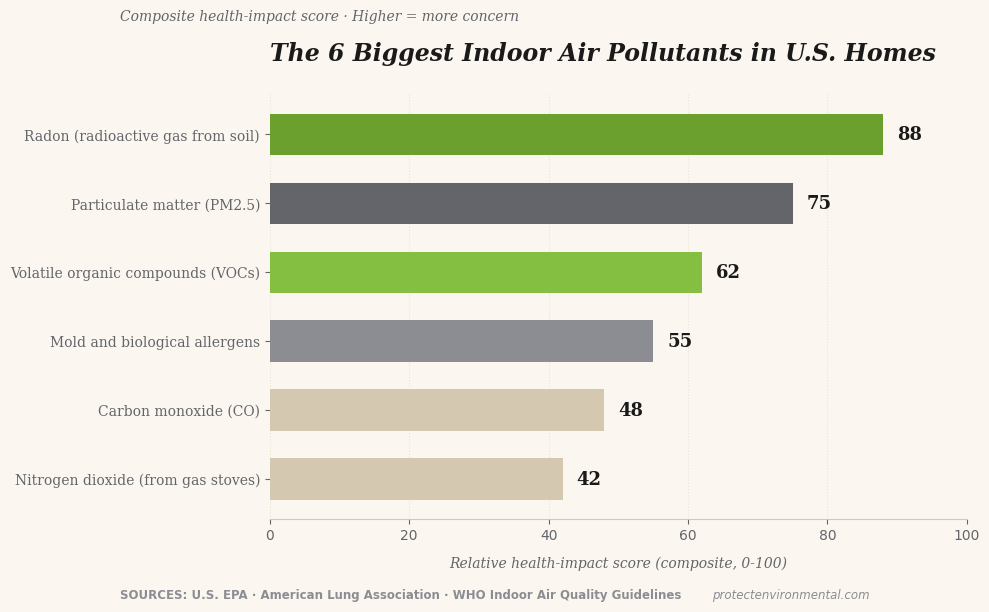
The 6 biggest indoor air pollutants in U.S. homes

Indoor air is a cocktail of dozens of pollutants, but a handful do most of the damage. Here are the ones EPA and the American Lung Association rank highest by health impact in typical U.S. homes.

1. Radon


Radon is a naturally occurring radioactive gas that rises from the ground into homes through foundations and floors. It is the second leading cause of lung cancer in the United States and the leading cause among non-smokers. The EPA estimates it kills 21,000 Americans every year. About 1 in 15 U.S. homes has elevated levels — you can check the EPA radon zone map for your county’s baseline risk.

2. Particulate matter (PM2.5 and PM10)


Microscopic particles from cooking, candles, fireplaces, dust, pet dander, and outdoor sources that infiltrate the home. PM2.5 is small enough to penetrate deep into the lungs and bloodstream. Linked to asthma flare-ups, heart disease, and reduced lung function.

3. Volatile organic compounds (VOCs)


Off-gassed chemicals from paint, new furniture, cleaning products, air fresheners, and many building materials. Common ones include formaldehyde, benzene, and toluene. Short-term exposure causes headaches and dizziness; long-term exposure has been linked to several cancers and liver/kidney damage.

4. Mold and biological allergens


Includes mold spores, dust mites, pet dander, and pollen. Thrives in homes with high humidity or moisture problems. Major asthma and allergy trigger, and certain molds (like Stachybotrys chartarum) produce mycotoxins that can cause more serious respiratory illness.

5. Carbon monoxide (CO)


Colorless, odorless, and lethal at high concentrations. Typical sources include malfunctioning gas furnaces, water heaters, fireplaces, and attached garages. According to the CDC, around 400 Americans die from CO poisoning each year, mostly from preventable home incidents.

6. Nitrogen dioxide and gas-stove emissions


Gas stoves release NO₂, formaldehyde, and other irritants. Recent peer-reviewed research has linked unvented gas-stove use to higher rates of childhood asthma. The simplest fix is using a range hood that vents outside, every time you cook.

How to test indoor air quality in your home

You can’t fix what you haven’t measured. Indoor air quality testing breaks down into three tiers, from quick at-home checks to certified professional assessments.

Consumer-grade air quality monitors


Plug-in monitors give you a real-time, continuous reading on common pollutants; typically particulate matter (PM2.5), volatile organic compounds, CO2, humidity, and temperature. They’re widely available and easy to set up. Good for ongoing awareness of how your indoor air changes throughout the day, especially during cooking, cleaning, or wildfire smoke events. The catch: most consumer-grade devices aren’t certified for radon measurement, so they shouldn’t be used to make radon decisions. Treat them as a daily dashboard, not a definitive answer.

DIY single-pollutant test kits


For radon specifically, short-term kits (3–7 days) are widely available and simple to use. Place one on the lowest livable level of your home, follow the instructions, and mail it back to a lab for analysis. Long-term kits (90+ days) give a more reliable average, since radon levels fluctuate with weather, season, and ventilation patterns. The EPA Citizen’s Guide to Radon walks through the testing protocol step by step. DIY kits also exist for mold and VOCs, but tend to be less accurate than professional sampling.

Professional indoor air quality testing


For a certified, lab-grade reading, especially before a real estate transaction, after a renovation, or if someone in your home has respiratory issues, professional testing is the right call. A certified specialist assesses your specific home, runs multi-pollutant sampling using calibrated equipment, and delivers a defensible report with recommendations. Protect Environmental does this for homeowners across the United States, and the assessment is free.

How to improve indoor air quality

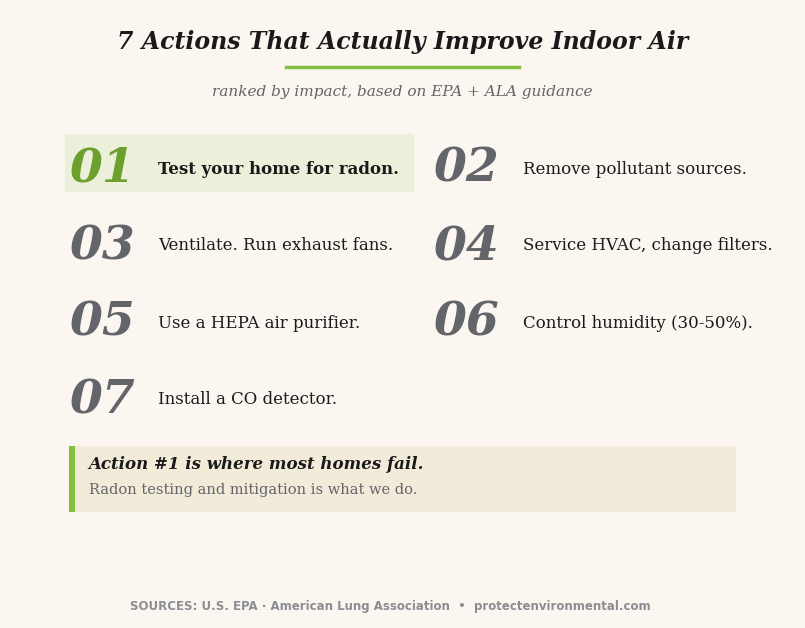
Once you know what is in your air, the actions to clean it up are surprisingly affordable. Here are the seven that move the needle most, ranked by impact:

01. Test for radon


Single biggest IAQ action with the single biggest health upside, because radon is invisible and silently lethal in elevated homes. Every home should be tested. If yours is above 4.0 pCi/L, mitigate.

02. Remove or reduce pollutant sources


Source control is more effective than filtration. Use low-VOC paints and finishes. Avoid air fresheners, scented candles, and aerosol sprays. Store solvents, paints, and pesticides outside the living envelope (in a detached garage or shed, not the basement).

03. Ventilate aggressively


Open windows on opposite sides of the home to get cross-flow. Run kitchen exhaust fans every time you cook. Run bathroom exhaust fans during and after showers. For tightly sealed modern homes, consider a heat recovery ventilator (HRV) or energy recovery ventilator (ERV).

04. Service your HVAC and change filters


Use MERV 11 or MERV 13 filters in your HVAC system. Change them on the manufacturer’s schedule, usually every 1-3 months. Get the system serviced annually. Have ducts cleaned only when there’s visible mold, vermin infestation, or substantial dust accumulation, not on a regular schedule.

05. Use a HEPA air purifier


A true HEPA air purifier in the bedroom is the single highest-leverage purchase for the air you actually breathe (since you spend a third of your life in that room). Size it to the room. Don’t bother with ionizers or ozone-generating purifiers, which can do more harm than good.

06. Control humidity


Keep relative indoor humidity between 30-50%. Below 30% and you get dry skin, irritated airways, and increased viral transmission. Above 50% and you get dust mites and mold. Dehumidifiers and humidifiers are cheap and effective.

07. Install CO and radon detectors

Battery-powered CO detectors are required by code in most U.S. states. Continuous radon detectors are a relatively recent home-safety addition and increasingly affordable ($150-$300). They give you ongoing visibility into one of the two indoor air risks most likely to kill you.

A note from Protect Environmental

Protect Environmental specializes in the radon piece of the indoor air quality picture, because it’s the highest-impact single action a homeowner can take, and because most homes never get to it.

We test homes. We design and install mitigation systems when levels are elevated. We re-verify after install. We maintain systems annually so they keep working. And we do it across the United States through our network of regional teams.

Clean Air Month is a good moment to think about the air in your home. If you’ve never tested for radon, or it’s been more than two years since you did, we’ll come out and assess your home for free.

Get my free quote →

Frequently Asked Questions

Clean Air Month is observed throughout the entire month of May each year. In 2026, it runs from May 1 through May 31. It is organized by the American Lung Association and has been observed every May since 1972, the year after the original Clean Air Act was passed.

Indoor air quality (IAQ) refers to the air inside and around buildings, especially as it relates to the health and comfort of the people inside. It is measured by the concentration of airborne pollutants, humidity, ventilation, and air circulation. The U.S. EPA classifies poor indoor air quality as one of the top five environmental health risks in the United States.

Yes. According to the U.S. EPA, indoor air is typically 2-5 times more polluted than outdoor air, and occasionally up to 100 times more polluted. Because the average American spends about 90% of their time indoors, indoor air is the air that matters most for daily health.

The six most common and consequential indoor air pollutants in U.S. homes are radon, particulate matter (PM2.5 and PM10), volatile organic compounds (VOCs), mold and biological allergens, carbon monoxide, and nitrogen dioxide from gas appliances. Radon ranks highest in long-term health impact, since it is the leading cause of lung cancer in non-smokers.

Yes. Long-term exposure to poor indoor air quality has been linked to asthma, lung cancer (especially from radon), heart disease, chronic respiratory illness, cognitive decline, and developmental issues in children. Short-term exposure can cause headaches, dizziness, eye and throat irritation, and worsened allergies. The EPA classifies indoor air pollution as one of the top five environmental health risks in the United States.

Slightly. A famous 1989 NASA study showed that certain houseplants can remove small amounts of VOCs from indoor air, but follow-up research has shown the effect in real homes is minimal. Plants are a great addition to a home for many reasons, but they cannot replace ventilation, source control, HEPA filtration, or radon mitigation. They are a supplement, not a strategy.

Categories
Blog

Lung Cancer Action Week 2026: Causes, Types, Stages & Prevention

In this article

  • 01What is Lung Cancer Action Week 2026
  • 02The leading cause in non-smokers
  • 03Lung cancer types, stages, and treatment
  • 04Warning signs you shouldn’t ignore
  • 05How to test your home for radon
  • 06What if your radon test comes back high

This week is Lung Cancer Action Week. Buildings across the country are lit up turquoise. The American Lung Association’s LUNG FORCE campaign is running, and the message they want every American to hear is simple.


Lung cancer is the leading cause of cancer death in the United States. About every two minutes, someone is diagnosed. And it is not just a smoker’s disease. Roughly 10 to 20% of lung cancer cases occur in people who have never smoked at all.


If you have never picked up a cigarette in your life, that statistic should land. The leading reason it happens is also the most fixable, and it has nothing to do with your habits.

Quick Answer

Radon is the leading cause of lung cancer in non-smokers and the second leading cause overall, after smoking. The U.S. EPA estimates radon causes about 21,000 lung cancer deaths each year in the United States. Lung Cancer Action Week, observed each May, includes home radon testing among the American Lung Association’s seven recommended actions to reduce lung cancer risk.

What is Lung Cancer Action Week 2026?

Lung Cancer Action Week is the awareness initiative of the American Lung Association’s LUNG FORCE program, observed annually in early May. In 2026, it runs from May 5-11. The week is paired with Turquoise Takeover, which is the broader month-long campaign that encourages communities, landmarks, and individuals to wear turquoise, the LUNG FORCE signature color, to raise lung cancer awareness.

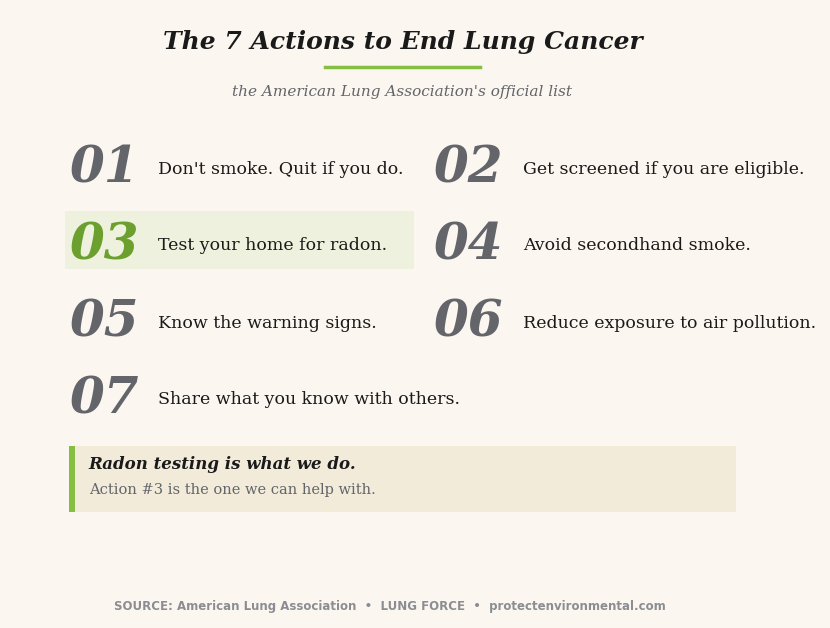
The American Lung Association uses the week to publish its seven actions to end lung cancer, a list aimed at homeowners, patients, caregivers, and the general public. We’ll get to all seven, but here’s the one most people overlook.

Action #3 on the ALA's list: test your home for radon

Sitting at number three on the American Lung Association’s official list of actions, between “get screened” and “avoid secondhand smoke,” is “test your home for radon.” Most people never get past number one.

Radon is a colorless, odorless, tasteless radioactive gas that rises from the natural decay of uranium in soil and rock. It seeps up through foundations, floors, and any opening in contact with the ground, and it accumulates inside homes. According to the U.S. EPA, radon is responsible for roughly 21,000 lung cancer deaths per year in the United States. That is more than drunk driving. More than home fires. More than drowning.

Why this matters more if you have never smoked

If you smoke, your single biggest controllable risk factor for lung cancer is the cigarette. Quit and your risk drops dramatically over time. The math is straightforward.


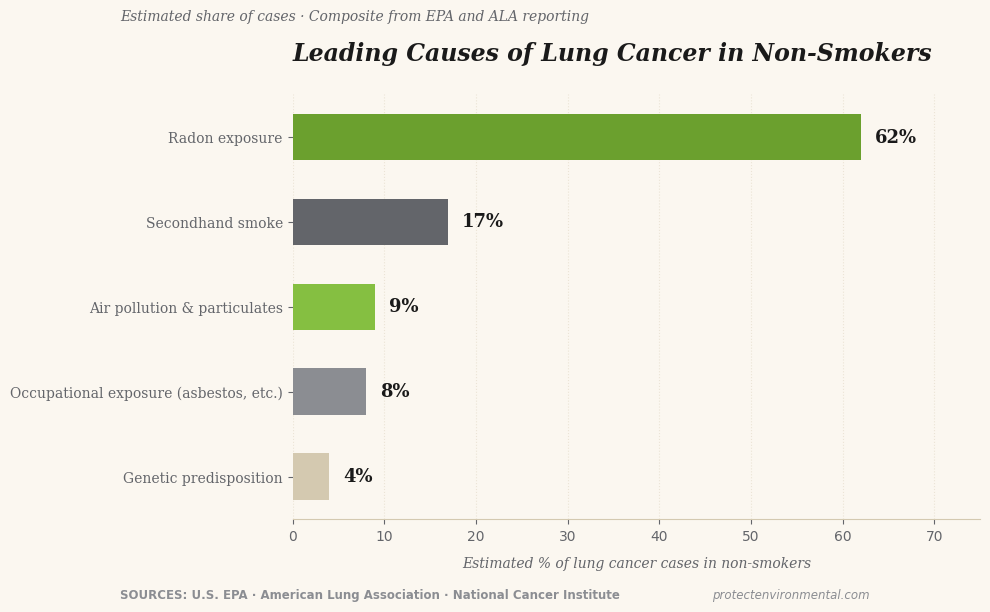
If you don’t smoke, the math is different. With smoking off the table, the leading remaining causes of lung cancer cluster around environmental and genetic factors. Radon is at the top of that list. The U.S. EPA estimates that radon is the leading cause of lung cancer among non-smokers, responsible for the majority of lung cancer cases in people who never smoked.

And here is the part that gets to people: radon does not announce itself. There is no smell, no visible warning, no symptom in real time. The first signal something is wrong is, frequently, a lung cancer diagnosis years or decades later. The exposure is silent. The result is not.

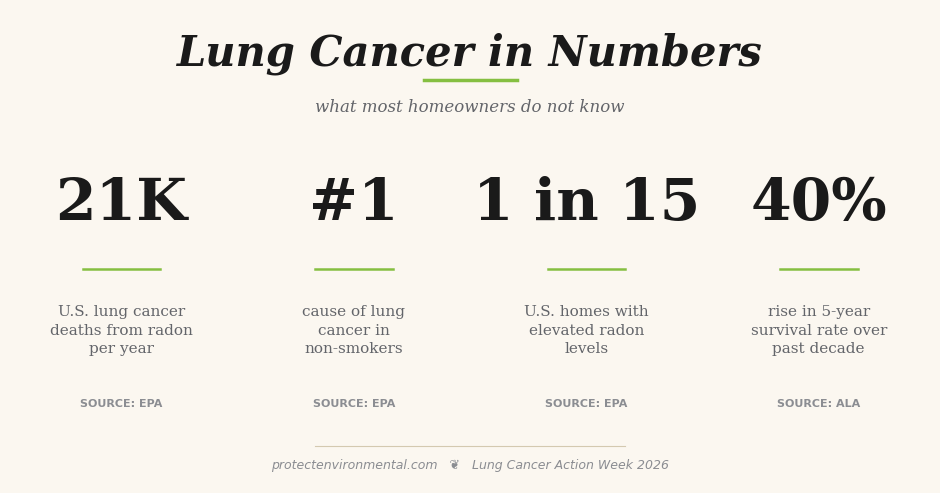
Lung cancer in numbers

A few stats from the American Lung Association, the EPA, and the National Cancer Institute that frame why this conversation matters this week:

  • Lung cancer is the leading cause of cancer deaths in the United States, killing more Americans each year than breast, prostate, and colon cancer combined.
  • Roughly 10 to 20% of lung cancer cases occur in people who have never smoked.
  • 21,000 lung cancer deaths per year are attributable to radon, per EPA estimates.
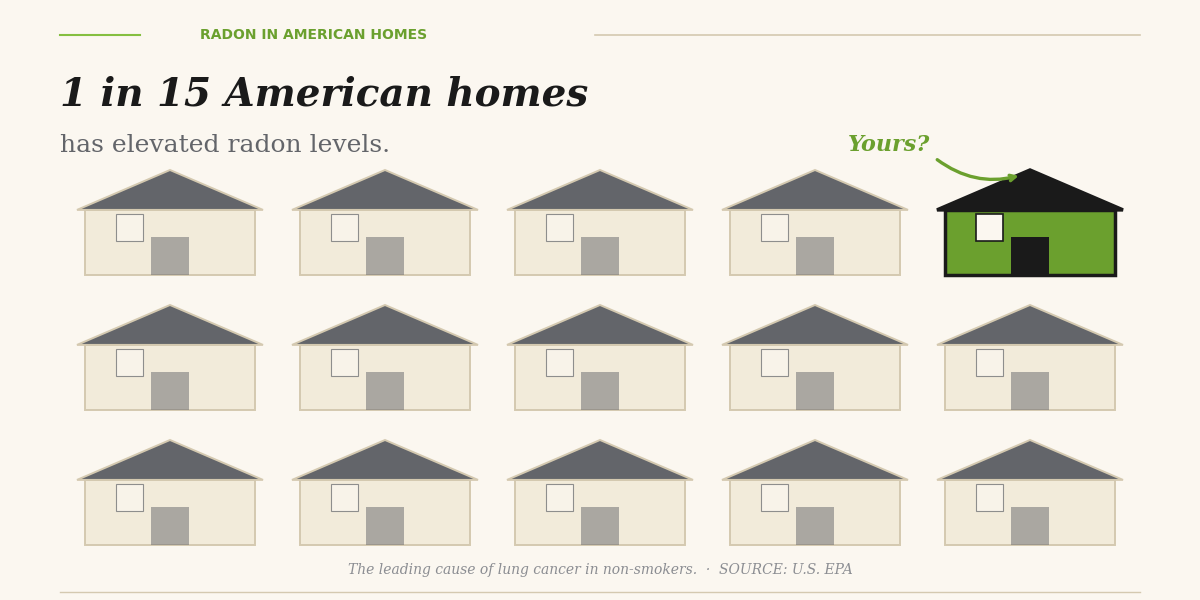
  • About 1 in 15 U.S. homes has elevated radon levels above the EPA’s action threshold of 4 picocuries per liter (pCi/L).
  • There is good news, too: the 5-year lung cancer survival rate has risen by nearly 40% over the past decade, driven by earlier screening and better treatments.

Warning signs of lung cancer to know

Lung cancer often develops silently and produces no symptoms in its earliest stages. When symptoms do appear, they are easy to mistake for less serious conditions like a stubborn cold or a respiratory infection. The American Lung Association recommends learning these warning signs and not ignoring them, especially if they persist:


  • A cough that does not go away or worsens over time.
  • Chest pain, shortness of breath, or wheezing.
  • Coughing up blood or rust-colored sputum.
  • Hoarseness or persistent voice changes.
  • Unexplained weight loss or loss of appetite.
  • Recurring respiratory infections, like bronchitis or pneumonia.
  • Fatigue or weakness that does not improve.

Symptoms can be different in women than in men. Women are more likely to be diagnosed with adenocarcinoma, which often develops in the outer regions of the lungs, where it may produce subtler early symptoms. If something feels off, talk to your doctor. Early detection is the single biggest factor in survival.

Lung cancer basics: types and stages

When those symptoms show up in someone you know or in yourself, the next questions are usually clinical. What kind of lung cancer is it? How far has it spread? Here’s the vocabulary in plain terms, sourced from the American Lung Association and the National Cancer Institute.

Small cell vs. non-small cell lung cancer


Lung cancer is divided into two main categories based on how the cells appear under a microscope.

  • Non-small cell lung cancer (NSCLC). The most common form, accounting for about 80-85% of all lung cancer cases. It tends to grow and spread more slowly than small cell, which gives screening and treatment more time to work.
  • Small cell lung cancer (SCLC). Accounts for roughly 10-15% of cases. It is strongly associated with smoking and tends to grow faster and spread earlier, which makes early detection critical.

Common subtypes of non-small cell lung cancer


Within NSCLC, three subtypes account for nearly all cases.

  • Adenocarcinoma. The most common subtype overall, especially in non-smokers and in women. It usually develops in the outer parts of the lungs.
  • Squamous cell carcinoma. Often forms in the central airways. More strongly linked to smoking.
  • Large cell carcinoma. Less common, can appear anywhere in the lungs and tends to grow quickly.

How lung cancer is staged


Staging is the medical shorthand for how far the cancer has spread. The American Cancer Society and National Cancer Institute use a 1-4 scale.

  • Stage 1. Cancer is in one lung only and has not spread to lymph nodes.
  • Stage 2. Cancer is still in one lung but may have spread to nearby lymph nodes.
  • Stage 3. Cancer has spread to lymph nodes in the chest, sometimes on both sides.
  • Stage 4. Also called metastatic lung cancer. Cancer has spread beyond the lungs to other parts of the body. Stage 4 is the most advanced stage.

The earlier the stage at diagnosis, the better the prognosis. The 5-year survival rate for stage 1 lung cancer can exceed 60%, while stage 4 survival rates have historically been much lower, though they have been steadily climbing thanks to advances in immunotherapy and targeted therapy.

How to test your home for radon

Testing your home for radon is inexpensive, simple, and a one-time data point that gives you real information. The EPA recommends that every home in the United States be tested, regardless of geographic location, age of the home, or whether the basement is finished or unfinished.


Short-term test (3 to 7 days)

A short-term test is the fastest way to get an initial reading. You place the test kit in the lowest livable level of your home, leave it for the recommended exposure period, and send it to a lab. Available at hardware stores and online for under $30.


Long-term test (90+ days)

A long-term test gives a more accurate picture of your home’s average radon level over time. Radon levels fluctuate seasonally and with weather, so a longer test smooths out variation. Recommended if your short-term test came back near or above the EPA action level.


Professional testing

For a certified, lab-grade reading, especially for a real estate transaction or before installing a mitigation system, professional testing is the right path. Protect Environmental and our regional teams handle this across multiple U.S. markets.

What if your radon test comes back high?

The EPA’s action level is 4.0 pCi/L. If your test comes back at or above that, the EPA recommends reducing it through a process called radon mitigation. If it comes back between 2.0 and 4.0 pCi/L, the EPA still recommends considering mitigation, since no level of radon is technically safe.


A radon mitigation system is essentially a custom-engineered ventilation setup that pulls radon from beneath your foundation and vents it harmlessly above the roofline before it can enter your living space. Properly installed systems are highly effective, often reducing indoor levels by 50-99%. The cost ranges from roughly $1,000 to $2,500 for a typical home, comparable to a single home-improvement project, and it lasts decades.

A note from Protect Environmental

Protect Environmental and our network of legacy brands have built our work around the radon-and-lung-cancer connection. We test homes. We design and install mitigation systems. We re-verify them after install. And we maintain them annually so they keep working a decade later.

If you’ve never tested your home, Lung Cancer Action Week is a fitting moment to start. Action #3 on the ALA’s list is the one we can help with.

Test your home →

Frequently Asked Questions

Lung Cancer Action Week 2026 runs from May 5–11. It is organized by the American Lung Association’s LUNG FORCE program, observed annually in early May. The week is paired with Turquoise Takeover, a month-long awareness campaign that encourages people to wear turquoise and illuminate landmarks turquoise to raise awareness about lung cancer prevention, screening, and research.

Radon is the leading cause of lung cancer in non-smokers in the United States. According to the U.S. EPA, radon, a naturally occurring radioactive gas that rises from soil into homes, is responsible for approximately 21,000 lung cancer deaths each year. Among lung cancer cases in people who have never smoked, radon exposure accounts for the majority of attributable risk.

Yes. Radon is classified as a Group 1 carcinogen by the World Health Organization and the U.S. EPA. When inhaled, radon’s radioactive decay products damage lung tissue at the cellular level, increasing cancer risk over time. The EPA estimates radon causes around 21,000 U.S. lung cancer deaths annually, making it the second leading cause of lung cancer overall, after smoking.

The EPA’s action level is 4.0 picocuries per liter (pCi/L) of indoor air. At or above this level, the EPA recommends mitigation. Between 2.0 and 4.0 pCi/L, the EPA still recommends considering mitigation, because no radon level is technically safe. The average outdoor radon level is 0.4 pCi/L, while the average indoor level in the U.S. is 1.3 pCi/L.

Test your home for radon using a short-term test kit (3-7 days) or a long-term test (90+ days). Short-term kits are available at hardware stores and online for under $30. For a certified, lab-grade reading, especially before a real estate transaction or mitigation system installation, hire a licensed professional radon testing service. The EPA recommends every home be tested regardless of location.

Lung cancer often produces no symptoms in early stages. Warning signs include a persistent cough, chest pain, shortness of breath, coughing up blood, hoarseness, recurring respiratory infections, unexplained weight loss, and unusual fatigue. Symptoms can be subtler in women, who are more likely than men to develop adenocarcinoma. The American Lung Association recommends seeing a doctor about any symptom that lasts more than two weeks.

Categories
Blog

What’s in Your Tap Water? | Drinking Water Week 2026

Quick Answer

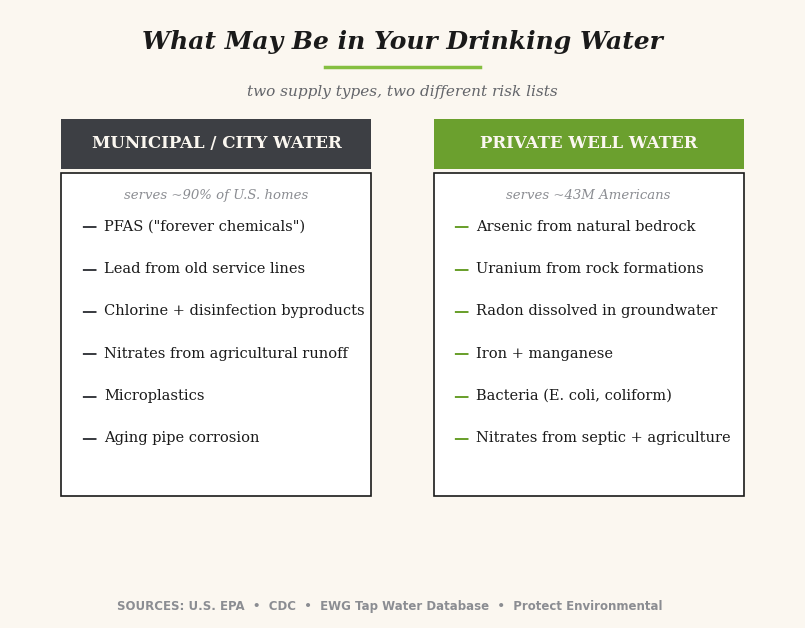
Tap water in the U.S. may contain PFAS (“forever chemicals”), lead from old service lines, chlorine and disinfection byproducts, and trace contaminants like nitrates or microplastics. Private well water faces a different list, including arsenic, uranium, radon, and bacteria. The EPA regulates municipal water at the treatment plant, but contamination can also enter through service lines and home plumbing.

Why Does Earth Day Belong Inside Your Home?

This week is Drinking Water Week, the national observance that runs May 3-9, 2026. It is led by the American Water Works Association, and most years, it focuses on celebrating the people who keep public water systems running.

That part matters. So does this part: most homeowners have no idea what’s actually in the water coming out of their tap. Some of that is reassuring (American tap water is among the most regulated in the world). Some of it should not be.

Earlier this year, new EPA monitoring data showed that roughly 176 million Americans are now drinking tap water with detectable levels of PFAS, the family of so-called “forever chemicals” that don’t break down in the body or the environment. That’s more than half the country.

So this Drinking Water Week, we want to actually answer the question most people don’t ask out loud: what’s in this stuff?

What is Drinking Water Week 2026?

Drinking Water Week is organized by the American Water Works Association (AWWA), and in 2026 it runs from Tuesday, May 3 through Sunday, May 9. It’s been observed since 1988, when Congress passed a joint resolution recognizing the first full week of May as Drinking Water Week.


The official AWWA framing is that it’s a chance for utilities to celebrate the work that goes into delivering safe water. Tours, classroom visits, social media campaigns. Most of the audience is municipal water professionals.


For homeowners, though, the week is also a useful reminder. If you have never thought carefully about your home’s water, this is a good week to start.

Two water supplies, two different risk lists

The first thing worth knowing is what kind of water you have. About 90% of U.S. households are connected to a municipal (“public” or “city”) water system that’s regulated by the EPA. The other roughly 43 million Americans, according to the CDC, are on private wells, which are not federally regulated. That regulatory difference matters because each supply faces a different set of contaminants.

If you’re on municipal water


Your utility tests for over 90 contaminants regulated under the federal Safe Drinking Water Act. They send you a Consumer Confidence Report once a year (usually in July). That covers a lot, but not everything. Items getting the most attention right now:

  • PFAS (“forever chemicals”). In April 2024, the EPA set the first-ever national drinking water limit for six PFAS compounds, including a 4 parts per trillion ceiling for PFOA and PFOS. Compliance has since been pushed to 2031, and four of the six original limits may be rescinded. Until utilities are fully in compliance, tap water at the faucet may still exceed health-protective levels.
  • Lead from service lines. The EPA estimates around 9.2 million lead service lines remain in the ground across the United States. Treatment plants don’t add lead. The pipe between the main and your home does, especially if it’s old or recently disturbed.
  • Chlorine and disinfection byproducts. Chlorine keeps water safe in transit, but it can react with organic matter to form trihalomethanes and haloacetic acids, both of which are regulated but worth being aware of.
  • Nitrates, microplastics, and pipe corrosion byproducts. Less talked about, but real, especially in agricultural regions and homes with aging plumbing.

If you’re on a private well

You are the test administrator. The EPA does not regulate private wells, which means whatever’s in your groundwater is your responsibility to find and treat. The list looks different:

  • Arsenic and uranium from natural bedrock, especially in parts of New England, the Northeast, and the Mountain West.
  • Radon dissolved in groundwater. Wells in uranium-rich geology, including parts of New Jersey and Massachusetts, can carry radon directly into your home through the tap. We covered this in detail in our April Water Week piece on private wells.
  • Bacteria like E. coli and total coliform, especially after heavy rain or flooding events.
  • Iron, manganese, and hardness minerals that are usually nuisance contaminants but can mask others.
  • Nitrates from septic systems and agricultural runoff.

How water actually reaches your tap

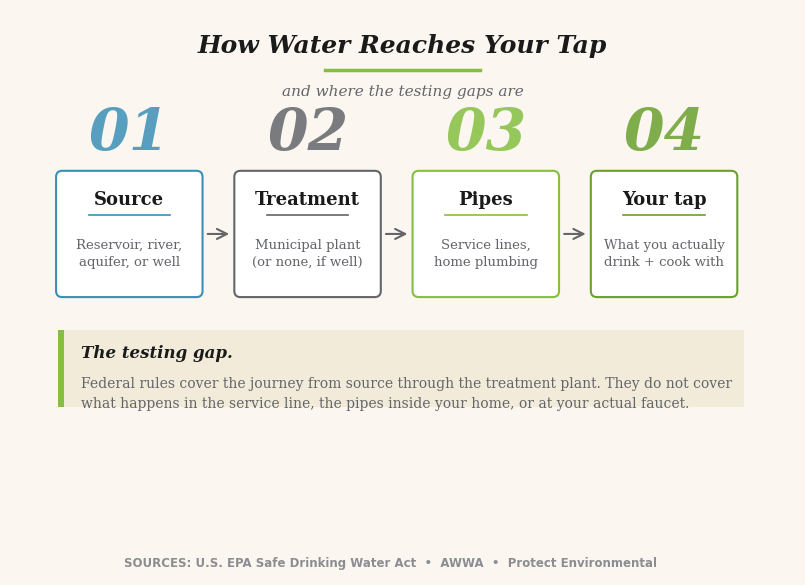
There’s a four-step journey from source to glass, and it’s worth understanding because the federal regulatory framework only covers part of it.

Federal Safe Drinking Water Act standards apply at the treatment plant. Once water enters the distribution system (the city mains), the service line into your house, and finally your home plumbing, things change. Lead can leach in from old service lines. Disinfection byproducts can form. Sediment can build up. Old galvanized pipes can corrode. None of this shows up in your utility’s annual report, because it happens after the water leaves the plant.


That’s why the only test that tells you what’s actually in the water you drink is a test from your own faucet.

How Protect Environmental thinks about home water testing

Protect Environmental and our legacy brands have been testing residential water for decades, with our deepest water expertise concentrated in two markets: Massachusetts and New Jersey.

Massachusetts

Cliff Cummings Water Services

A Protect Environmental Company

40+ years serving Central Massachusetts. 15,000+ customers. Specializes in arsenic, uranium, iron, manganese, radon-in-water, and bacteria — the contaminants common in Massachusetts groundwater. Full-stack service: testing, filtration system design and install, well pump and tank work, annual maintenance.

Visit cummingswaterservices.com

New Jersey

RAdata

A Protect Environmental Company

The first licensed radon and water testing business in New Jersey, with an in-house water testing laboratory. Handles New Jersey’s Private Well Testing Act (PWTA) requirements for real estate transactions, full panel water quality testing, and treatment design for the contaminants typical of NJ groundwater.

Visit radata.com/water-testing

A practical drinking water checklist

Whether you’re on municipal water or a private well, here’s where to start this Drinking Water Week.


  • If you’re on municipal water, look up your utility’s annual Consumer Confidence Report. They’re public and required by law.
  • Look up your address in the EWG Tap Water Database to see what’s been detected in your local supply.
  • Find out whether your home has a lead service line. Many utilities now publish public maps of known and suspected lead lines.
  • If you’re on a private well, test annually for bacteria and nitrates at minimum. Test every two to five years for a full panel including metals.
  • In radon-prone geology (most of NJ, much of MA, parts of PA and CO), test your well water for radon, separately from your air radon test.
  • If you have well water and you’ve never had a full panel test done, schedule one. It’s the only way to know your baseline.
  • If your home is older than 1986, assume there may be lead somewhere in the plumbing path and run cold water for 30 seconds before drinking first thing in the morning.

A note from Protect Environmental

Most weeks, your tap water gets none of your attention. That’s the privilege of living in a country with the regulatory infrastructure we have. But once a year, Drinking Water Week is a reasonable nudge to actually look.

If you’ve never had your home’s water tested, this is a good week to start. If you’re in Massachusetts or New Jersey, our local teams are the people to call.

Massachusetts team → New Jersey team →
❦   ❦   ❦

Frequently Asked Questions

Drinking Water Week 2026 runs from May 3 through May 9. It is the annual national observance led by the American Water Works Association (AWWA), recognizing the importance of safe, reliable drinking water and the work of water utilities and professionals across North America. The week has been observed since 1988 when Congress passed a joint resolution establishing it.

Tap water in the United States may contain PFAS (“forever chemicals”), lead from old service lines, chlorine and disinfection byproducts, nitrates, and trace amounts of microplastics. Private well water can also contain arsenic, uranium, radon, iron, manganese, and bacteria. The EPA regulates municipal water at the treatment plant, but contamination can also enter through service lines and home plumbing.

U.S. tap water is among the most regulated in the world, and most municipal supplies meet federal safety standards at the treatment plant. However, contamination can occur after treatment through aging service lines, household plumbing, and private wells that aren’t federally regulated. The only way to know what’s actually in your water is to test it at the faucet.

According to EPA monitoring data released in early 2026, approximately 176 million Americans drink tap water with detectable levels of PFAS, the family of synthetic “forever chemicals” that don’t break down in the environment or the human body. The EPA set a national limit of 4 parts per trillion for PFOA and PFOS in 2024, with utility compliance now extended to 2031.

Yes, especially if you have a private well, your home is older than 1986 (potential lead plumbing), or you’ve never had your tap water tested. Public water systems test at the plant, but contamination can enter after that point. A faucet-level test is the only way to know what’s actually coming out of your tap.

Start with your utility’s Consumer Confidence Report (free, sent annually). Look up your area in the EWG Tap Water Database. For specific concerns, professional testing identifies lead, PFAS, bacteria, arsenic, and other contaminants. Protect Environmental and its legacy brands, including Cliff Cummings Water Services in Massachusetts and RAdata in New Jersey, offer full residential water testing.

Categories
Blog

Indoor Asthma Triggers in Your Home | World Asthma Day 2026

Quick Answer

Common indoor asthma triggers include dust mites, mold, pet dander, cockroach allergens, tobacco smoke, particulate matter, and volatile organic compounds (VOCs). The U.S. EPA identifies these as the indoor pollutants most likely to cause or worsen asthma symptoms. Because Americans spend up to 90% of their time indoors, home air quality directly affects how often asthma flares.

Why Does World Asthma Day Belong Inside Your Home?

Today is World Asthma Day. It’s the global moment, set every year for the first Tuesday of May, when the asthma community talks about what’s working, what’s still broken, and what the rest of us can do about it.

The 2026 GINA theme is access to anti-inflammatory inhalers. Inhalers and care plans matter. Doctors matter. But there’s a parallel piece of this conversation that gets less attention, and it sits inside the home.

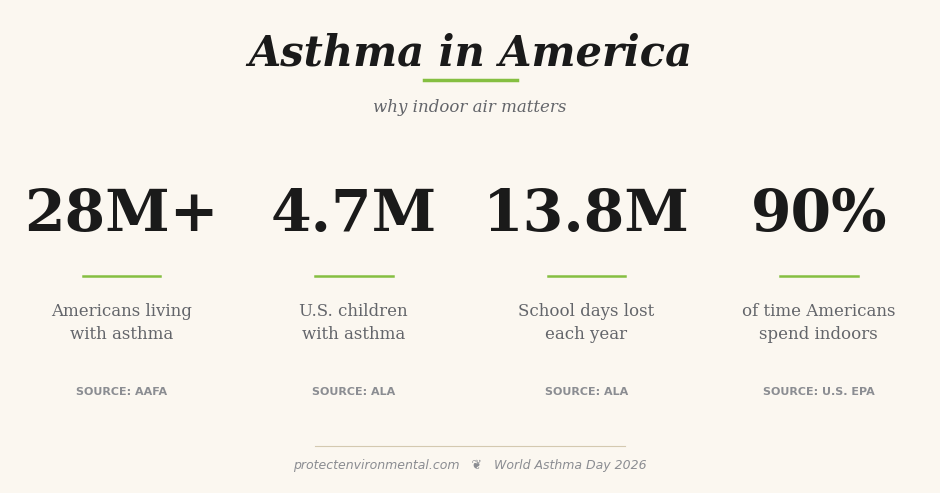
Most asthma flare-ups happen in the place where people spend the most time. According to the U.S. EPA, Americans spend up to 90% of their time indoors, and indoor allergens and irritants play a major role in triggering asthma attacks. So if you or someone you love has asthma, your home is part of the equation. This is what to look for.

What is World Asthma Day 2026?

World Asthma Day is organized by the Global Initiative for Asthma (GINA) and recognized in countries around the world. In 2026, it falls on Tuesday, May 5. The 2026 theme is “Access to anti-inflammatory inhalers for everyone with asthma, still an urgent need.”


It’s a fitting theme. Asthma affects more than 260 million people globally and over 28 million Americans, including 4.7 million children, according to the Asthma and Allergy Foundation of America and the American Lung Association. Asthma is responsible for roughly 13.8 million missed school days a year in the United States alone.

Why your home matters as much as your inhaler

If you live with asthma, you’ve probably built a list of things that set it off. Pollen on a windy day. A neighbor’s cat. Smoke from a backyard fire. That list is useful and it’s personal.


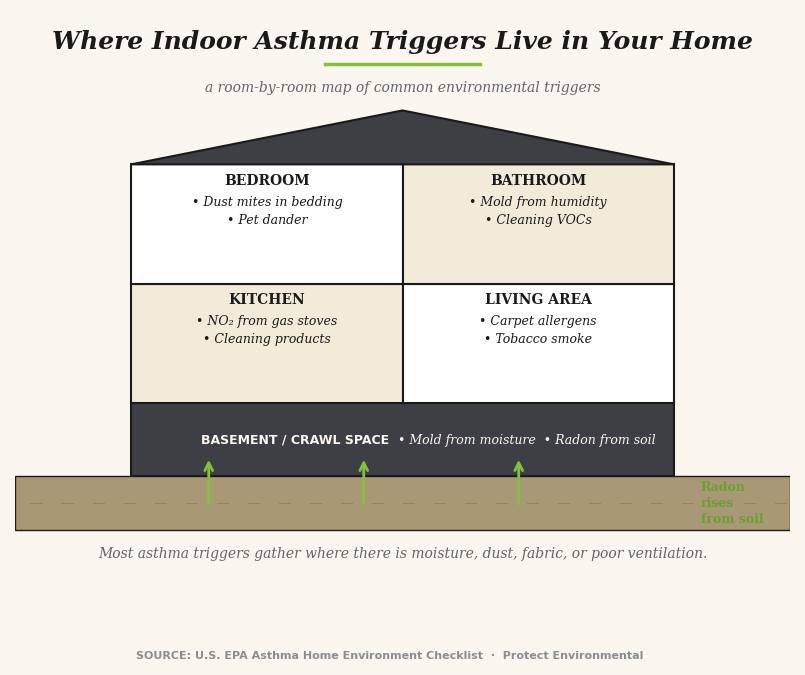
But there’s a second list most people never write down: the triggers inside their own home. The EPA’s environmental risk research identifies dust mites, mold, pet dander, environmental tobacco smoke, cockroach allergens, and particulate matter as indoor pollutants that can trigger asthma attacks. These are not exotic chemicals. They are present, in some amount, in nearly every home in the country.


And because the air inside your home is the air you breathe most of the day, what’s in it matters more than what’s outside, more often than not.

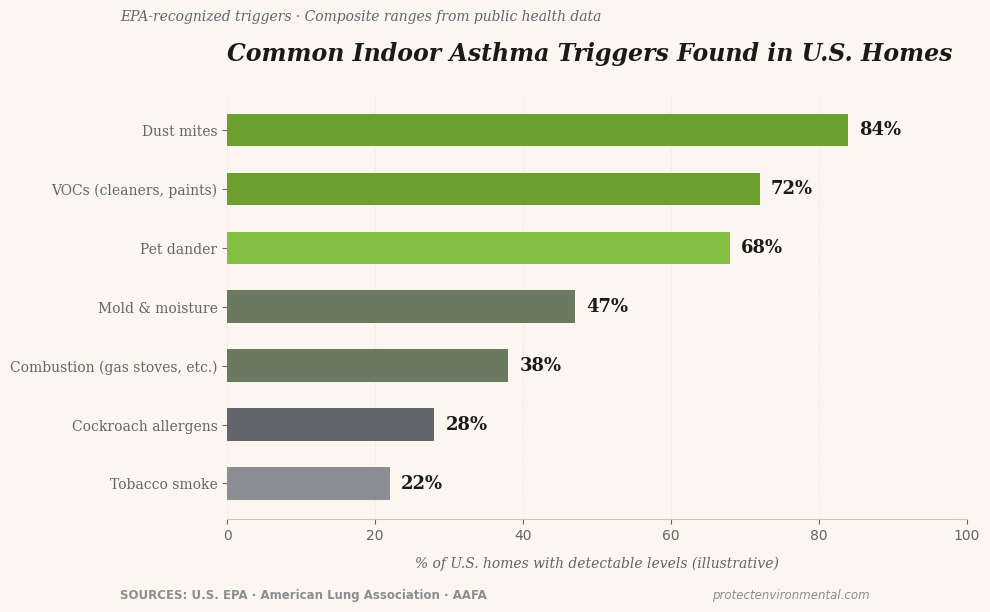
The 7 most common indoor asthma triggers

Based on EPA, American Lung Association, and AAFA guidance, these are the indoor environmental triggers worth knowing by name.

1. Dust mites

Dust mites are microscopic and live in mattresses, pillows, bedding, carpet, and upholstered furniture. Their droppings are one of the most common indoor allergens linked to asthma. They thrive in warmth and humidity above 50%.

2. Mold and moisture

Mold grows wherever there’s moisture, often where you can’t see it. Bathrooms, basements, crawl spaces, around leaky pipes, behind drywall after a flood. The EPA’s research on environmental asthma triggers specifically calls out mold and moisture from water-damaged homes as an asthma risk.

3. Pet dander

Dander is the tiny flakes of skin that pets shed. It sticks to fabric, floats in air, and accumulates in carpet and upholstery. Cat and dog dander are the most common, but birds and rodents shed allergens too.

4. Tobacco smoke

Secondhand smoke is a powerful asthma trigger. So is third-hand smoke, the residue that settles into walls, fabric, and dust long after the cigarette is out.

5. Cockroach allergens

Cockroach saliva, droppings, and body parts contain allergens that are a particularly significant trigger in dense urban housing. They can persist in dust for years.

6. Combustion byproducts

Gas stoves, fireplaces, kerosene heaters, and unvented appliances can release nitrogen dioxide (NO2), carbon monoxide, and fine particulate matter into the air. The American Lung Association notes that gas stoves without proper ventilation can be a significant indoor source of asthma-aggravating pollution.

7. VOCs from cleaning products, paints, and furnishings

Volatile organic compounds, or VOCs, are gases released by everyday products, cleaning sprays, air fresheners, paints, certain glues, new furniture, and synthetic carpets. Many irritate the airways and can trigger symptoms in people with asthma.

Indoor air triggers vs. indoor air hazards: what's the difference?

There’s an important distinction in indoor air quality that gets blurred a lot, and it’s worth being clear about.


An asthma trigger is something that causes asthma symptoms or attacks. The list above covers the main ones. An indoor air hazard is anything in the air that can harm your health, even if it doesn’t trigger asthma. Some things appear on both lists. Some don’t.


Radon is a good example. Radon is not currently classified as an asthma trigger. It’s a colorless, odorless radioactive gas that rises from soil into homes, and it’s the second leading cause of lung cancer in the United States after smoking. So if you’re already paying attention to what’s in the air your family breathes because of asthma, radon is part of the same conversation. It’s just a different conversation.


If you’ve never tested for it, that’s worth doing. The EPA recommends every home be testedregardless of where you live or how new the home is.

An indoor air quality checklist for an asthma-aware home

If you live with asthma, or someone in your household does, here’s a starter list. Most of these are things you can do yourself this week.


  • Keep indoor humidity between 30% and 50% to discourage dust mites and mold.
  • Wash bedding in hot water weekly. Use allergen-proof mattress and pillow covers.
  • Vacuum carpets with a HEPA filter vacuum and consider removing carpet from bedrooms.
  • Don’t smoke or allow smoking inside your home.
  • Run exhaust fans in the kitchen and bathroom, especially when cooking on gas or showering.
  • Fix leaks fast. Anything wet for more than 48 hours can grow mold.
  • Switch to fragrance-free, low-VOC cleaning products and avoid air fresheners and aerosol sprays.
  • Get any visible mold professionally assessed if it covers more than 10 square feet or comes from a hidden water source.
  • Test your home for radon if you haven’t recently. It’s inexpensive and a one-time data point that matters.

Where Protect Environmental fits in

A note from Protect Environmental

We’re not asthma doctors. Asthma management belongs with your physician, and the GINA 2026 message about access to inhalers is the right thing to focus on this week.

What we do is the air side: testing homes for what’s actually in the indoor environment, including conditions that overlap with asthma triggers (mold, water damage, ventilation, humidity) and conditions that don’t (radon, vapor intrusion). If you’ve been managing asthma without ever having your home’s indoor environment looked at, that’s a gap worth closing.

Request a quote →

Frequently Asked Questions

World Asthma Day 2026 is observed on Tuesday, May 5. Organized annually by the Global Initiative for Asthma (GINA), it raises awareness of asthma worldwide. The 2026 theme is “Access to anti-inflammatory inhalers for everyone with asthma, still an urgent need.” Asthma affects more than 260 million people globally and over 28 million Americans.

The most common indoor asthma triggers are dust mites, mold, pet dander, cockroach allergens, tobacco smoke, particulate matter, and volatile organic compounds (VOCs) from cleaning products, paints, and gas appliances. The U.S. EPA classifies these as the indoor pollutants most likely to cause or worsen asthma symptoms in homes.

Mold can trigger asthma attacks in people who already have asthma, and ongoing exposure can worsen symptoms. Some research also links early childhood mold exposure to a higher risk of developing asthma. Mold thrives where there’s moisture, so controlling humidity, fixing leaks promptly, and addressing water damage are the most effective ways to limit indoor mold.

Yes, humidity can trigger asthma. High humidity, generally above 50%, encourages dust mites and mold, both of which are indoor asthma triggers. Very humid air itself can also feel harder to breathe. Very dry air, below 30%, can irritate airways too. The EPA recommends keeping indoor humidity between 30% and 50% for healthier indoor air.

Air quality is considered bad for asthma when fine particulate matter (PM2.5), ozone, nitrogen dioxide, or known indoor allergens are elevated. Outdoors, AQI readings above 100 typically affect sensitive groups including people with asthma. Indoors, the warning signs are visible mold, persistent dampness, smoke residue, strong chemical odors, and obvious dust accumulation.

Radon is not currently classified as an asthma trigger. Radon is a radioactive gas that rises from soil into homes and is the second leading cause of lung cancer in the United States. So while radon and asthma are separate issues, both fall under the broader category of indoor air quality, and the EPA recommends every home be tested for radon regardless of asthma status.

Find Your Local Office

What's Your Radon Risk?

Enter your zip code to learn about the radon levels near you.

what's your radon risk?

0% APR

FOR 24 MONTHS

Finance Your Radon Mitigation Installation

Offer Ends: 2/29/24

USE CODE: LoveYourLungs